



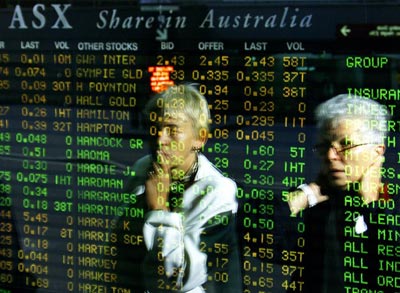
 MELBOURNE: Australian shares slipped on Friday in very thin trade, bringing the market's loss for 2011 to a hefty 14.5 percent and the first back-to-back annual loss in 30 years as investors shied away from risky assets.
"If you look around at all the asset classes, it really has been a year of safe-haven flows, it is about preserving your capital and returning your equity," said IG Markets institutional dealer Chris Weston.
The benchmark S&P/ASX 200 index has not posted a back-to-back annual loss since it was created.
The previous benchmark, the All Ordinaries index, recorded two consecutive annual declines in 1981 and 1982 during a deep recession.
On Friday, S&P/ASX 200 index fell 14.5 points or 0.4 percent to 4,056.6 in a shortened trading session, but volume was extremely thin with most investors away for the week. It has now fallen for two consecutive months and 4 straight weeks.
The index ended 2010 down 2.6 percent at 4,745.
"The best performing asset class has been fixed income by a country mile," said Weston, pointing to the Australian 10-year bond which gave a 36 percent return this year.
Surprisingly, the battered Australian discretionary retail sector was not the worst performer of 2011.
The biggest loser was the materials sector with a 25.5 percent slide over the year as commodities prices receded from their peaks.
Steelmakers, faced with rising costs and sliding demand, had massive declines, with BlueScope Steel off 78.7 percent and smaller rival OneSteel down 73 percent over the course of the year.
One of the stand-outs for the year is the world's biggest mineral sands company Iluka Resources, which makes zircon and titanium, up 70 percent as prices for its products surged.
The top banks helped minimise the losses in the financial sector index to 10.4 percent for the year.
In 2012, efforts by China to put the brakes on growth could spell a recovery for materials and mining companies, but the heavy debt burden in Europe remains the major risk for global markets, analysts said.
Among defensive stocks, phone company Telstra posted a gain of 19.4 percent for this year as investors sought high-yielding companies.
Telstra shares were off 0.3 percent on Friday.
Retailers had a horrible 2011, with a 21.9 percent sector decline as consumers saved more and bought less in store and more online.
Surfwear label Billabong slid 78 percent and electrical and furniture store Harvey Norman lost 38 percent of its value this year.
Retailers on Friday were mixed following warnings of disappointing Christmas sales.
Department store chain Myer Holdings was flat at A$1.935, just above a record low of A$1.92. Electronics retailer JB Hi-Fi was up 0.8 percent.
The market showed little reaction to data showing China's factory activity likely shrank again December as demand at home and abroad slackened, according to a purchasing managers' survey showed.
The market will be closed on Monday for the New Year's Day public holiday.
New Zealand's benchmark NZX 50 index closed on Friday up 0.9 percent to 3,274.7 points. New Zealand market opens next on Jan 4.
For the year, the New Zealand market ended in slightly negative territory, off 1.0 percent, after rising 2.4 percent in 2010.























Comments
Comments are closed for this article.