



Pakistan’s oil marketing companies ended 1QFY27 with higher overall sales, but the headline growth masks continued weakness in underlying fuel demand. Petroleum product sales reached 1.35 million tons in Sep-26, down around 2 percent year-on-year but up nearly 7 percent from Aug-26.
The monthly improvement was driven largely by high-speed diesel (HSD), where volumes jumped nearly 25 percent month-on-month.
The seasonal pickup is likely linked to agricultural activity around the harvesting and Rabi sowing period.
However, HSD sales were still 11 percent lower than September last year, suggesting that the sequential rebound should not yet be read as a broad recovery in transport, agriculture, or industrial demand.
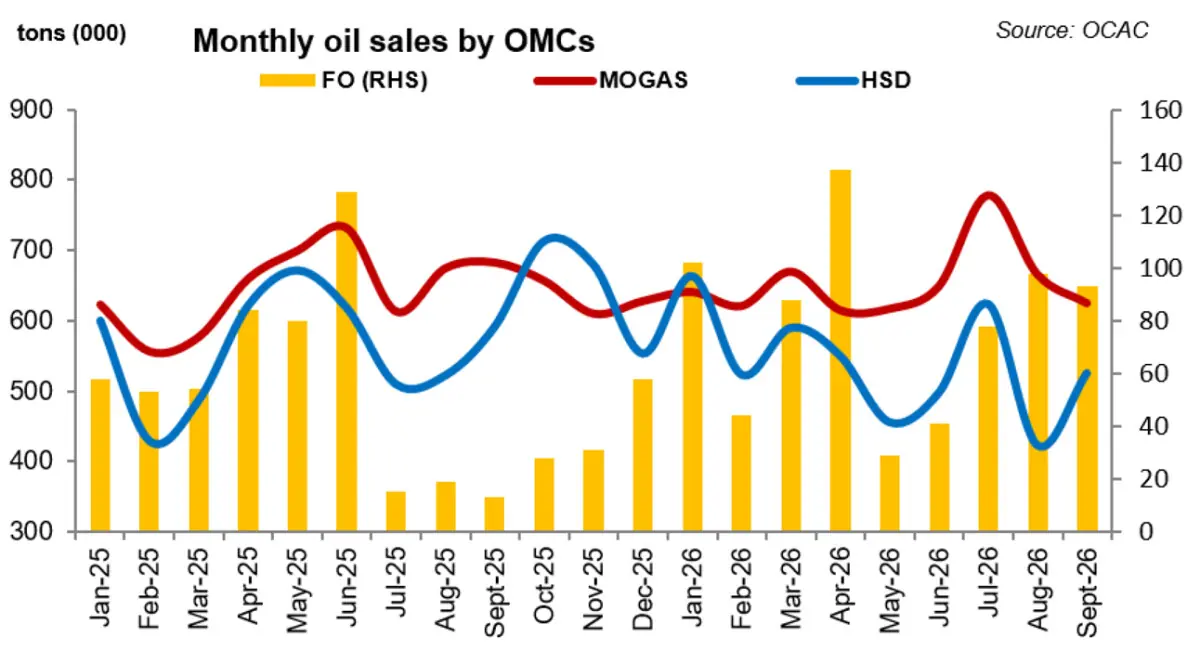
Motor spirit (MS) remained under pressure. Petrol sales fell 5 percent year-on-year and 2 percent month-on-month. Fuel prices have risen sharply compared with last year, and the weakness in MS volumes shows that household and mobility-related demand remains price sensitive.
The outlier continues to be furnace oil (FO). Though Sep-26 FO sales reached almost seven times the level recorded a year earlier. The increase has been linked to higher FO-based power generation amid constrained RLNG availability. This has materially lifted overall OMC volumes, but it is not evidence of stronger underlying petroleum demand. In fact, excluding FO, September sales were down almost 8 percent year-on-year.
The same distinction is important for the first quarter. Total petroleum sales increased by around 6 percent year-on-year to 4.11 million tons in 1QFY27. MS sales rose 4 percent, while HSD slipped 3 percent. FO sales, meanwhile, surged by more than 5 times in 1QFY27 versus 1QFY26.
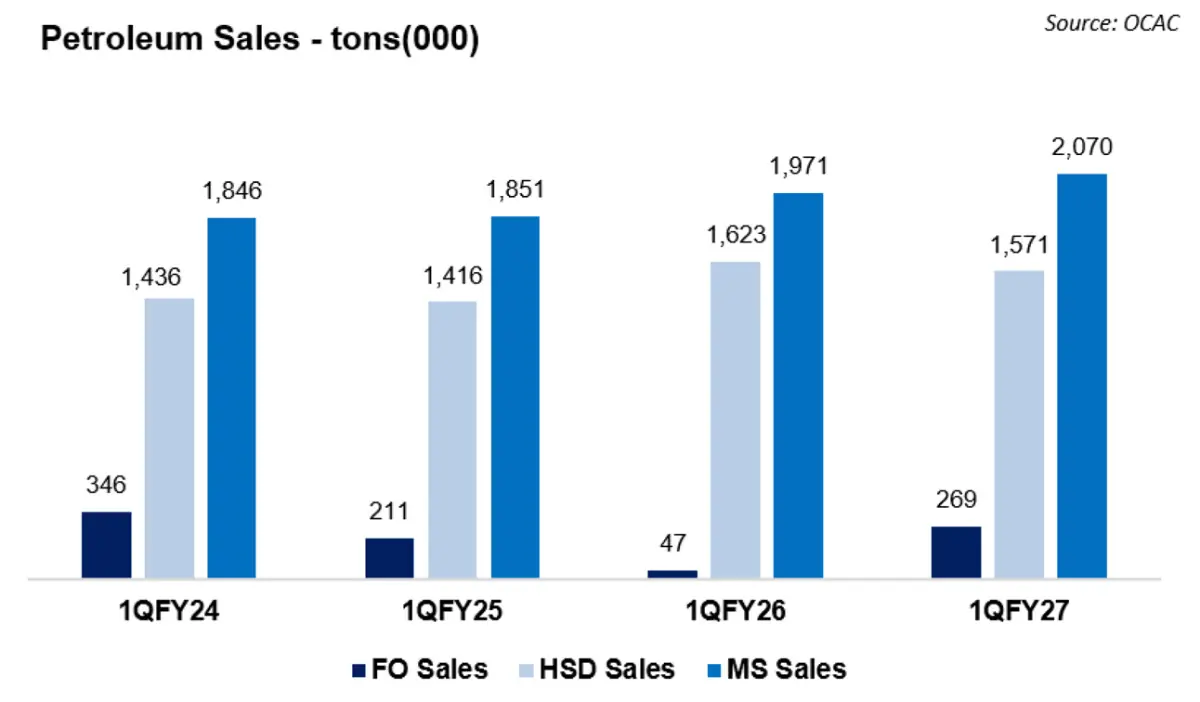
Strip out FO, however, and 1QFY27 sales were essentially flat year-on-year. That is perhaps the clearer reading of demand conditions: petroleum consumption has stabilised, but a strong, broad-based recovery has yet to emerge.
The outlook therefore remains mixed. HSD demand could receive some support from seasonal agricultural and freight activity, while gradual improvement in economic activity may help MS volumes. But elevated fuel prices remain the biggest constraint on consumption. At the same time, FO volumes will remain heavily dependent on the power-generation mix and RLNG availability.

























Comments