


‘Arteries of global economy’: At UN, PM Shehbaz says Hormuz, Bab al-Mandab must remain open
- Says 'these waters must carry the promise of prosperity, not the perils of war'
Prime Minister Shehbaz Sharif will address the UNGA, presenting Pakistan's views on regional security, global challenges, and advocating for dialogue, sustainable development, and resolution of key disputes.
- Pakistan's foreign policy principles and priorities at the UNGA.
- PM Sharif's engagements with global leaders in New York.
- Pakistan's stance on Kashmir, Palestine, and global economic challenges.
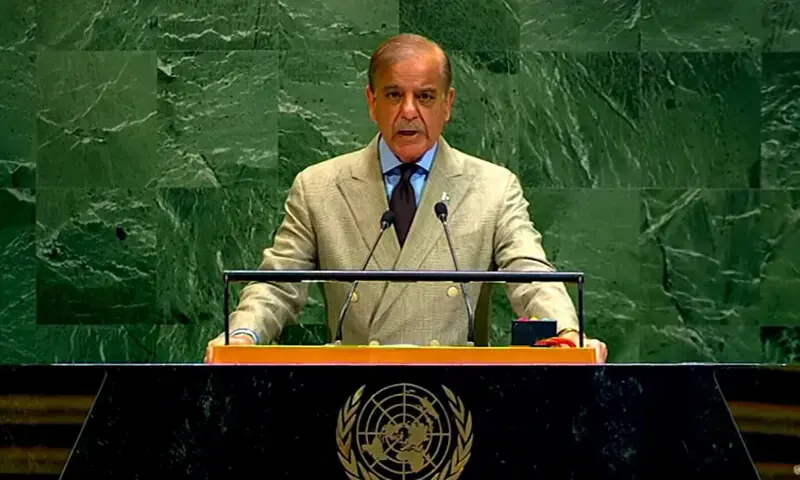
Prime Minister Shehbaz Sharif has called for the Strait of Hormuz and Bab al-Mandab to remain open, warning that the two vital maritime routes are “arteries of the global economy” and must connect nations rather than become “choke points of confrontation.”
Addressing the 81st session of the United Nations General Assembly, the prime minister said the recent surge in hostilities had placed critical maritime routes under severe pressure, stressing that “amid the roar of missiles, drones and guns, the voice for diplomacy must echo even louder and stronger.”
“The Strait of Hormuz and Bab-el-Mandab are arteries of the global economy. They must remain open, connecting nations, not becoming choke points of confrontation,” he said.
“These waters must carry the promise of prosperity, not the perils of war.”
The prime minister said Pakistan had chosen to act swiftly during the recent crisis and, through concerted efforts, brought Washington and Tehran under one roof in Islamabad.
He said the Islamabad talks and subsequent Islamabad Memorandum of Understanding represented historic steps towards ending the conflict.
Praises Field Marshal Munir
Shehbaz praised Chief of Defence Forces Field Marshal Syed Asim Munir, saying his “relentless efforts” helped create space for diplomacy under exceptionally difficult circumstances.
He also condemned attacks by the Houthis against Saudi Arabia, particularly the attempted drone attack targeting the holy city of Makkah al-Mukarramah.
“Any threat to the safety and sanctity of the Haramain Sharifain is a red line that must never be crossed,” he said, adding that Pakistan stood in complete solidarity with Saudi Arabia.
The prime minister also highlighted the historic Makkah Joint Defence Agreement among Saudi Arabia, Türkiye and Pakistan, saying it was not directed against any country but represented a collective commitment to defence, stability and peace in the region.
India: PM invokes right to self-defence
Turning to India, Shehbaz said Pakistan had faced external aggression from India a year ago under what he described as a false pretext.
Pakistan, he said, exercised its inherent right of self-defence under Article 51 of the UN Charter.
“Our brave and valiant armed forces, under the courageous leadership of Field Marshal Syed Asim Munir, responded with precision and professionalism,” he said.
The prime minister also credited US President Donald Trump’s intervention with preventing further escalation, saying “hundreds of millions of lives in South Asia were saved.”
He said Pakistan must ensure that South Asia never again reaches such a precipice, arguing that this required a just and fair solution to the Kashmir dispute.
Highlights Kashmir’s plight
Shehbaz said Kashmiris had waited for eight decades for the United Nations to fulfil its commitment to a free and impartial plebiscite.
He accused India of human rights abuses including arbitrary detention, extrajudicial killings, enforced disappearances, sexual violence and collective punishment, and alleged attempts to alter the legal status of Jammu and Kashmir through demographic changes.
He pledged Pakistan’s continued “diplomatic, political and moral support” for Kashmiris until they were granted what he called their “inalienable right to self-determination.”
“Kashmir has and always will be Pakistan’s jugular vein,” he said.
‘Water must never be weaponised’
The prime minister also warned that the foundation of stability in South Asia was under threat over the Indus River system.
He said India’s decision to hold the Indus Waters Treaty in abeyance had “no legal basis whatsoever” and said Pakistan’s position that the treaty remained valid, binding and operative had been vindicated by UN experts and the Court of Arbitration.
“Water must never be weaponised. Rivers should nourish nations, not divide them,” he said.
“Any attempt to stop, impede or divert Pakistan’s share of the waters will be treated as an act of war.”
‘A child born in Gaza deserves the same future’
On Palestine, Shehbaz said Palestinians, particularly women, children and the elderly, had suffered occupation, eviction, suffering and death.
Recalling Hind Rajab, whom he described as an innocent Palestinian girl killed during Israeli military operations, he highlighted the death of eight-year-old Wafaa Aqeelah.
“What should have been the first day of her school became the last day of her life,” he said.
“Does not a child born in Gaza deserve the same life and the same future and the same dream as a child anywhere else in the world?”
Pakistan, he said, believed the only lasting solution was an independent, sovereign, viable and contiguous Palestinian state based on the pre-1967 borders, with Al-Quds Al-Sharif as its capital.
He also condemned continued Israeli aggression against Lebanon and Syria.
Terrorism
Shehbaz described terrorism as one of the gravest threats to international peace and security.
“As a frontline state in combating the menace of terrorism, we have fought terrorists in our own cities, in our own mountains and along our frontier,” he said.
He said Pakistan had sacrificed almost 100,000 lives and suffered economic losses exceeding $150 billion.
“The world is safer today,” he said, attributing this to the sacrifices of Pakistan’s armed forces and civilians who fought terrorists.
The prime minister accused the TTP, Fitna al-Khawarij and BLA, Fitna al-Hindustan, of operating from sanctuaries inside Afghanistan to destabilise Pakistan.
He called on Afghan authorities to take “verifiable, decisive action” to ensure Afghan territory was not used against Pakistan or any other country, while stressing that the fundamental rights of Afghans, particularly women and girls, must be respected.
Pakistan’s contributions in UN peacekeeping
Shehbaz said UN peacekeeping remained one of the strongest expressions of collective security.
“For decades, Pakistani men and women have served under the blue flag, protecting civilians and helping countries emerge from conflict,” he said, adding that Pakistan was proud of their sacrifices.
Islamophobia
The prime minister also voiced concern over the rise in Islamophobia, citing hate speech, discrimination, attacks on mosques and desecration of the Holy Quran.
He alleged that RSS-driven Hindutva ideology across the border was contributing to religious hatred, including lynchings, communal violence, attacks on places of worship and restrictions on religious freedom.
‘Dialogue over confrontation’
Concluding his address, Shehbaz said Pakistan had chosen dialogue over confrontation, cooperation over coercion and peace over war.
“Let this 81st Assembly make it a unanimous choice – for ourselves, for our children and for generations yet unborn,” he said.
“Let us, therefore, restore trust. Let us, therefore, preserve peace. And let us prove that, even in a divided world, humanity can still choose to stand together.”
At the outset of his address, he recalled Quaid-e-Azam Muhammad Ali Jinnah’s declaration that Pakistan stood by the UN Charter and would contribute fully to global peace and prosperity.
Sharif said the unanimous adoption of UN Security Council Resolution 2788 during Pakistan’s presidency of the Council demonstrated Islamabad’s commitment to strengthening mechanisms for peaceful settlement of disputes.
Pakistan had signalled ahead of Sharif’s UNGA address that the prime minister would focus on diplomacy, regional peace, Kashmir and Palestine, as well as Pakistan’s role in de-escalating conflicts.
PM in New York
The prime minister arrived in New York on Monday, leading a small delegation to the UNGA session. He was received by Ambassador Asim Iftikhar Ahmad, Pakistan’s Ambassador to the US Rizwan Saeed Sheikh and other mission officials. He is accompanied by Deputy Prime Minister and Foreign Minister Ishaq Dar.
On Tuesday, the prime minister attended the opening session of the General Assembly, during which US President Donald Trump described him as a “terrific man” while referring to the May 2025 Pakistan-India conflict.
On Wednesday, PM Shehbaz addressed the 40th anniversary session of the Declaration on the Right to Development, calling for reform of the international financial architecture, action on debt distress and support for climate adaptation and loss-and-damage financing.
On the sidelines, he met IMF Managing Director Kristalina Georgieva and told her that Pakistan was moving from macroeconomic stabilisation towards economic recovery. The two also discussed the forthcoming IMF programme review.
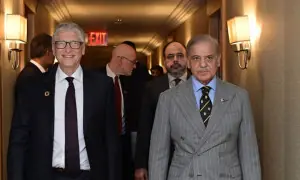
He also met European Commission President Ursula von der Leyen and European Council President António Costa, highlighting the importance of GSP Plus for Pakistan’s economy, as well as Syrian President Ahmed al-Sharaa, Bosnia and Herzegovina Presidency Chairman Denis Bećirović and Gates Foundation Chair Bill Gates, with whom he discussed polio eradication and agricultural reforms.
Speaking to the media, the premier said Islamabad had “not lost hope” of de-escalating tensions between the United States and Iran.
On Thursday, the prime minister met Iranian President Masoud Pezeshkian to discuss the regional situation and bilateral relations.
He also met US-based Pakistani business leaders, inviting them to invest in Pakistan, and a delegation of Pakistani youth professionals.





















Comments