


Concrete progress, institutional paralysis
The World Bank downgraded Pakistan's Sindh Barrages project despite physical progress, citing lagging institutional reforms for operation and maintenance. This recurring issue threatens the long-term sustainability of critical infrastructure.
- World Bank's downgrade of the Sindh Barrages project.
- The critical gap between physical construction and institutional capacity.
- The project's vital role in Sindh's irrigation and flood resilience.
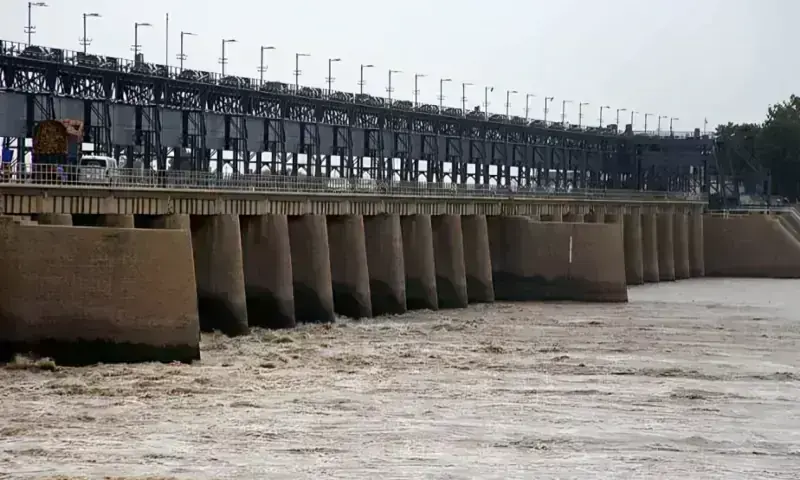
EDITORIAL: An 82.25 percent disbursement rate and substantial progress on rehabilitation works at the Guddu and Sukkur barrages should ordinarily have been grounds for satisfaction. Instead, the World Bank has downgraded both the development objective and implementation progress ratings of the $314.93 million Sindh Barrages Improvement Project from “Satisfactory” to “Moderately Satisfactory”, while retaining its overall risk assessment at “Substantial”.
The reason is depressingly familiar: physical construction is moving ahead, but the institutional machinery required to operate, maintain and sustain the investment is falling behind.
This is precisely where Pakistan has repeatedly stumbled with major development projects. Building infrastructure is relatively straightforward because contracts can be awarded, money disbursed and physical progress measured. Building institutions capable of managing that infrastructure over decades requires administrative competence, accountability, continuity and sustained political attention. That second part has too often proved beyond the state’s capacity.
The contrast in this case is particularly revealing. Rehabilitation and modernisation works at the two barrages had reached 84 percent by July, while 125 gates had been replaced. Yet the operation and maintenance performance score improved only from 40 in December 2025 to 44 in July 2026, against a target of 90 by June 2028. Progress on canal head-regulator calibration remains slow, no performance-based maintenance contract has yet been awarded by the Barrage Management Unit, and the World Bank has also flagged limited progress on the sediment-testing standard operating procedure.
These cannot be treated as secondary details to be addressed once the engineering work is finished. They determine whether hundreds of millions of dollars spent rehabilitating critical infrastructure produce lasting benefits or merely another expensive asset that begins deteriorating because the institutions responsible for it remain weak. The Bank has explicitly warned that slow institutional reform could threaten the long-term sustainability of the investment.
That warning should carry a particular weight because these are barrages, central to Sindh’s irrigation system and increasingly important in an environment of greater climate and flood risk. The project is intended eventually to increase the flood-passage capacity of both Guddu and Sukkur barrages from 900,000 cusecs to 1.2 million cusecs and is expected to benefit around five million people through more climate-resilient infrastructure. Failure here therefore carries consequences far beyond another missed development target.
There has been progress and it should be acknowledged. Main gate replacements at Sukkur have been completed, substantial work has been achieved at Guddu, technical studies for long-term flood and sediment management at Sukkur have been completed, and emergency preparedness plans for three barrages have been prepared and revised. But even here the familiar implementation gap appears: the flood and sediment studies still need to be operationalised, while emergency plans require proper dissemination among barrage and local authorities.
This is how early gains are squandered. Pakistan frequently manages to secure financing, launch projects and complete visible infrastructure, only to lose momentum when attention turns to maintenance, management and institutional reform. Eventually another loan, rehabilitation programme or emergency intervention becomes necessary to repair what should have been properly managed in the first place.
The downgrade should therefore serve as a jolt while there is still ample opportunity for correction before the revised June 2028 closing date. Sindh authorities should publish periodic progress reports covering the institutional benchmarks alongside physical construction, particularly operation and maintenance performance, regulator calibration, maintenance contracting and emergency preparedness.
Concrete can be photographed and gates can be counted. The real measure of success will come after the contractors leave.
Copyright Business Recorder, 2026





















Comments