


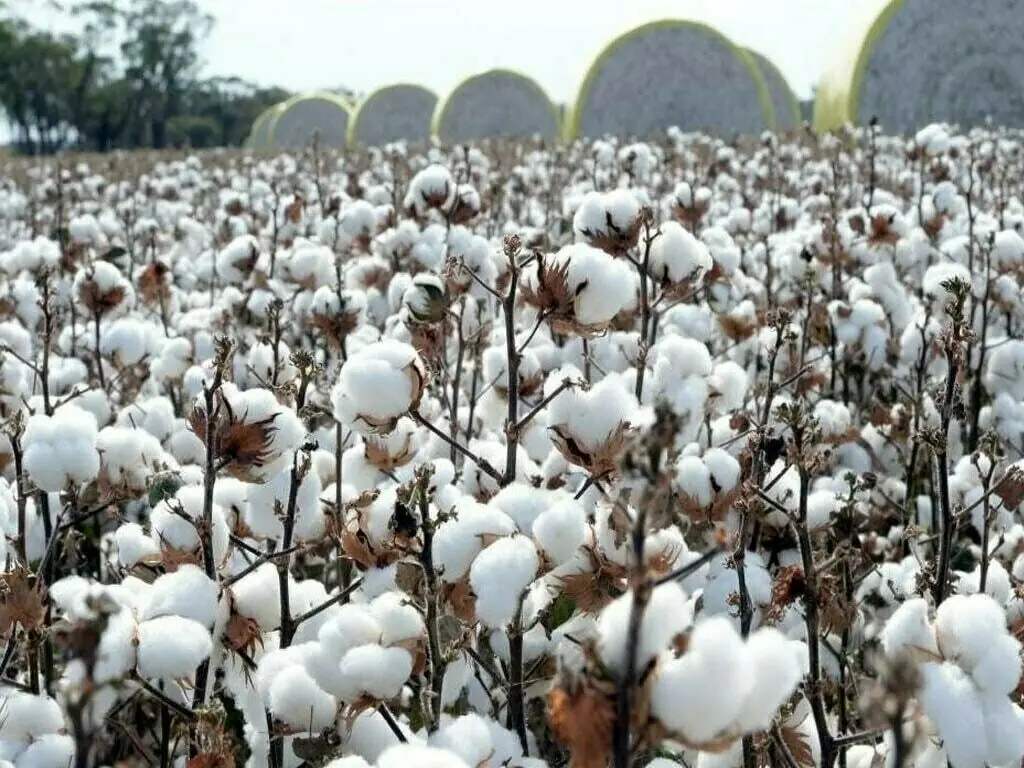
KARACHI: The domestic cotton market maintained overall price stability this week, with the spot rate holding firm at Rs 17,800 per maund and trading volume showing improvement, even as futures prices on the New York cotton exchange fluctuated and a deepening crisis among ginning factories cast a shadow over the sector.
According to Musaib Adil, the persistent instability in cotton pricing has discouraged ginners from purchasing seed cotton (phutti), forcing several ginning factories to operate only partially while a considerable number have shut down entirely. Industry observers say the situation could worsen unless prices stabilize further and demand from ginners picks up.
Compounding the challenge, cotton growers in Sindh are grappling with a severe shortage of water and rainfall, which has begun to affect both the quality and yield of the crop. The lint output extracted from seed cotton, known locally as “kan,” has also registered a decline, raising fresh concerns about the province’s overall cotton output for the season.
Weighing in on broader agricultural policy, former Finance Minister Dr Qaiser Bengali criticized the practice of establishing sugar mills in cotton-growing regions, arguing that cotton carries far greater economic significance than sugar. He urged authorities to relocate sugar mill projects to areas situated closer to rivers, rather than encroaching on land historically reserved for cotton cultivation.
Meanwhile, the long-running dispute over the Cotton Exchange Building in Karachi remains unresolved. Affected stakeholders say the Federal Investigation Agency (FIA) continues to occupy the building in defiance of a clear ruling issued by the Sindh High Court, prolonging uncertainty for those associated with the historic trading venue.
Separately, the production estimates released by the Federal Committee on Agriculture (FCA) have come under sharp criticism from industry stakeholders. Ehsan-ul-Haq warned that unrealistic projections for the 2026-27 fiscal year risk undermining Pakistan’s credibility in international cotton markets, calling for more accurate and transparent data collection.
On a more optimistic note, experts suggested that cotton production in Pakistan could be significantly boosted through technical cooperation with China. However, the Sindh Abadgar Board voiced growing concern over the recent decline in seed cotton prices, warning that continued weakness could further discourage growers ahead of the coming season.
Cotton prices in the local market remained largely stable over the past week, registering a modest increase of 200 to 300 rupees per maund as textile mills stepped up purchasing activity relative to the available supply of seed cotton (phutti). Trading volume improved during the week, while New York cotton futures also posted gains, reflecting a broader firming trend in the market.
Despite the steady pricing, concerns are mounting over the condition of the cotton crop in Sindh province, where growers urgently require water and rainfall to sustain output. Prevailing intense heat has begun to take a toll on both the quantity and quality of the crop. Industry sources report that this year’s cotton from Sindh is of comparatively lower quality than in previous seasons, with shorter staple length and reduced micronaire value, though some improvement cannot be ruled out as the season progresses. By contrast, cotton quality in Punjab province is reported to be somewhat better than that of Sindh.
Regionally, cotton in Sindh traded between 17,700 and 17,800 rupees per maund, with seed cotton fetching 8,200 to 8,800 rupees per 40 kilograms. In Punjab, cotton prices ranged from 18,200 to 18,400 rupees per maund, while seed cotton sold between 8,300 and 9,000 rupees per 40 kilograms. In Balochistan, cotton prices stood at 17,700 to 17,800 rupees per maund, with seed cotton priced between 8,800 and 9,200 rupees per 40 kilograms.
Meanwhile, the Spot Rate Committee of the Karachi Cotton Association maintained the spot rate unchanged at 17,800 rupees per maund.
New York cotton futures registered a relative increase this week, trading between 78 and 82 American cents per pound, according to Karachi Cotton Brokers Forum Chairman Naseem Usman, who cited the latest data from the United States Department of Agriculture’s weekly export and sales report.
The report showed that 66,400 bales were sold for the 2025-26 marketing year. Vietnam emerged as the leading buyer, purchasing 23,500 bales, followed by India in second place with 23,400 bales and Mexico in third with 10,400 bales. Pakistan ranked sixth among buyers, having purchased 3,300 bales during the period.
For the upcoming 2026-27 season, sales reached 87,000 bales, with Vietnam once again leading the way by acquiring 48,700 bales. Turkey followed in second position with 30,800 bales, while Japan secured third place with 2,400 bales.
On the export front, total shipments amounted to 230,100 bales. Vietnam remained the top destination, importing 85,400 bales, while Pakistan followed in second place with 42,800 bales. Turkey rounded out the top three importers, receiving 23,900 bales.
Cotton stakeholders have questioned the credibility of the Federal Committee on Agriculture’s (FCA) production estimates for the 2026-27 cotton season after the committee projected Sindh’s per-acre cotton yield to be 63 percent higher than Balochistan’s and 41pc higher than Punjab’s, despite Balochistan historically recording the country’s highest yields.
Expressing surprise over the figures, Cotton Ginners Forum chairman Ehsanul Haq said the FCA, an attached body of the Ministry of National Food Security and Research, had once again issued, what he termed unrealistic projections for national cotton production and provincial yields.
According to the FCA’s estimates for crop year 2026-27, Pakistan is expected to produce 9.643 million bales of cotton. The committee has projected Punjab to cultivate cotton on 3.2m acres, producing five million bales with an average yield of 1.60 bales per acre.
For Sindh, the FCA has estimated cotton cultivation over 1.486m acres, producing 4.042m bales with an average yield of 2.72 bales per acre. Balochistan, meanwhile, has been projected to cultivate cotton on 604,250 acres with an average yield of only one bale per acre.
Haq termed the figures “highly unrealistic”, arguing that Balochistan has consistently achieved the highest per-acre cotton yields in Pakistan due to its favourable climatic conditions, lower environmental pollution and limited sugarcane cultivation.
He said cotton produced in Balochistan is widely regarded as superior in quality, with its lint fetching Rs500 to Rs700 more per maund than cotton from Punjab and Sindh. Cottonseed and cottonseed oil from the province also fetch higher prices in the market, he added.
He wonders how the FCA could project Sindh’s average yield to be 63pc higher than Balochistan’s and 41pc higher than Punjab’s, saying such estimates did not reflect ground realities.
He also criticised the FCA’s forecasting record, pointing out that the committee had fixed a national production target of 10.18m bales for crop year 2025-26, including 5.553m bales for Punjab and 4.042m bales for Sindh. However, he says, the actual production during the season stood at only 5.524m bales across the country, with Punjab producing 2.718m bales and Sindh 2.807m bales, highlighting what he describes as a significant gap between official projections and actual output.
He urged the FCA to adopt realistic, field-based assessments, instead of issuing what he described as “drawing-room estimates”, warning that inaccurate production figures could damage Pakistan’s credibility in international markets and create uncertainty for cotton stakeholders in planning procurement, imports, exports and overall marketing
Pakistan’s cotton sector, having posted its lowest output in three decades last season with just 5.6 million bales harvested, still holds significant untapped potential that could be unlocked through better crop management and deeper collaboration with China, industry officials said this week.
Speaking at a meeting held at the Secretariat of the Pakistan-China Joint Chamber of Commerce and Industry (PCJCCI), Commercial Ambassador Adeel Munawar said the sector’s decline is not due to a lack of capacity but to slow adoption of science-based farming practices. He noted that Pakistan continues to benefit from strong genetic resources, extensive cultivation areas, experienced farmers, and a large textile industry that remains heavily reliant on domestically grown cotton.
Munawar said timely sowing, balanced fertilizer application, efficient irrigation, integrated pest management, disease and weed control, growth-stage-based decision making, and careful harvesting could substantially improve boll formation, fibre quality, and overall yield. Citing research trials in Punjab and Sindh, he said differences in crop management, rather than climate alone, are chiefly responsible for yield gaps between neighbouring farms growing identical cotton varieties. Fields that maintain balanced nitrogen levels, avoid over irrigation, and act early against whitefly and pink bollworm infestations, he said, consistently outperform others. He added that because cotton is highly sensitive to temperature, humidity, and day length, understanding local climatic conditions is essential to successful crop planning.
On prospects for bilateral cooperation, Munawar said Pakistani cotton varieties are notably heat-tolerant, while Chinese varieties are known for high yield and superior fibre quality, making the two countries’ genetic resources complementary for joint breeding programs. He revealed that Pakistan and China are planning to introduce new cotton seed varieties in Pakistan before selecting the most suitable ones for commercial cultivation, describing the move as an important step in deepening cotton-sector cooperation between the two countries.
He added that Xinjiang Agricultural University has for several years been collaborating with Pakistani universities on cotton cultivation research, with experimental fields already established in Faisalabad and trials underway to test mechanical harvesting under local conditions. Close cooperation between the two countries in research, seed development, mechanization, and modern farming technology, he said, would play a key role in raising cotton productivity on both sides.
PCJCCI Secretary General Salahuddin Hanif said a new Biotechnology Centre of Excellence laboratory is being established at the Central Cotton Research Institute (CCRI) to strengthen research and promote technological progress in the sector.
Separately, the Sindh Abadgar Board expressed concern over falling prices of raw cotton (phutti), warning that landowners are increasingly turning away from cotton cultivation as a result.
The Sindh Abadgar Board has expressed concern over the sharp decline in cotton prices, heavy losses suffered by mango growers and continuous increase in agricultural input costs, urging the government to take immediate measures to support farmers.
The concerns were raised during a meeting of the board chaired by Mahmood Nawaz Shah in Hyderabad. The meeting noted that the price of seed cotton had dropped from around Rs11,500 per 40 kilogrammes to below Rs7,900 within the last month, even before the cotton harvesting season had reached its peak.
Growers expressed the fear that the prices could fall further as arrivals increased, causing significant financial losses to cotton farmers. The participants also described the 2026 mango season as one of the worst in more than a decade.
They said mango orchards were severely affected by malformation attacks forcing farmers in some areas to spray pesticides more than five times without achieving satisfactory results. The reduced production, coupled with lower market prices and higher production costs, had resulted in heavy losses with some growers reportedly considering cutting down their orchards, it was said.
Copyright Business Recorder, 2026

















Comments