


Finance bill 2026 cleared by NA amid opposition walkout
The National Assembly passed the Rs18.771 trillion Finance Bill 2026-27, implementing the new budget despite opposition criticism and a walkout, focusing on economic growth.
- Key allocations within the 2026-27 federal budget.
- Opposition's criticisms and proposed amendments to the bill.
- Concerns regarding new taxes on essential goods and services.
- Demands for tax relief and economic support for various sectors.
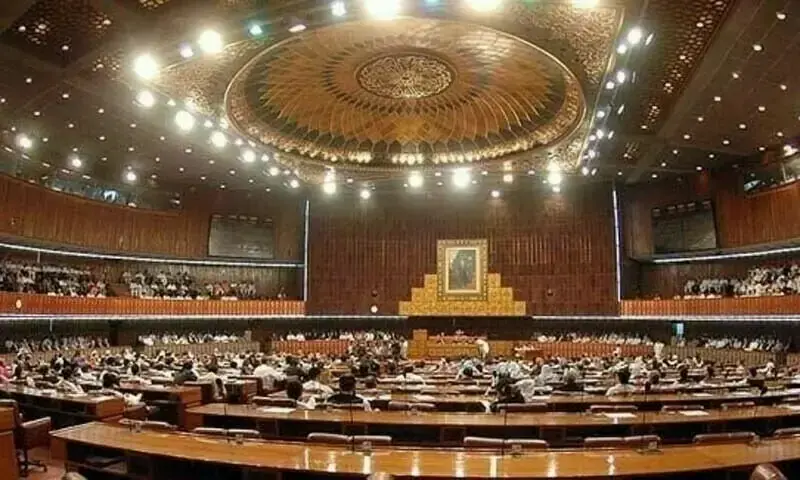

ISLAMABAD: The National Assembly on Tuesday passed ‘the Finance Bill, 2026’ despite criticism from the opposition, which ultimately staged a walkout, paving the way for the implementation of the 2026-27 budget.
The House adopted government-backed amendments and rejected all amendments moved by the opposition.
The Lower House had passed the federal budget for the next fiscal year 2026-27, with a total outlay of Rs18.771 trillion, focusing on accelerating the country’s economic growth.
Members of the Jamiat Ulema-e-Islam-Fazl (JUI-F) did not join the walkout staged by Pakistan Tehreek-e-Insaf (PTI). The three female members of JUI-F — Aliya Kamran, Naeema Kishwar Khan, and Shahida Begum — participated in the legislative process and other business of the House.
The House rejected a total of 63 proposed amendments, mostly moved by the three female members of JUI-F in “The Finance Bill, 2026”. The House adopted two amendments — one in clause six and the insertion of a new clause 6A — and two amendments in clause five of the bill. These amendments were moved by the Finance Minister in the House. The House approved the amendments.
In the Budget-2026-27, the revenue collection target for the Federal Board of Revenue (FBR) is set at Rs15.264 trillion, while the non-tax revenue target is estimated at Rs5.336 trillion for the next fiscal year. A total of Rs1 trillion has been allocated for the federal PSDP 2026-27. The House has approved the largest allocation for the Benazir Income Support Programme (BISP), Rs844.78 billion, to continue its social protection and cash transfer initiatives for low-income households across the country.
While discussing the bill, MNA Aalia Kamran questioned whether the government had adequately consulted traders, salaried individuals, small businesses, tax experts, and civil society before finalising the budget. She proposed capping the Petroleum Development Levy at Rs50 per litre, reducing the carbon levy to Rs2.5, lowering taxes on telephone cards and air tickets, and fixing the sales tax rate at 10 percent.
Naeema Kishwar Khan opposed the increase in token tax on 1,000cc vehicles from Rs 4,000 to Rs 20,000 and called for avoiding additional taxes on household goods, plastic products, stationery, and hygiene items. She also urged relief for salaried classes and economy-class air passengers.
Former National Assembly Speaker Asad Qaiser demanded an extension in tax exemptions for the former FATA and Provincially Administered Tribal Areas (PATA). He said the federal government should return net hydel profit arrears and the remaining share of NFC to Khyber Pakhtunkhwa.
Amir Dogar urged the government to extend tax concessions to all airlines operating in Pakistan following the privatisation of Pakistan International Airlines (PIA). He said that on the one hand, the government is paying billions of rupees in capacity payments to IPPs, while on the other, it is imposing taxes on solar systems that provide low-cost electricity.
Rana Atif highlighted the growing circular debt burden, which he said had reached Rs2.8 trillion, and pointed to mounting losses of power distribution companies (DISCOs).
Muhammad Mubeen Arif stressed that fiscal legislation falls within Parliament’s constitutional domain and raised concerns over the proposed faceless tax system, arguing that while tax officials’ identities would remain confidential, taxpayers were not offered similar protection. He also criticised higher withholding taxes, increased penalties, and the creation of another compliance directorate.
Usama Mela criticised the tax structure, saying profitable companies continued to enjoy exemptions while taxes were being imposed on infant milk and solar panels. He also called for promoting non-profit social organisations.
Acting Pakistan Tehreek-e-Insaf (PTI) leader Barrister Gohar Khan opposed provisions allowing the freezing of assets during trial proceedings, arguing that such measures could discourage business activity and investment. He also questioned the legal and constitutional sustainability of the proposed faceless audit system.
Several lawmakers, including Shahida Akhtar Ali, Shandana Gulzar, and Dr Nisar, called for greater tax relief on essential food items, medical equipment, and renewable energy products, while urging measures to protect farmers and the middle class.
They also called for support to small and medium-sized enterprises, greater incentives for local industries, revisions to the federal excise framework, and fulfillment of commitments made to the merged districts of the former Federally Administered Tribal Areas (FATA).
Copyright Business Recorder, 2026


























Comments