


Alan Greenspan dies at 100
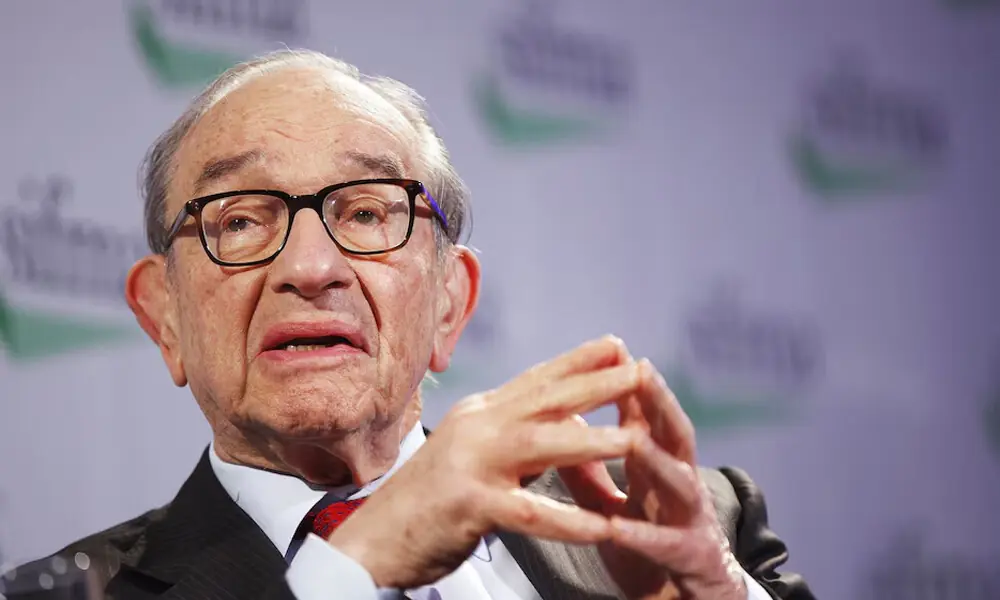

WASHINGTON: Alan Greenspan, hailed as the greatest Federal Reserve chairman when he retired in 2006 but derided for a severe financial crisis that followed barely two years later, died on Monday aged 100, his wife said.
Greenspan, who exerted a powerful influence on the US economy during his tenure at the helm of the Fed from August 1987 to January 2006, died at his home from complications of Parkinson’s Disease, Andrea Mitchell said in a statement.
“He was a giant of a man who helped shape the US economy for decades under presidents of both parties, but was always honest in acknowledging his mistakes,” Mitchell said.
“He will be remembered for his brilliance and his kindness. Being his life partner was the joy of my life,” she added.
Greenspan oversaw the second-longest economic expansion in US history, an uninterrupted decade of growth from March 1991 to March 2001. His decision to let the economy run — despite pressure to raise interest rates against an inflation threat that never materialized — helped foster years of US prosperity and earned him rock star status as an economic “maestro.”
The era was marked by his prescient judgment that a productivity surge in the mid-1990s would keep inflation contained.
His intuition in that moment is still a touchstone for policymakers, and has been referred to by former Fed Chair Jerome Powell as an example of how judgment can sometimes outperform technical models of the economy.
However, the one-time jazz musician’s monetary policy acumen later came into question as critics attacked his policies for fueling a series of asset price bubbles and laying the groundwork for the 2007-2009 financial crisis.
“I think the deification that came just before the financial crisis was never really deserved, and I think the lambasting that he took after he left was never fully deserved either,” said Stephen Oliner, a former senior Fed official.
Greenspan, who fell in love with math through an obsession with baseball statistics, won quick plaudits for a strong response to the Black Monday stock market crash of 1987, just two months after he took office.
He also steered the US economy through the 1990-91 recession, the 1997-1998 Asian and Russian financial contagion, the collapse of the dot-com stocks bubble in 2000, and the turbulent economic aftermath of the September 11, 2001, attacks.
Along the way, biographer Sebastian Mallaby detailed, he became a consummate Washington power player able to maneuver presidents and cabinet secretaries into making the decisions he felt were best, sometimes without them realizing who pulled the strings.
“The Federal Reserve notes with deep sadness the passing of Alan Greenspan,” the Fed said in a statement. “He brought rigorous analytical discipline to monetary policymaking and helped establish the credibility that remains one of the Federal Reserve’s most important assets.”
Just days before Greenspan’s death, new Fed Chairman Kevin Warsh evoked numerous comparisons with Greenspan for the spare policy statement Warsh crafted at the conclusion of his first policy meeting last week. Greenspan introduced post-meeting statements in February 1994 with a terse 99-word missive announcing a rate hike, and Warsh’s first one on June 17 was — at 130 words — the shortest in years.
Bursting bubble
At the Fed’s vaunted Jackson Hole gathering in 2005, two leading economists billed him as perhaps the greatest central banker of all time.
But when the housing price bubble that had grown during his final four years in office finally burst, it savaged his once-stellar reputation — along with the global economy.
Whatever Greenspan’s merits in the moment, his successors steadily pushed the Fed in a new direction, rolling out financial crisis response tools to address problems Greenspan had never confronted, such as zero interest rates, and shifting from opaque communications to more frequent speeches, a set inflation target, and regular press conferences.
In addition to critiques of his monetary policy, critics slammed Greenspan, a powerful advocate for the light regulation of financial markets, for a hands-off attitude that allowed banks to make disastrous housing market bets.
Greenspan subsequently admitted to being “shocked” that he was wrong in his assumption that bankers’ self-interest would deter them from taking actions that imperiled the survival of their own institutions.
“Those of us who have looked to the self-interest of lending institutions to protect shareholders’ equity, myself included, are in a state of shocked disbelief,” he told the House of Representatives Committee on Oversight and Government Reform, in 2008.
But as apologies go in Washington, it fell far short of what his most ardent critics sought.
Some economists also felt the chairman, who never disguised he was a Republican, dented his political independence by backing tax cuts in 2001 proposed by President George W. Bush, although he also worked closely with Democratic President Bill Clinton.
The second-longest-serving Fed chair behind William McChesney Martin, Greenspan was first tapped by President Ronald Reagan in 1987 and was later re-appointed by Presidents George H.W. Bush, Bill Clinton and George W. Bush.
He was 80 when he left the Fed in 2006 but moved smoothly into a new career as a consultant and adviser with his own firm, Greenspan Associates, offering insights on where he thought the economy was going for big fees.




















Comments