


Tax to be abolished on female hygiene products
- The new budget prioritizes women's health by eliminating taxes on sanitary pads and contraceptives
The government's Budget 2026-27 proposes removing taxes on sanitary pads and contraceptives, declaring them essential, while unveiling an Rs18.77 trillion budget aimed at economic growth and relief.
- Tax removal on sanitary pads and contraceptive products.
- Sanitary pads declared essential health and hygiene products.
- Key features of the Rs18.77 trillion federal budget.
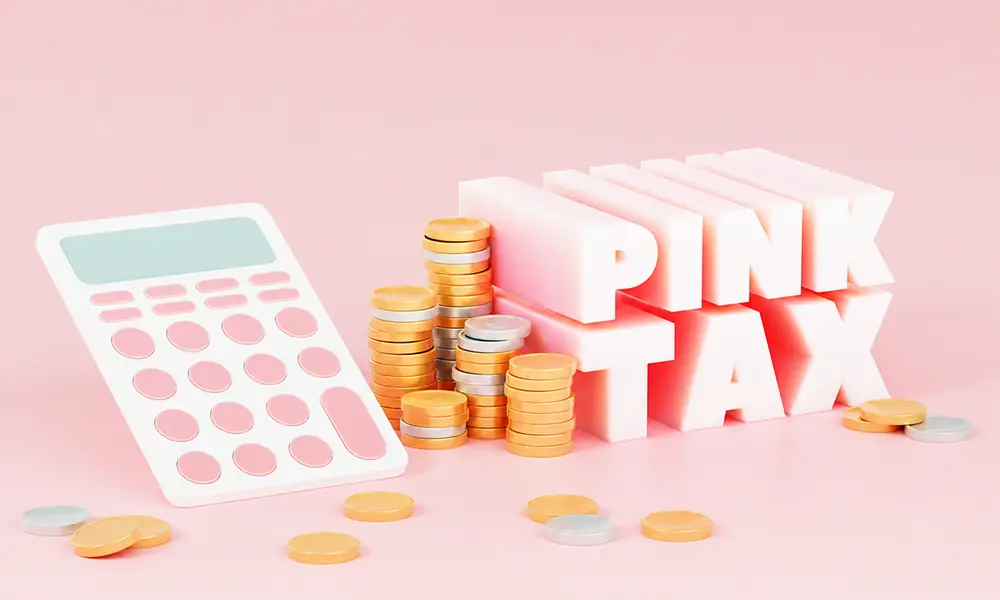
The government has proposed removing taxes on sanitary pads in the recently passed Budget 2026-27.
The government has declared them an essential health and hygiene product for women nationwide.
Also, the government has removed tax on contraceptive products as part of measures aimed at controlling population growth.
Speaking exclusively to Business Recorder, Human Rights Lawyer Mahnoor Omer said that she and her lawyer had petitioned the court for the tax to be completely abolished.
Named among TIME magazine’s ‘Women of the Year’ for 2026 earlier this year, Mahnoor said that, however, this was one step in the direction of alleviating period poverty and to make it more affordable.
Under Pakistan’s Sales Tax Act of 1990, locally manufactured sanitary pads were subject to an 18 percent sales tax, while imported pads and the raw materials used in their production faced a 25 percent customs duty.
When additional local taxes were factored in, UNICEF Pakistan estimated that the effective tax burden on menstrual products reached nearly 40 percent.
Meanwhile, Mahnoor further said that although the case was ongoing, media pressure and online advocacy played one of the most major roles in bringing about this change.
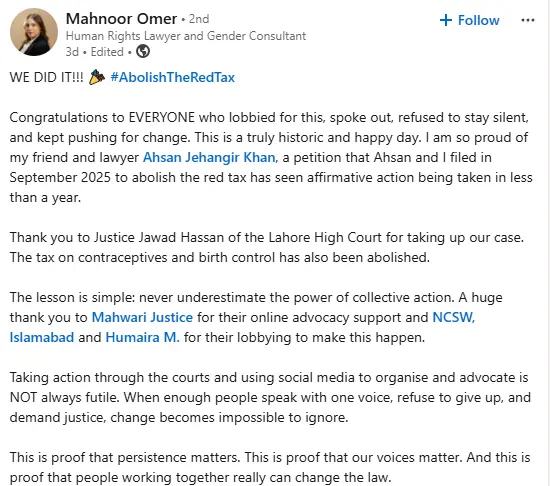
“The petition went viral on every single news outlet, not only in Pakistan, but internationally.
So when all eyes are on Pakistan like this, I wouldn’t just say it’s because of online pressure, but I will say it brought this topic to the forefront. So it’s a whole host of things. It’s media pressure.”
Mahnoor said their journey was far from over.
“What more myself and all the civil society activists and friends and colleagues and I’ve been speaking about is what we want to push for now is to ask for things such as like in Scotland, for example, tax and all period products in Scotland are free.
So that is kind of a utopian ideal for a country like Pakistan.”
The newly announced tax exemptions are set to officially take effect from July 1.
Meanwhile, Federal Minister for IT and Telecom, Shaza Khawaja termed it a huge win for the women of Pakistan.
“Women hygiene is not a luxury. Removal of taxes from women hygiene products makes them more accessible, helps reduce financial burdens on families and supports the health and well-being of millions of women and girls,” she said.
Moreover, UN Women also welcomed the government’s decision.
“Menstrual health is a matter of health, dignity, and equality—not a luxury,” the statement said.















Comments