


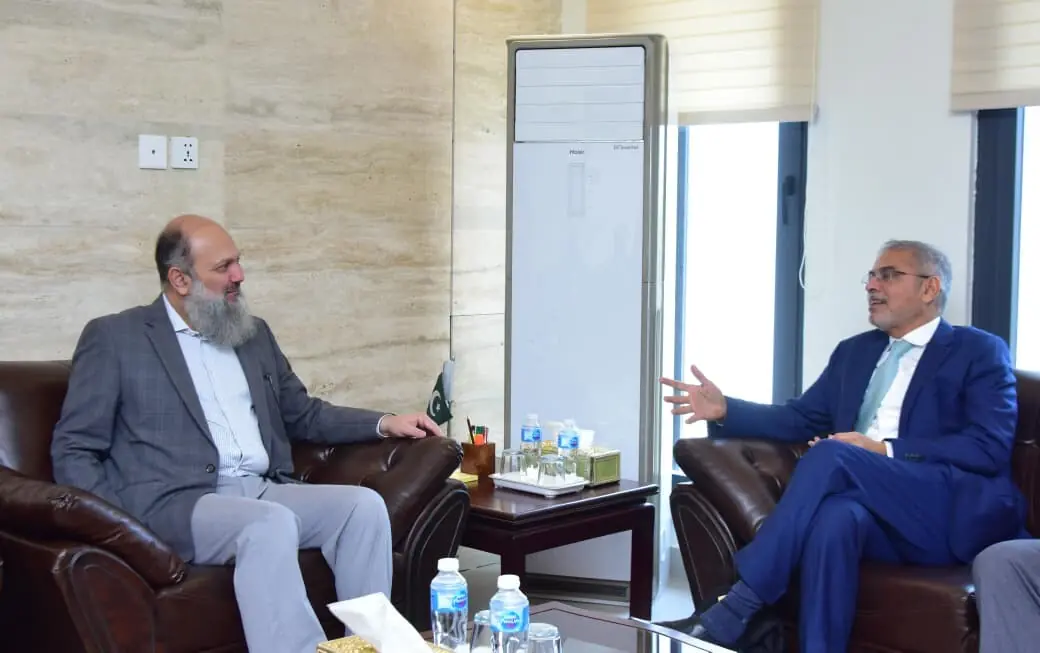
Federal Minister for Commerce Jam Kamal Khan on Friday held a detailed meeting with representatives of the Pakistan Business Council and leading industrial stakeholders, including the CEO of Gatron Industries Limited and Novatex Limited, to discuss industrial competitiveness, tariff rationalisation, export sustainability, and challenges facing Pakistan’s manufacturing sector.
During the meeting, participants discussed the broader impact of tariff reforms, anti-dumping duties, and the cost structure affecting local industries, particularly the petrochemical, plastics, polyester, and SME sectors, as per a press release.
Industrial representatives informed the minister that while tariff rationalisation and trade liberalisation were important objectives, abrupt across-the-board duty reductions could adversely affect domestic manufacturing, government revenues, and industrial investment.
“They stressed the importance of distinguishing between genuine industrial exporters and trading activities that rely heavily on imports without contributing significantly to local value addition.”
Meanwhile, Khan emphasised that Pakistan’s industrial and export ecosystem must support long-term manufacturing growth and sustainable industrialisation.
“He observed that emerging industries require time, infrastructure development, capital recovery, and policy stability before becoming globally competitive exporters,” the press release said.
Khan said that policy decisions should remain responsive to changing economic realities and geopolitical developments.
READ MORE: Jul-Jan: Large Scale Manufacturing sector posts 5.75pc growth
He noted that Pakistan’s economic environment differs significantly from many regional competitors due to security challenges, energy costs, law-and-order concerns, and regional uncertainties, making direct comparisons with other economies difficult, the press releases added.
During the meeting, the participants highlighted concerns regarding the informal economy and uneven enforcement mechanisms, noting that compliant industries often face unfair competition from undocumented commercial importers and unregulated sectors operating outside the tax and regulatory framework.
Khan stressed the importance of stronger enforcement mechanisms “to ensure fair competition and protect registered industries contributing to the formal economy”.
Meanwhile, the meeting also discussed challenges faced by Pakistan’s petrochemical and downstream chemical industries due to fluctuating global raw material prices, high production costs, and changing international market dynamics.
“Stakeholders particularly underlined the strategic importance of downstream industries, petrochemicals, PVC, plastics, and value-added manufacturing for Pakistan’s future industrial growth and export diversification.”
“Industrial representatives informed the Minister about ongoing and planned investments in Pakistan’s manufacturing sector, including expansion projects involving international partners and foreign investors,” the statement said.
They emphasised that stable industrial policies and supportive tariff structures are essential to encourage further investment and strengthen industrial self-reliance.
Khan observed that industrial development globally had historically been supported through phased protection and strategic industrial policies.
“The Minister reaffirmed the Ministry of Commerce’s commitment to continued consultations with the business community and industrial stakeholders to formulate practical, balanced, and sustainable trade policies aimed at enhancing exports, strengthening manufacturing, supporting SMEs, and improving Pakistan’s long-term economic resilience.”









Comments