


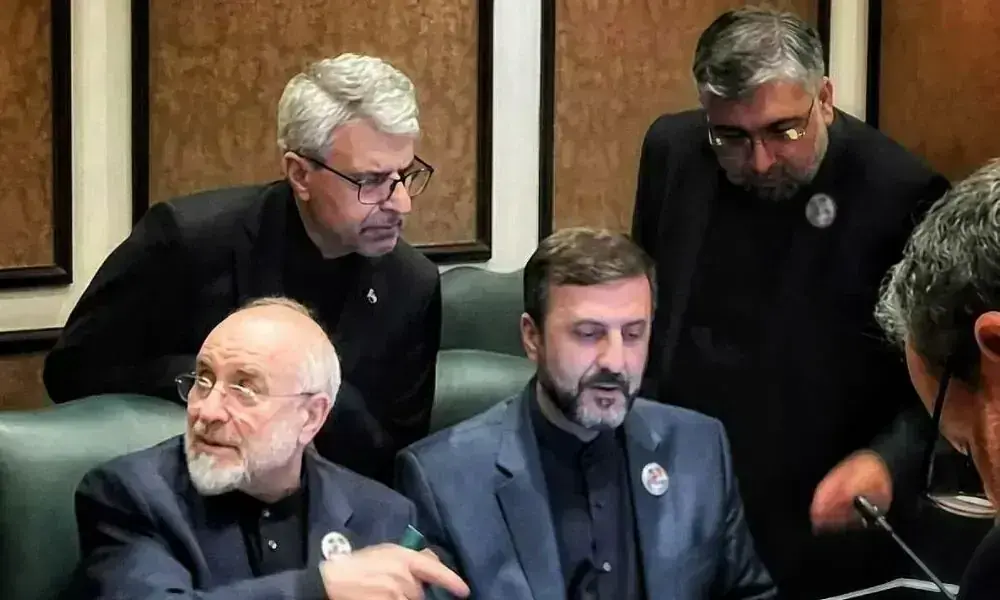

Twenty-one hours of direct talks in Islamabad between Vice President JD Vance and Iran’s parliamentary speaker Mohammad Bagher Ghalibaf ended without a deal. Vance left saying he had put forward a “final and best offer.” Iran’s foreign ministry said agreement was reached on several points but differences remained on two critical issues: the Strait of Hormuz and the nuclear programme. Both sides claim to have emerged the victor of six weeks of war; neither appears in any mood to compromise. The two-week ceasefire, brokered by Pakistan, expires on April 21.
Hours after Vance boarded Air Force Two in Islamabad, Trump announced a naval blockade of the Strait of Hormuz. “Effective immediately,” he wrote on Truth Social, the US Navy would begin “BLOCKADING any and all ships trying to enter, or leave” the waterway. He ordered the Navy to interdict every vessel that had paid a toll to Iran and to begin clearing the mines Iran had laid since February. US Central Command confirmed the blockade would take effect Monday at 10 a.m. Eastern Time, enforced “impartially against vessels of all nations entering or departing Iranian ports and coastal areas.” Ships transiting to non-Iranian ports would not be impeded. The Wall Street Journal reported that Trump is also considering resumption of limited military strikes to break the stalemate. On Fox News, he reminded viewers that Iran’s water desalination plants and power stations remain “very easy to hit.”
Iran’s armed forces called the blockade “an illegal act that amounts to piracy.” The IRGC warned that any military vessels approaching the Strait would be “dealt with harshly and decisively”. Ghalibaf, still in the region, posted a map of American gas station prices near the White House with the caption: “Enjoy the current price of gasoline. With what is being called a ‘blockade,’ you will soon miss USD 4 to USD 5 gasoline.”
Markets responded within hours. Brent crude surged 8.6 percent to above USD 103 on Monday morning, erasing the relief rally that followed the ceasefire. European gas futures spiked 18 percent. The Nikkei fell one percent, the Kospi 1.2 percent, and S&P 500 futures dropped 0.8 percent. Columbia University’s Karen Young warned that elevated oil prices would persist “into the end of 2026,” noting that even after the war ends prices will not decline until the Strait reopens and damaged oil facilities are repaired. The ceasefire, it turns out, was a parenthesis. The sentence has resumed.
Since Iran closed the Strait in early March, it did not seal it entirely. A handful of Chinese, Indian, and Pakistani-flagged vessels were quietly permitted to transit, some paying tolls of up to USD 2 million in Chinese yuan under what Lloyd’s List Intelligence described as an IRGC “toll booth” regime. Trump’s blockade is designed to dismantle that arrangement, with CENTCOM ordered to interdict any vessel that paid a toll to Iran regardless of flag. The consequences are already visible: India has more than a dozen tankers stranded in the Gulf, LPG shortages have triggered protests across its major cities, and migrant workers in Mumbai and Delhi have begun returning to their home villages because they can no longer afford cooking gas. Washington’s allies, meanwhile, have kept their distance. The United Kingdom refused to participate and is instead leading a separate 40-nation coalition with France to protect freedom of navigation. Australia said it received no request. The blockade, for now, is a unilateral American operation with global consequences.
Beneath the geopolitics, a slower crisis is building. One-third of the world’s seaborne fertiliser trade transits the Strait of Hormuz. That trade has been severely disrupted since February. Urea prices have surged 40 to 50 percent, from roughly USD 450 per ton to over USD 700. India’s gas supply to its fertiliser plants has been cut to 70 percent of contracted volumes, costing an estimated 800,000 tons of urea production every month. Fertiliser plants across India, Bangladesh, and Pakistan have curtailed or shut down production entirely because of natural gas shortages. India’s monsoon season begins in June. Fertiliser demand peaks in the months just before it. Private forecaster SkyMet places a 60 percent probability on a poor monsoon this year. Pakistan faces identical exposure: both countries are agrarian economies, both depend on Gulf-origin fertiliser inputs, and neither maintains strategic reserves. The FAO has warned of a three-month window before “risks escalate significantly.” That window is closing, and the blockade just made it smaller.
For Pakistan, the math is punishing from every direction. On April 3, the government announced the steepest fuel price hike in the country’s history: petrol surged Rs 137 to Rs 458 per litre, diesel Rs 184 to Rs 520. Within 36 hours, the Prime Minister cut the petroleum levy on petrol by Rs 80, bringing it to Rs 378. Diesel stayed at Rs 520. Then on April 11, as global crude dipped on ceasefire hopes, prices were cut again: petrol fell Rs 12 to Rs 366.58, diesel dropped Rs 135 to Rs 385.54 with the petroleum levy restored. That relief lasted less than 48 hours. With Brent back above USD 103, the next OGRA revision around April 16 will almost certainly reverse some or all of the April 11 reduction. The current pump prices are a function of a ceasefire that is collapsing in real time.
Revenue is already strained. The FBR has missed its target by Rs 612 billion through the first nine months. The petroleum levy, one of the few instruments capable of narrowing that gap, has been cut and restored twice in ten days. The IMF programme remains in place, with a USD 1.2 billion tranche pending Executive Board approval in early May and a primary surplus target of 1.6 percent of GDP. Remittances reached USD 38.3 billion in FY25 and are projected above USD 41 billion, but they flow overwhelmingly from the Gulf, where Saudi Arabia intercepted ballistic missiles aimed at its eastern oil facilities during the war and desalination infrastructure has been struck. If Gulf security deteriorates further, those flows slow. Merchandise exports are running at roughly USD 31 billion annualised, with IT services adding USD 4 to USD 5 billion, all dependent on shipping routes the blockade has further imperilled.
Electricity compounds the strain. Pakistan generates roughly 60 percent of its power from fossil fuels. Four major LNG-fired plants at Bhikki, Balloki, Haveli Bahadur Shah, and Trimmu depend on Qatari gas that transits the Strait. Qatar declared force majeure on LNG shipments within days of the Strait closing in March. Beyond LNG, dozens of thermal IPPs run on furnace oil and imported crude derivatives, with capacity payments owed regardless of dispatch. If LNG does not normalise and furnace oil stays expensive, load-shedding returns at exactly the moment summer demand peaks. If load-shedding returns while inflation heads toward 9.25 percent, the SBP cannot cut rates from 10.5 percent. If rates stay frozen, borrowing costs crush businesses already absorbing the fuel shock. The chain runs mechanically from oil to inflation to frozen monetary policy to suffocated growth to shrinking revenue to the disappearance of the fiscal space needed to fund the very subsidies keeping people afloat.
There was a time, not long ago, when Pakistan’s capacity to play any meaningful role on the global stage was openly questioned. That question has been answered. Pakistan hosted the highest-level direct talks between the United States and Iran since 1979. The PAF escorted the Iranian delegation under a protective air shield. A US delegation of nearly 300, led by the Vice President, arrived in Islamabad. Field Marshal Asim Munir’s simultaneous access to the IRGC and to Trump, a dual channel no other mediator possessed, got both sides into the same room. The historic handshake between Vance and Ghalibaf happened on Pakistani soil. Pakistani officials believed the contours of a deal were within reach; the breakdown surprised Islamabad as much as it disappointed it.
The talks did not deliver a settlement. The blockade that followed within hours made that failure more painful. But Pakistan’s role in this crisis has established something that outlasts any single negotiation. A country dismissed by many as an economic ward of the IMF stood at the centre of the most consequential diplomatic effort of 2026 and performed. The pen was held in Islamabad. That the script was torn up in Washington does not diminish what was written. It does, however, make what comes next more dangerous for a country whose economic exposure to a prolonged conflict is not a background condition but the central constraint. Every additional day without a settlement narrows the margin between a temporary shock and a structural fracture. The blockade starts Monday morning. The ceasefire expires in eight days. And the clock does not pause for diplomats.
Copyright Business Recorder, 2026
The writer is an economist and an educationist




















Comments