


Pakistan’s ceasefire moment — and the lessons of the past
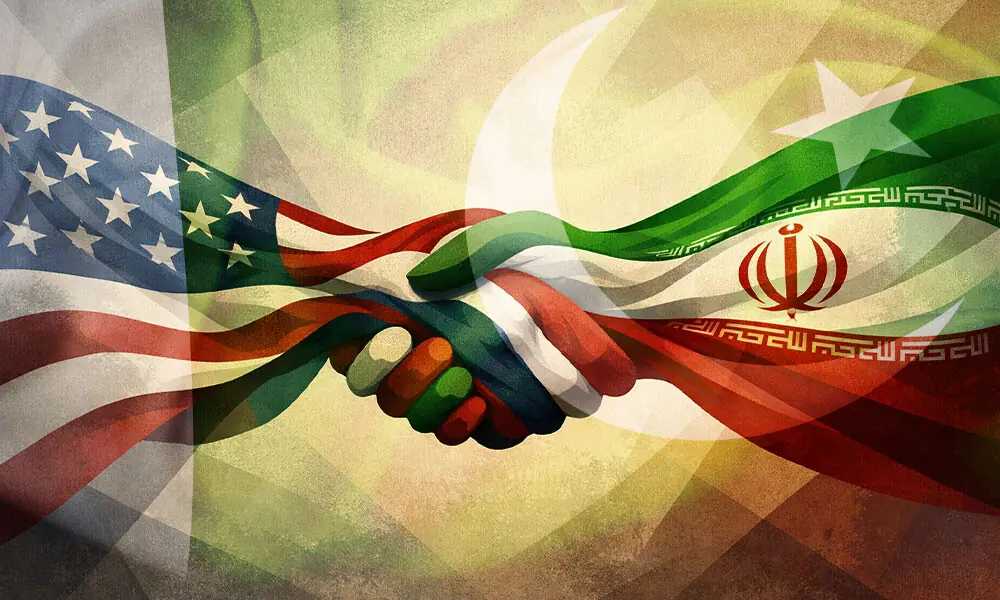

As the United States edged closer to military escalation with Iran, Pakistan did something it has not done in years—it mattered.
In the final hours before President Donald Trump’s ultimatum, Islamabad stepped in as an intermediary. Prime Minister Shehbaz Sharif made a public appeal for a pause. Behind the scenes, Pakistan’s military and diplomatic leadership facilitated communication between Washington and Tehran.
Within hours, a two-week ceasefire was announced.
Markets responded instantly. Pakistan’s KSE-100 surged as much as 9 percent intraday, triggering a temporary trading halt—its strongest single-day gain in nearly a year. Oil fears eased. A worst-case scenario—one that would have sent energy prices soaring and battered already fragile economies—was, at least temporarily, avoided.
READ MORE: ‘Violations of ceasefire’: PM Shehbaz urges all parties to exercise restraint for two weeks
The headlines have called this a diplomatic success. They are not wrong. But they are incomplete.
Because Pakistan has been here before—more than once.
In 1971, it facilitated one of the most consequential geopolitical openings of the 20th century—the secret US-China rapprochement. Weeks later, when Pakistan itself was at war and the country faced dismemberment, that strategic importance did not translate into support. The lesson is not that mediation is meaningless. It is that mediation, on its own, delivers nothing.
The pattern has repeated itself more recently. Pakistan played a central role in facilitating the US withdrawal from Afghanistan and the handover to the Taliban. Yet within months, relationships with both Washington and Kabul had deteriorated. Once again, a moment of geopolitical relevance produced little in the way of durable economic or strategic gain.
This is the distinction that should define how we understand the present moment.
Pakistan’s role in brokering a ceasefire between the United States and Iran is being framed as a return to geopolitical relevance. But relevance is not an outcome. It is an opportunity.
The real question is not whether Pakistan can mediate a crisis. It is whether it can convert that role into something more durable—something that shows up not in headlines, but in its balance of payments.
Because beneath the diplomacy lies a harder reality. Pakistan did not step in simply out of principle. It stepped in because it had to.
Pakistan imports roughly 80–85 percent of its oil requirements, leaving it highly exposed to global price shocks. Energy accounts for a substantial share of the country’s import bill, making it one of the most externally vulnerable components of the economy. Much of this supply transits through the Strait of Hormuz, a chokepoint through which nearly a fifth of global oil supply passes.
The recent escalation had already begun to filter through. The government was forced to raise petrol and diesel prices, while removing a blanket fuel subsidy to manage fiscal pressure. Speaking in parliament, Finance Minister Muhammad Aurangzeb warned that the economic impact of the crisis will outlast the ceasefire itself. “Even if a ceasefire is achieved, it will take weeks—possibly months—for normalisation, as energy infrastructure has been targeted and continues to be hit. Therefore, we have to plan.”
In that context, mediation was not just diplomacy. It was economic self-preservation.
And that is precisely why this moment matters.
Countries that have successfully played intermediary roles in global conflicts have not treated them as isolated events. They have built systems around them. Oman translated neutrality into port infrastructure and industrial zones. Qatar turned diplomatic centrality into an aviation hub and energy leverage. Singapore converted credibility into capital flows and financial dominance.
They did not expect protection. They built position.
There is another constraint that these countries addressed early: internal stability. Trade flows, investment, and logistics do not follow diplomacy alone—they follow predictability. Pakistan’s own experience over the past two decades shows how quickly security challenges can undermine economic potential, deterring investment and disrupting continuity. Mediation may open doors internationally, but without stability at home, those doors do not stay open.
Pakistan, by contrast, has historically treated geopolitical moments as transactions—valuable in the moment, but disconnected from long-term economic strategy.
The ceasefire with Iran offers a chance to do something different.
If Islamabad succeeds in hosting follow-on talks, it can begin to position itself as a neutral convening ground in a region that lacks one. If it leverages its geography, it can deepen its role in trade and logistics between the Gulf, Central Asia, and beyond. If it aligns policy with positioning, it can reduce the very vulnerabilities that forced it into mediation in the first place.
None of this is automatic. Credibility, once gained, is easily lost. And geopolitical relevance, if not anchored in economic structure, fades quickly.
The temptation will be to treat this episode as validation—to see it as proof that Pakistan has “returned” to the global stage.
But 1971—and everything since—offers a more sobering perspective. Pakistan opened a door then, and expected something in return. It received little. Not because the moment lacked importance, but because importance alone does not create leverage. Today, Pakistan has opened another door. The difference will be whether it builds anything on the other side of it.
Copyright Business Recorder, 2026




















Comments