


Terrorist attacks condemned: NA urges Balochistan govt, LEAs to ensure public safety
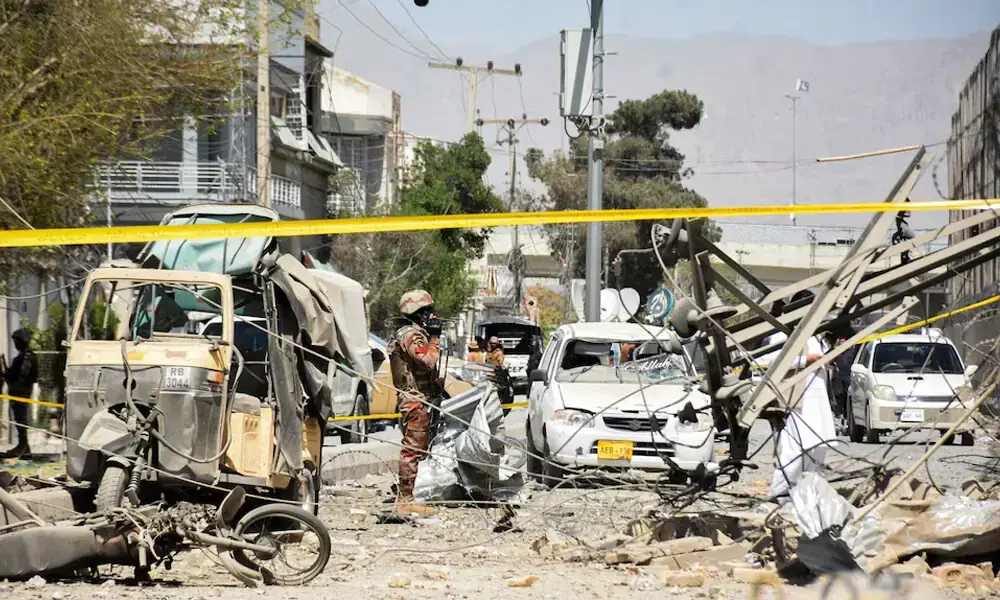

ISLAMABAD: The National Assembly on Tuesday passed a unanimous resolution condemning the recent terrorist attacks in Balochistan, urging security forces, law enforcement agencies, and the provincial government to take swift and decisive action to ensure public safety.
The resolution, moved by Minister for Parliamentary Affairs Tariq Fazal Chaudhary, also called for strong and decisive actions against both foreign sponsors and local supporters of terrorism.
It also acknowledged the prompt response of the security forces, law enforcement, the Balochistan provincial government, and the civil administration. It also expressed solidarity with the families of the martyrs and victims.
The resolution read, “This House expresses deep grief over the incidents and strongly condemns the brutal violence against women.
It rejected the use of women as tools for political gain, deeming such acts unacceptable to Pakistan, the Islamic world, and especially the people of Balochistan.”
The House further declared that attacks on women and children are unforgivable crimes, with the state vowing to hold the perpetrators accountable according to the law.
It also pointed to evidence suggesting external involvement, particularly India’s role, in several of these attacks.
The resolution raised concerns about neighbouring countries supporting terrorism through logistics, financial aid, training, and propaganda.
The House called for an immediate, coordinated national response targeting both foreign sponsors and internal facilitators of terrorism, smuggling, and propaganda.
It emphasised that this response should be multifaceted, combining political, diplomatic, military, intelligence, legal, and narrative efforts. The House pledged its commitment to ensuring peace and security for all citizens.
Opposition leader Mehmood Khan Achakzai proposed an amendment to the resolution, advocating that the children’s right to their province’s resources be recognised first.
Speaker Ayaz Sadiq noted that this matter is constitutionally protected, and the Minister for Parliamentary Affairs agreed, stating that it is the people’s fundamental right to control their provincial resources.
In a separate resolution, moved by Chairman of the Parliamentary Committee on Kashmir, Rana Muhammad Qasim Noon, the House called on the international community, including the UN, to play an active role in resolving the Jammu and Kashmir dispute.
The resolution urged the international community to press India to end human rights abuses in Indian Illegally Occupied Jammu and Kashmir (IIOJK), lift repressive measures, release political prisoners, and allow unrestricted access to international human rights organisations.
The resolution also welcomed US President Donald Trump’s initial offer to mediate the dispute after the May 2020 conflict between Pakistan and India.
The House expressed its unwavering solidarity with the Kashmiri people, paying tribute to their sacrifices, and pledged support for their legitimate aspirations.
The House also demanded India reverse its illegal actions of 5 August 2019, and cease any attempts to alter the region’s demographic, political, or legal status.
Additionally, the House rejected any unilateral decisions by India regarding the Indus Waters Treaty, describing such actions as a threat to regional peace and stability.
Winding up the debate on Balochistan’s law and order situation, Minister of State for Interior Talal Chaudhary highlighted that Balochistan receives 40% more funding than Punjab under the National Finance Commission (NFC) Award.
He stressed that the federal government provides 91% of the province’s financial resources, pointing to significant federal support for Balochistan’s development.
He cited major developments, such as 13 cadet colleges, 321 technical institutions, airports, hospitals, health centres, and thousands of kilometres of roads.
He questioned why public institutions like schools and hospitals were being targeted, asserting that such acts harm ordinary citizens rather than addressing grievances.
“What is the motive behind attacking highways, exploding bridges, and hijacking trains when these are vital for the common people,” he asked.
He further condemned terrorist groups like the TTP and BLA, noting that both exploit religion and identity for their agendas but have no legitimate connection to either.
He also criticised India for its failure to condemn the recent attacks in Balochistan, despite global condemnation.
He reiterated that while security forces are actively combating terrorism, political leadership must unite behind a common narrative.
He stated that 177 terrorists had been killed in engagements with security forces.
PTI leader Asad Qaiser noted the frequent terrorist incidents in both Balochistan and Khyber Pakhtunkhwa, stating that progress would be impossible without addressing the root causes of the insurgencies in these provinces.
He also condemned the denial of former Prime Minister Imran Khan’s right to meet his family in jail and criticised disparities in the treatment of provincial leaders.
He called for diplomatic efforts to address cross-border terrorism, citing the potential for talks between the United States and Iran as a model for dialogue with Afghanistan.
He urged the full implementation of the National Action Plan and warned that Pakistan risks international isolation if state policies are not reviewed.
JUI-F’s Aliya Kamran questioned the delayed response of security forces during attacks, particularly in Nushki, and called for an investigation into why escaped terrorists had not been apprehended.
She also emphasised the need to address why women were being used as suicide bombers and advocated for dialogue with the people of Balochistan.
Other MNAs, including Sofia Saeed, Usman Badini, Ejazul Haq, and Kiran Haider, also took part in the debate on the terrorist attack in Balochistan.
Copyright Business Recorder, 2026

























Comments
Comments are closed for this article.