


Solar power growth creates challenges to national grid: expert
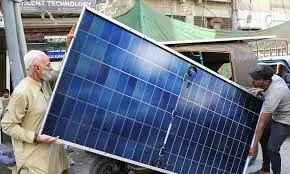

ISLAMABAD: A Chinese energy expert has warned that the rapid expansion of decentralized solar power in Pakistan is placing additional pressure on the national grid and increasing costs for consumers who cannot afford solar systems.
Prof. Dr Yixian Sun from the University of Bath, UK, said Pakistan has spent over USD 10 billion on solar imports without capturing industrial or economic spill-overs. He stated this at the launch ofthe policy report, titled “From Solar Boom to Green Industrialization: Policy Pathways to Localizing Solar Value Chains in Pakistan,” by the Sustainable Development Policy Institute (SDPI) in collaboration with the University of Bath, on Monday.
Highlighting global trends, he noted that Chinese companies have invested over USD 200 billion in solar manufacturing abroad in the last three years, particularly in Southeast Asia, while Pakistan has attracted almost none. “With its large market and low labour costs, Pakistan can become a competitive destination for clean energy manufacturing if the policy and political environment are aligned,” he said.
Dr Khalid Waleed, Research Fellow and Energy Economy Expert at SDPI, said the report aligns closely with Pakistan’s broader economic transformation agenda, including energy, exports, environment, and digitalization. “Pakistan has imported USD 2–3 billion worth of solar panels, representing 22–30 gigawatts of capacity, alongside USD 9 billion in Chinese financing for utility-scale coal plants, he said, adding that localization does not require reinventing the wheel but smart value addition. He underlined the importance of planning for solar panel recycling in the coming years through joint ventures with China.
Dr Hina Aslam, Visiting Fellow at SDPI, described the report as timely, saying it sheds light on the economic dimensions of Pakistan’s solar boom, an area often overlooked in energy debates. She stressed that clean energy supply chains are increasingly being diversified globally and said Pakistan can leverage this transition to train its youth, build local industries, and reduce dependence on imported energy technologies through inclusive and forward-looking policies.
Presenting key policy recommendations, Faisal Sharif, Doctoral Candidate at the University of Bath, outlined a “5S Roadmap” for solar PV manufacturing indigenization. The framework includes developing a national strategy, establishing a solar industrialization task force, adopting a 10-year policy, creating domestic demand through tailored solutions, and targeting export-oriented niches in the long run. He emphasized tariff rationalization, sales tax harmonization, blended finance, local content requirements, strong standards and certification regimes, and housing solar manufacturing clusters in CPEC-II SEZs.
Engineer Ubaid Ur Rehman Zia, Head of Energy Unit, SDPI, said Pakistan has witnessed an unprecedented surge in solar installations, driven largely by residential and commercial net-metering systems. He noted that Pakistan has already imported solar equipment equivalent to nearly 50 gigawatts, far exceeding officially installed grid capacity. Though solarisation has eased energy costs for many consumers, it has not translated into meaningful local industrial development or human resource capacity,” he said.
Aftab Khan, NPO, Ministry of Industries and Production, raised questions about Pakistan’s current technology readiness and stressed the need to clearly define priority areas for localization based on demand, efficiency, and industrial feasibility.
Dr Hassan Daud Butt, Senior Advisor to China Energy Engineering Group, said weak long-term planning has constrained Pakistan’s energy sector. He warned that unchecked solar imports are weakening system stability and called for a clear roadmap for Green SEZs under a reform-oriented CPEC framework.
Copyright Business Recorder, 2025




















Comments
Comments are closed for this article.