


26th amendment case: Whether CB should refer matter to JCP or ask CJP to constitute a full court, SC judge asks
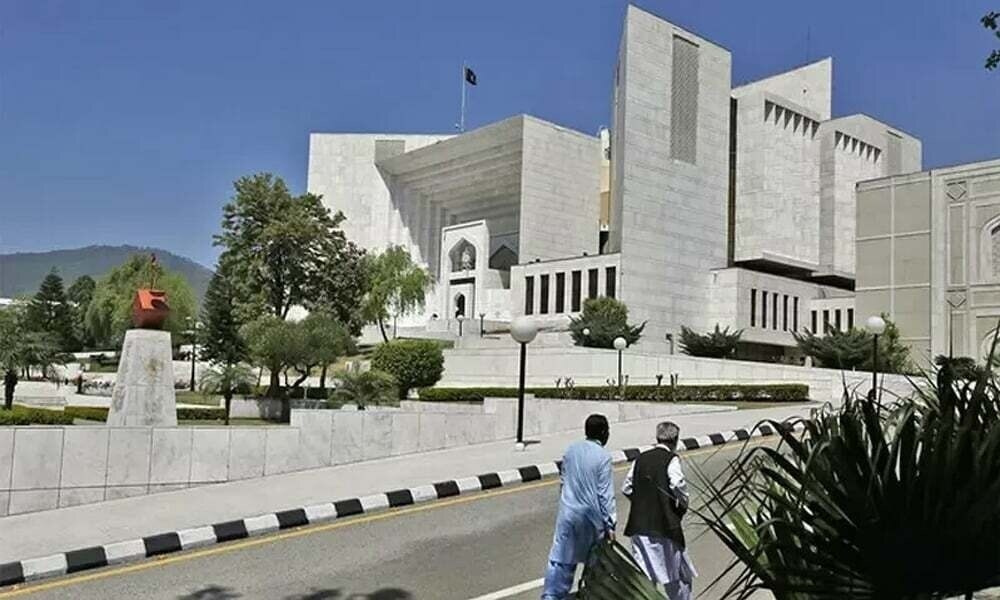

ISLAMABAD: Supreme Court Judge Justice Muhammad Ali Mazhar questioned whether the constitutional bench should refer the matter to the Judicial Commission of Pakistan (JCP) or pass a judicial order directing the Chief Justice of Pakistan (CJP) to constitute a Full Court to hear petitions against the 26th constitutional amendment.
An eight-judge bench, headed by Justice Amin-ud-Din Khan, on Wednesday heard the petitions filed by former Chief Justice of Pakistan Jawad S Khawaja, the Pakistan Tehreek-e-Insaf, the Jamaat-e-Islami, the Sunni Ittehad Council, chairperson of the Tehreek-i-Tahaffuz Ayeen-i-Pakistan Mustafa Nawaz Khokhar, and different bar councils and associations against the 26th constitutional amendment.
Justice Naeem Akhtar Afghan stated that under clause (1) of Article 191A, the constitutional benches are not only nominated, but also determined by the Commission. He questioned, “Can we direct the JCP through a judicial order to form a Full Court, while the decisions of the JCP are made by majority votes?” “Can we stop this process of the JCP, and if we do this are we not violating the constitutional provision,” Justice Naeem further asked.
Justice Amin stated that the total sanctioned strength of the Supreme Court is 34 judges.
While addressing Abid Zuberi, lawyer of former presidents of the Supreme Court Bar Association (SUPREME COURTBA), said that if we proceed according to your arguments, 16 judges will hear these petitions, but then an appeal against their decision would be heard by those judges who have been appointed after the enactment of the 26th Amendment.
Justice Musarat Hilali said the Committee, set up under PPA, comprises three judges of the Supreme Court; i.e., CJP, senior puisne judge, and head of the constitutional benches. She remarked that the incumbent CJP is a beneficiary of the 26th Amendment, while Justice Mansoor is an affectee of the amendment, then ultimately the matter regarding the Full Court would come before Justice Amin-ud-Din. She said, “We need to consider this case as the judges of the Supreme Court.”
Abid Zuberi submitted that the Committees formed under the Supreme Court Practice and Procedure Act (PPA) and Article 191A of the Constitution form the benches, but the Chief Justice has inherent power under Article 175 to constitute the Full Court.
Zuberi then cited the Supreme Court’s judgment in Hamza Rasheed’s case. Justice Ayesha A Malik asked him, “Why are you relying on this judgment?” According to the judgment, under no circumstance does the bench seized of a matter constitute a larger bench.
Justice Mazhar told the counsel that the judgment you are citing was delivered when there was no Article 191A. He further said that at that time there were no constitutional benches, adding the Judicial Commission of Pakistan (JCP) nominates the members of the constitutional benches, while the Committee under Article 191A forms the bench (es) and fixes the cases. Justice Mazhar questioned in light of Article 191A whether the present bench was vested with the power to pass a judicial order to include those judges who are not members of the constitutional bench for the hearing of this case. If needed, then at least they can include more judges of the constitutional bench, he remarked.
Zuberi contended that the judicial power under Article 175(2) of the Constitution is given to the Supreme Court. Justice Ayesha questioned whether there is any bar to refer the matter to the Chief Justice to constitute the Full Court. She said that when there is no bar, then this bench can pass a judicial order directing the Chief Justice to form the Full Court.
Zuberi argued that instead of the Chief Justice, who was “Master of Roster”, now the Committee under PPA has the power to constitute a Full Court.
Justice Jamal Khan Mandokhail questioned whether, after Article 191A, this case can be assigned to a regular bench for hearing? He asked, suppose the bench says this case would only be argued by Abid Zuberi, then would it exclude other lawyers? Zuberi replied ‘yes’.
Justice Ayesha questioned, “Do we recognise that the JCP’s power is above the Supreme Court,” saying the Commission can’t restrict the power of the Supreme Court.”
Justice Mazhar observed that there is no bar on the JCP to nominate any judge for the constitutional bench(es). However, the Committee, set up under Article 191A, can ask the Commission, which also has parliamentarians from both the opposition and the ruling party, to nominate more judges in the constitutional bench. It had done that in the past, he added. Justice Jamal stated, “If the JCP tomorrow says that four or five judges of the constitutional bench are no longer its members, then can they challenge that order?”
Copyright Business Recorder, 2025




















Comments
Comments are closed for this article.