



The Sindh government’s Safe City Project has made it mandatory for citizens to replace their vehicle registration plates with newly designed Ajrak-themed plates. These security-enhanced plates, embedded with threads, holograms, and barcodes, are expected to improve data accuracy, curb vehicle-related crimes, and generate significant revenue for the government.
Sindh Excise Minister Mukesh Kumar Chawla insists the project cannot succeed until every car and motorcycle carries the official plates.
According to official figures, around five million vehicles and motorcycles ply on Karachi’s roads. Of these, two million have been registered since 2023, with over two million plates already manufactured and issued.
The government charges Rs2,450 per plate for cars and Rs1,850 for motorcycles. In the fiscal year 2024–25, the Excise Department even achieved a revenue target of Rs220 billion.
While the Safe City Plan has focused heavily on ensuring compliance from private vehicle owners, little has been done to address the real menace on Karachi’s roads: heavy commercial vehicles, especially dumpers. These trucks, often driven recklessly in residential areas, are responsible for hundreds of deaths every year.
According to hospital data, nearly 500 people lost their lives and over 4,800 were injured in 2024 alone due to accidents involving heavy vehicles, including dumpers, and water tankers.
Almost every Karachiite has a close encounter story with a dumper. I count myself among the “lucky” ones who survived such a brush. Others are not so fortunate.
Just last week, a dumper on Rashid Minhas Road crushed a motorcycle carrying a family. Twenty-two-year-old Mahnoor and her 14-year-old brother Ali Raza were killed instantly, while their father was severely injured. Their uncle, Zakir, could only weep as he said, “We were saving every penny for Mahnoor’s wedding next month. Today, instead of her dowry, we are arranging her burial“.
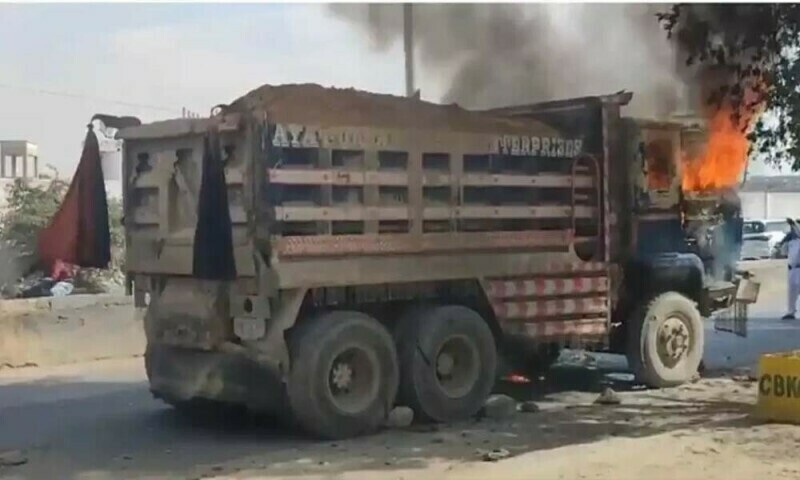
The tragedy sparked rage. Angry residents set seven dumpers on fire and beat the driver before handing him over to the police. The Dumper Drivers Association retaliated with protests, blocking the Super Highway and threatening to extend the blockade to the National Highway.
Authorities, meanwhile, remain reactive. Sindh Governor Kamran Tesori condemned the accident, urged punishment for the driver, and called for action against the “dumper mafia“. But beyond statements, little has been done to regulate these vehicles.
The irony is glaring. The government can force millions of citizens to pay for new Ajrak plates in the name of safety, yet it cannot—or will not—control dumpers that barrel through Karachi’s streets, turning commutes into life-or-death experiences.
Solutions exist. Oil companies and logistics startups install dashboards that monitor driver alertness, braking, speed limits, and vehicle fitness in real time. Such measures are not rocket science. They simply require political will and strict enforcement.
Until then, Karachi will remain a city where citizens pay for “safe city” number plates while dumpers continue to crush lives with impunity.
The article does not necessarily reflect the opinion of Business Recorder or its owners.
The writer is a Reporter at Business Recorder (Digital)




















Comments
Comments are closed for this article.