


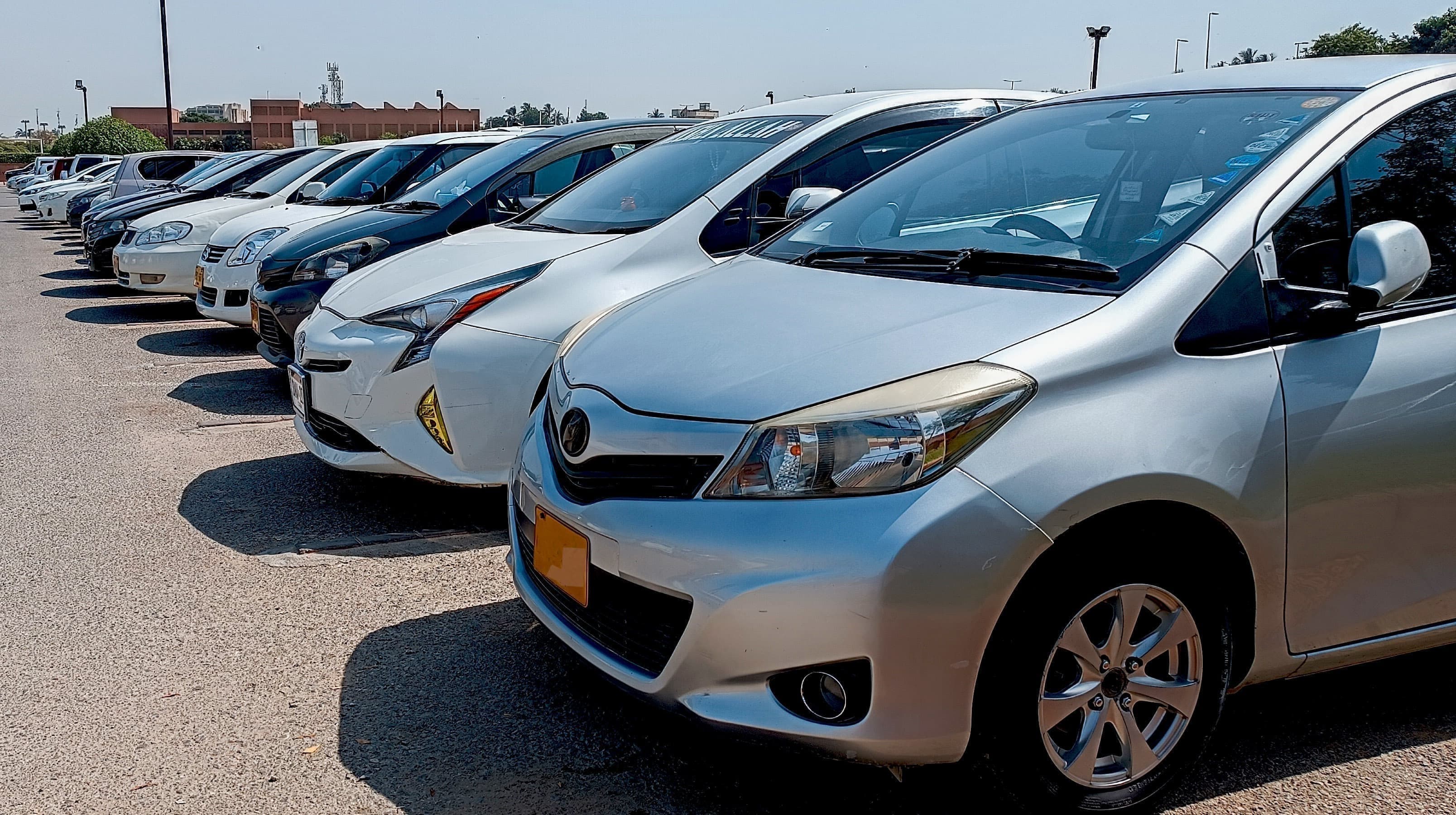

ISLAMABAD: The government is likely to merge the personal baggage and gift schemes for used imported cars — currently meant for overseas Pakistanis — with the upcoming five-year used car commercial import policy, expected to take effect from October 1, 2025.
This was revealed by Secretary Commerce Jawad Paul during a meeting of the National Assembly Standing Committee on Commerce, where he was responding to a query regarding the import of five-year-old used cars, which will initially face a 40% additional duty. This duty is expected to be reduced by 10% each subsequent year.
“The government is considering clubbing the personal baggage and gift schemes of used imported cars. However, the transfer of residence scheme will be treated separately. This proposal is still under discussion, and no final decision has been made yet,” he told the Committee.
Used cars’ import: Auto industry rallies against govt plan
Standing Committee members Usama Ahmed Mela and Gul Asghar Khan called for a comprehensive briefing on the import of used cars and electric vehicles (EVs), citing the potential impact on the country’s foreign exchange reserves.
A delegation of used car importers, led by Hassan Danji, suggested that since imports and exports fall under the purview of the Ministry of Commerce, the role of the Engineering Development Board (EDB)—an entity under the Ministry of Industries and Production—should be excluded from the commercial import process. They also recommended a reduction in the proposed 40% duty on five-year-old cars to make the scheme more feasible, and called for the formation of a working group comprising representatives from the Ministry of Commerce, Ministry of Industries, and importers to develop an attractive policy.
Secretary Commerce, however, distanced himself from the proposal, stating that auto sector matters fall under the domain of the Ministry of Industries and that his ministry already has numerous responsibilities.
Chairman of the Standing Committee, Jawed Hanif Khan, also disagreed with the importers’ proposal and decided to refer the matter — along with certain recommendations—to the National Assembly Standing Committee on Industries and Production.
Karachi Chambers of Commerce and Industry (KCCI) licence issue: On the issue of establishing separate Chambers of Commerce and Industry at the district level in Karachi, Director General Trade Organizations (DGTO), Bilal Khan Pasha, gave a detailed presentation on the history and current status of the Karachi Chamber of Commerce and Industry (KCCI). He noted that many businesspeople view KCCI as a traders’ body rather than a true representation of industry.
He stated that KCCI’s license was conditionally renewed on February 2, 2024, subject to the submission of amended Memorandum and Articles of Association (M&AoA). DGTO raised observations and queries on the M&AoA submitted by KCCI on May 6, 2025. A response is still awaited.
Pasha added that four applications are currently under review for the establishment of new district-level chambers in Karachi. He also noted that licenses for several chambers, particularly women’s chambers, have expired or become defunct. He mentioned KATI (Korangi Association of Trade and Industry) as one example that has yet to complete its legal documentation.
The Standing Committee unanimously agreed to allow each district of Karachi to establish its own Chamber of Commerce to better address the concerns of the local business community. However, the Committee decided to give KCCI one final opportunity to present its viewpoint. Some members suggested holding the next Committee meeting in Karachi to hear directly from representatives of all concerned chambers.
Briefing on US Tariff Agreement: The Ministry of Commerce also gave the Committee an in-camera briefing on a recent agreement with the United States, which includes a 15% additional tariff. Secretary Commerce, a member of the Pakistani negotiation team led by Finance Minister Senator Muhammad Aurangzeb, informed the Committee that while many aspects have been finalized, some issues remain unresolved.
Sources said the Committee members asked numerous questions regarding the benefits to Pakistan’s exports, particularly in light of the US imposing a 40% additional tariff on Indian imports, up from 25%. They also inquired about the likelihood of any reversal or revision of that decision.
According to the sources, the Committee was assured that the agreement is a win-win for both countries. For sectors negatively impacted by the deal, the government plans to introduce compensatory measures.
According to press release, the Committee deliberated on matters relating to the establishment of district chambers of commerce, the government’s motor vehicle import policy, and the Pakistan–US Tariff Agreement.
The Committee reviewed the legal framework governing the formation of chambers of commerce, noting the introduction of women’s chambers through amendments in 2006 and 2009 and the requirements under the Companies Act, 2013.
Members observed that centralization of representation with the Karachi Chamber of Commerce and Industry (KCCI) has created difficulties for the business community, with many entrepreneurs compelled to travel long distances to access services. It was highlighted that with more than 350,000 registered businesses in Karachi, the creation of district chambers would decentralize services, improve business facilitation, and expand the tax base.
Members across party lines expressed support for granting districts the right to establish chambers, while also agreeing that KCCI should be given an opportunity to present its position.
The Chairman directed the Director General of Trade Organizations (DGTO) to invite KCCI representatives to the next session and emphasized that the Committee was, in principle, supportive of district chambers, with a final decision to be taken after hearing KCCI’s stance. Representatives of various chambers that have applied for licenses also attended the meeting and were given the opportunity to present their concerns.
The Committee also heard from representatives of the motor vehicle import sector. Concerns were raised that the Engineering Development Board (EDB), whose primary mandate relates to manufacturing, should not be tasked with licensing commercial imports, and members recommended that this responsibility lie with the Ministry of Commerce. While, stressing the need to ensure fair competition between new and used cars in line with international practice, Members also cautioned that opening up commercial imports could place pressure on foreign exchange reserves and adversely affect local industry.
The Secretary, Ministry of Commerce, briefed the Committee on proposed policy features, including restrictions on the age of imported vehicles, tariff structures, environmental compliance requirements, and the consolidation of existing import schemes. After deliberations, the Committee decided to refer the matter to the Ministry of Industries for detailed policy input, particularly on the impact of electric vehicle imports, and directed the Ministry to brief the Committee in its forthcoming meeting.
The Committee was further given an in-camera briefing on the Pakistan–US Tariff Agreement.
The Chairman reiterated the Committee’s commitment to ensuring that business facilitation and industrial policy are designed in line with merit, transparency, and the needs of the people, noting that the issues discussed are of national significance and will be pursued with the concerned stakeholders until equitable and practical solutions are achieved.
The meeting was attended by MNAs, Muhammad Mobeen Arif, Usama Ahmed Mela, Ms. Shaista Pervaiz, Dr. Mirza Ikhtiar Baig, Muhammad Atif, Tahira Aurangzeb, Khurshid Ahmed Junejo, Gul Asghar Khan, Farhan Chishti, in person whereas, Ramesh Kumar Vankwani, Asad Alam Niazi, Rana Atif, Muhammad Ali Sarfaraz, MNAs and Senior officers from the Ministry of Commerce, Trade Organization and FBR were also present in the meeting.
Copyright Business Recorder, 2025

























Comments
Comments are closed for this article.