


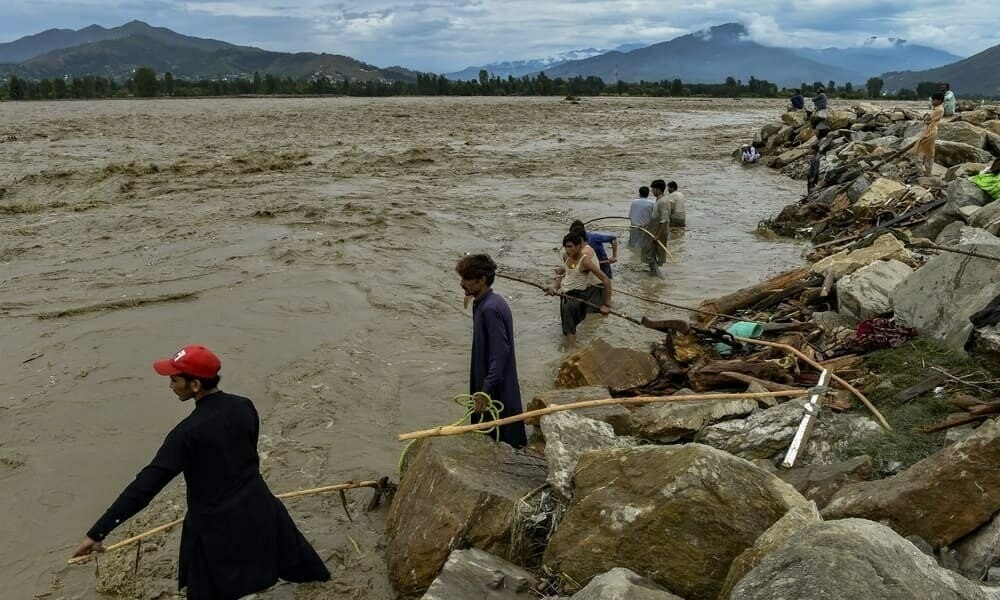

PESHAWAR: Alteast 313 people were killed and 156 others injured, while more than 159 houses damaged in rain-related incidents in Khyber Pakhtunkhwa, said the Provincial Disaster Management Authority (PDMA) latest report, released here on Sunday.
Torrential downpours triggered landslides, road collapses and swelling rivers that swept away bridges, homes and entire villages.
According to the PDMA, 313 people lost their lives and 156 were injured in various incidents. Among the deceased are 263 men, 29 women, and 21 children, while the injured include 123 men, 23 women, and 10 children.
KP death toll climbs to over 307: PDMA
The report highlights that 159 houses were damaged, including 97 partially damaged and 62 completely destroyed.
However, the independent source and locals put the death figure in recent floods and torrential rains at 332 that has prompted the provincial government to impose a state of emergency until August 31.
Buner, Shangla, Battagram, Mansehra, Bajaur, Swat areas of Khyber Pakhtunkhwa were worst-hit by floods, landslides; Death toll in Buner crosses 250 mark, according to locals and resources here on Sunday. As many as 156 people have been injured. Buner, Shangla, Battagram, Mansehra, Bajaur and Swat have emerged as the worst-hit areas.
In Buner alone, the death toll has exceeded 250, while bodies of 11 people have been found in Battagram. On the other hand, the Met Office has said that heavy rains will continue to lash the province and other parts of the country until August 21.
Meanwhile, Khyber Pakhtunkhwa Chief Minister Ali Amin Gandapur visited Buner and reviewed the situation, arising out of floods in the area. He also monitored a relief and rescue operation in the area.
Buner district was reported as the worst-hit area, with 208 deaths recorded. Other affected districts include Swat, Bajaur, Torghar, Mansehra, Shangla, and Battagram.
The PDMA has also warned of more heavy rainfall between August 17 and 19, with the spell expected to continue until August 21.
In response, the Chief Minister of Khyber Pakhtunkhwa has ordered the release of relief funds for the affected districts and directed all relevant departments to accelerate rescue and relief operations. The Khyber Pakhtunkhwa (KP) government is observing a day of mourning after devastating flash floods wreaked havoc across the province.
Under the directives of Prime Minister Shehbaz Sharif, Pakistan’s federal government has instantly activated the 911 emergency helpline nationwide.
The initiative aims to deliver instant assistance to citizens facing natural disasters and other critical situations.
According to the Ministry of Information Technology and Telecommunication, the purpose of 911 emergency helpline is to work in areas having damaged or inactive mobile network towers. The Local Government Department of Khyber Pakhtunkhwa (KP) has set up a special control room.
According to the official notification, the control room has been established at the Directorate General to monitor the KP floods and related emergency developments. Special staff assigned duties to ensure round-the-clock supervision of the situation.
Prime Minister Shehbaz Sharif Minister directed the National Disaster Management Authority (NDMA) to continue close coordination with the Khyber Pakhtunkhwa government and to utilise all available resources for rescue and relief operations.
The NDMA has warned of further rainfall from August 18 to 22.
Moderate to heavy showers are expected across Chitral, Dir, Haripur, Karak, Kohat, Kohistan, Khyber, Kurram, Mansehra, Mohmand, Nowshera, Malakand, Charsadda, Abbottabad, Bannu, Swabi, Peshawar, Waziristan and surrounding areas.
Rain is also likely in Gilgit-Baltistan and Azad Kashmir, particularly in Astore, Skardu, Hunza, Shigar, Bagh, Neelum Valley and Muzaffarabad.
AFP adds: Rescuers dug homes out from under massive boulders on Sunday as they searched for survivors of flash floods that killed at least 344 people, with more than 150 still missing.
Since Thursday, torrential rains across the country have caused flooding, rising waters and landslides that have swept away entire villages and left many residents trapped in the rubble.
Most of the deaths, 317, were reported in Khyber Pakhtunkhwa province, where monsoon rains that are only expected to intensify in the days ahead drove flooding and landslides that collapsed houses.
More than 150 people are missing in hardest-hit Buner district, where at least 208 people were killed and “10 to 12 entire villages” were partially buried, officials told AFP.
“They could be trapped under the rubble of their homes or swept away by floodwaters,” said Asfandyar Khattak, head of Khyber Pakhtunkhwa’s Provincial Disaster Management Authority.
“Separately, in Shangla district, dozens of people are also reported missing,” Khattak added.
“There is no electricity or mobile signal in Buner, as power lines and mobile towers were damaged,” he added.
The spokesman for the province’s rescue agency told AFP that around 2,000 rescue workers were involved across nine districts, where rain was still hampering efforts.
“The operation to rescue people trapped under debris is ongoing,” said Bilal Ahmad Faizi.
“The chances of those buried under the debris surviving are very slim,” he added.
AFP journalists in Buner saw half-buried vehicles and belongings lying strewn in the sludge, with mud covering houses and shops.
A grave digger, Qaiser Ali Shah, told AFP he dug 29 burial places in the last two days.
“I have also dug six graves for children. With each grave, it felt as though I was digging it for my own child,” he told AFP.
“For the first time, my body simply refused to carry me through. That’s why today I apologised and said I cannot do this work anymore.”
Flooded roads hampered the movement of rescue vehicles, as a few villagers worked to cut fallen trees to clear the way after the water receded.
“Our belongings are scattered, ruined and are in bad shape,” shopkeeper Noor Muhammad told AFP as he used a shovel to remove mud.
“The shops have been destroyed along with everything else. Even the little money people had has been washed away,” he added.
The provincial government has declared the severely affected mountainous districts of Buner, Bajaur, Swat, Shangla, Mansehra and Battagram as disaster-hit areas. “We were trapped in our homes and could not get out,” another Buner resident, Syed Wahab Bacha, told AFP.
“Our entire poor community has been affected… This road was our only path, and it too has been washed away,” he added.
On Saturday, hundreds gathered for mass funerals, where bodies wrapped in blood-stained white shawls were laid out on the village ground. Fallen trees and straw debris were scattered across nearby fields, while residents shovelled mud out of their homes.
Pakistan’s meteorological department has forecast “torrential rains” with monsoon activity “likely to intensify” from Sunday onwards.
The monsoon season brings South Asia about three-quarters of its annual rainfall, vital for agriculture and food security, but also brings destruction. “The intensity of this year’s monsoon is around 50 to 60 percent more than last year,” said Lieutenant General Inam Haider, chairman of the national disaster agency.
“Two to three more monsoon spells are expected until the first weeks of September,” he told journalists in Islamabad.
Landslides and flash floods are common during the season, which usually begins in June and eases by the end of September.
The torrential rains that have pounded Pakistan since the start of the summer monsoon have killed more than 650 people, with more than 920 injured.
Pakistan is one of the world’s most vulnerable countries to the effects of climate change and is contending with extreme weather events with increasing frequency.
Monsoon floods in 2022 submerged a third of the country and killed around 1,700 people.
Another villager in Buner told AFP on Saturday that residents had spent the night searching through the rubble of their former homes.
“The entire area is reeling from profound trauma,” said 32-year-old schoolteacher Saifullah Khan.
“I helped retrieve the bodies of the children I taught. I keep wondering what kind of trial nature has imposed on these kids,” he said.
Copyright Business Recorder, 2025




















Comments
Comments are closed for this article.