


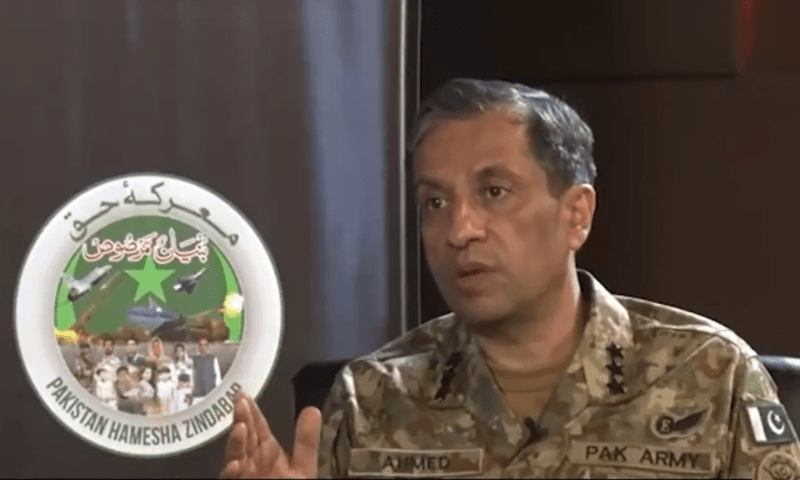

RAWALPINDI: Pakistan Army spokesperson Lieutenant General Ahmed Sharif Chaudhry has firmly denied the swirling rumours that Field Marshal Syed Asim Munir plans to become the next president of Pakistan, calling them “completely baseless” in an interview with The Economist.
Speaking to the renowned British magazine, the Director General of the Inter-Services Public Relations (ISPR) dismissed political speculation that surfaced after the “Marka-e-Haq”, saying such commentary is detached from reality and aims to embroil the military in unnecessary political discourse.
Lt Gen Ahmed Sharif made it clear that Field Marshal Asim Munir has shown no interest in the presidency and no such proposal is under consideration. “These claims are irresponsible and purely fictional. Dragging the military into politics is dangerous and misleading,” he stated.
This statement aligns with earlier remarks from Prime Minister Shehbaz Sharif, who had categorically denied any such development. Similarly, PML-N Senator Irfan Siddiqui had clarified that neither Nawaz Sharif nor his party had discussed the idea of making the Field Marshal president.
Federal Interior Minister Mohsin Naqvi also weighed in last month, saying on social platform X that “there has been no discussion nor any proposal for the president to resign or the COAS to assume that office.” He suggested that those spreading these rumours are part of a “nefarious campaign” against top state figures, including President Asif Ali Zardari.
It may be recalled that Indian rumour machines started circulating news that Field Marshal Asim Munir would soon take over Pakistan as president.
The Indian media frenzy was based on an article in the British magazine The Economist published on August 3, in which Field Marshal Munir’s leadership qualities were acknowledged for “giving a new direction to US-Pakistan relations” and his private meeting with President Donald Trump at the White House on June 18.
Pakistan Army chief Field Marshal Syed Asim Munir’s leadership has been acknowledged at the global level for his role in improving the country image in the comity of nations and “strengthening ties with the United States.”
When asked about rising tensions with India, DG ISPR warned of a robust and potentially unconventional response if India launches military aggression.
“This time we will start from the east,” he warned, adding that Pakistan would strike deep inside Indian territory. “India needs to understand that they too can be targeted anywhere.”
He said Pakistan would no longer remain reactive and that future provocations from India could be met with preemptive, full-spectrum retaliation.
The already strained relations between Pakistan and India worsened after the April 22, 2025, Pahalgam incident, which India blamed on Pakistan without evidence.
India retaliated by suspending the Indus Waters Treaty, scaling back diplomatic relations, canceling Pakistani visas, and expelling patients undergoing treatment in India. Pakistan responded in kind—declaring the treaty’s suspension an act of war, reducing Indian diplomatic staff, closing airspace to Indian flights, and halting all trade.
On the night of February 6–7, India launched missile attacks on multiple Pakistani cities, including Kotli, Bahawalpur, Muridke, Bagh, and Muzaffarabad, resulting in 26 civilian deaths and 46 injuries. Pakistan retaliated by shooting down six Indian warplanes, including three Rafale jets.
India launched another strike on February 10, targeting three airbases. In response, Pakistan initiated Operation Banyan Marsus (Iron Wall) in the early hours, targeting Indian military infrastructure such as Udhampur, Pathankot, Adampur airbases, and strategic locations like the BrahMos missile storage and S-400 defence systems.
A ceasefire was eventually brokered by the Trump administration, although the Indian government has not officially acknowledged the US role.
Meanwhile, President Trump has reportedly referenced this ceasefire effort over 30 times in public statements, highlighting the severity of the conflict and the diplomatic efforts required to contain it.




















Comments
Comments are closed for this article.