



Pakistan’s green policy is a massive red flag. A fancy climate support levy, a carbon levy on fossil fuels, a higher GST on internal combustion engines, a subsidy for e-bikes sound well and dandy. But don’t worry, they hit all the wrong targets.
There is a carbon levy of Rs2.5 per liter on petrol and diesel which will be imposed on consumers to discourage the consumption of fossil fuels. Next year, this could go up to Rs5 per liter. Let’s call it what it is. It is a regressive tax that hurts the poor disproportionately, and for virtually no benefit whatsoever except to the help the government afford its unhealthy spending habits.
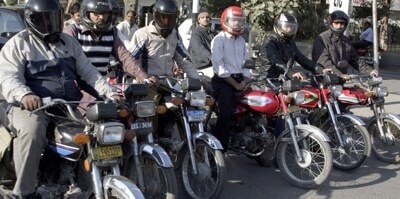
A carbon levy means that the millions of bikers on Pakistani roads, already crumbling under the pressure of inflation and taxes, the perfect killer combo will have to pay the government an extra Rs2.5 for every liter they consume. Safe for walking to work, dodging manholes and dilapidated roads, they don’t have a choice because there is virtually no reliable public transport system that could be an alternative.
Karachi does not have a fully functional, integrated public transport system and while Lahore and Islamabad have partially integrated public transport systems, they do not have full coverage. The bus system in major cities is unreliable, unsafe, and outdated. According to the PSLM survey, every one in two households in Pakistan use a motorcycle. Two decades ago, this used to be every one in ten households. For every car sold in the year 1999, two motorcycles were sold. By 2020, this grew to 12 motorcycles. The growth is undeniable, considering the affordability compared to four wheelers, the ease of commute on crowded and congested streets, lower commute times and lack of reliable public commute systems.
Bear in mind here that this doesn’t just impact motorcyclists that are going from home to work. This includes a large number of people working in the gig economy—from food deliveries to parcel deliveries—who predominantly cover their own fuel costs. Any substantive increase in fuel tax also hurts commercial transportation and logistics adding to the cost of business.
One could argue that Rs2.5 per liter is not a large enough tax to hurt consumers. But we are here talking about people not even earning a state-legislated minimum wage or are earning based on delivery orders. Counterintuitively, if this tax is not large enough to hurt the consumers enough to make them change their behavior—why are we imposing this tax? If 40 percent of fuel is used by motorcyclists in the country, this tax may be the most blatant display of revenue grab there ever was, with limited to no expected change in consumption patterns.
The government must understand this. The poor do not need more sticks. they are already ruffling through a haystack. They need substantial carrots. Taxing fuel consumption without investing adequate in the public transport system—where the green buses, one might ask? As far as green taxes go, this tax is not sufficient enough. There is an electric vehicle policy that will begin to subsidize electric motorbikes. In the first year, the subsidy will provide 100,000 e-bikes to consumers. For context, there are 24 million motorcycles on the roads of Pakistan. If one were to trade these out for an e-bike, it would take the government 240 years-worth of currently allocated subsidy to do the job.
There is also a climate support levy on combustion engine cars which would raise prices of cars but not by a large degree. It also not directly encourage EVs or plug-in hybrids that are substantially more expensive.
Meanwhile, a sales tax on the import of solar panels is imposed—solar panels that are as green as they come simply because if more consumers consume less grid electricity—which is predominantly made from fossil fuels—the government will not be able to cover capacity payments to be made to IPPs. Capacity payments of plants that are largely thermal that are burning coal, fossil fuel or gas. Make it make sense! why is the government targeting those barely scraping by?
Pakistan’s green policy is a masterclass in missing the point. Slapping poor commuters with a regressive fuel tax, tossing around token e-bike subsidies, and taxing solar panels, all the while failing to offer anything back.


























Comments
Comments are closed for this article.