


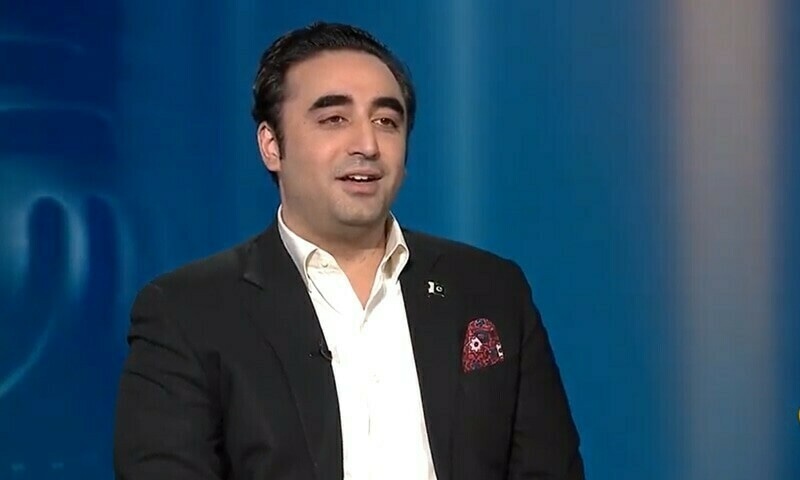

KARACHI: PPP Chairman Bilawal Bhutto-Zardari on Tuesday urged the United Nations and the international community to push India towards a comprehensive dialogue with Pakistan, where the two countries could address their outstanding issues and achieve peace in the wake of their recent military conflict in the aftermath of the Pahalgam attack.
Bilawal was addressing a press conference at the UN Headquarters in New York on recent regional developments after the military conflict.
The address came amid the visit of a high-level team — consisting of three former foreign ministers, two former foreign secretaries, two former ambassadors to the US, and a serving federal minister — for consultations at the United Nations. The team arrived in New York on Sunday
FO condemns remarks of Indian leaders
Ex-FMs Bilawal, Hina Rabbani Khar and Khurram Dastgir; Senators Sherry Rehman, Musadik Malik, Faisal Sabzwari and Bushra Anjum Butt; and Jalil Abbas Jilani and Tehmina Janjua are members of the delegation.
Bilawal said Pakistan’s position was to hold a “comprehensive dialogue” with India that would include the issue of terrorism as well. Bilawal said Pakistan was the country where the “single largest number of terrorist attacks” occurred and was also the country with the single largest number of victims of terrorism.
Bilawal said the Pakistani delegation was concluding its visit to New York and the UN and had appealed to the international community to assist the country in its pursuit of peace. “Just as the international community played its role in encouraging India to agree to a ceasefire, it should also encourage engaging in a comprehensive dialogue with Pakistan so that we can address our issues and achieve peace,” he added.
Bilawal said he wanted to use the opportunity to share Pakistan’s perspective on the recent military conflict with India in the wake of the Pahalgam attack, as well as the way forward.
Reiterating the “illegal strikes” launched by India as part of its ‘Operation Sindoor’ “in violation of the UN Charter, international law”, Bilawal said the attacks had targeted civilian infrastructure, places of worship, energy infrastructure and innocent women and children.
He said India had used the April 22 terrorist attack in IIOJK’s Pahalgam as a premise for the strikes.
“We expressed our sympathy with the victims of terrorism and Pakistan has consistently and unequivocally condemned terrorism in all its forms and manifestations,” he said, adding that Prime Minister Shehbaz Sharif had immediately expressed Pakistan’s willingness to India and the global community to be part of any impartial international investigation.
He said India subsequently launched missile strikes into Pakistan in the next two days and the latter “responded in kind”. “Due to the intervention of the international community, and I’d like here to particularly mention the role of US President Donald Trump and his team led by Secretary of State [Marco] Rubio, we did manage to achieve a ceasefire,” Bilawal added.
“The military and political leadership of Pakistan and the country are not the caricature that India would like to paint of us,” he said, adding that politicians had fought terrorists on the frontline and paid a heavy cost while the military had confronted them on the battlefield and earned their honours and promotions.
He also pointed out that the Financial Action Task Force — the international watchdog against money laundering and financing of terrorism — had endorsed Pakistan’s taking measures to combat terror financing.
“It’s become too easy for wannabe hegemons to use the wolf whistle of terrorism to justify illegal actions and violent actions in Muslim countries and communities,” Bilawal said, adding that terrorism could not be confronted by India while using it as a political tool to demonise Muslims within, in IIOJK and Pakistan.
Despite that, he said Pakistan would still like to cooperate with India in combatting terrorism and the fate of the region’s people could not be left in the hands of non-state actors and terrorists for them to decide that two nuclear-armed powers go to war.
In addition, he said the most recent front opened by India was the weaponisation of water, adding that the violation of the Indus Waters Treaty must be condemned across the board and the precedent must not be allowed to be set.
He said the threat to cut Pakistan’s water supply was a violation of the UN Charter and any action on it would be seen as an act of war by Pakistan.
He said Trump had a unique opportunity to deliver on his commitment to peace, enjoying good relations with both countries. He added the delegation would be beginning its engagements in Washington DC from tomorrow and encourages US lawmakers and government officials to play their role in facilitating the peace process.
The Pakistani delegation is scheduled to arrive in Washington today, where it plans to engage with Rubio, other senior officials, lawmakers, and think tanks till June 6. The team will also visit London and Brussels. The visit coincides with the arrival of an Indian delegation in Washington on June 3, led by Congress MP Shashi Tharoor.
Earlier, the team met officials from the Organisation of Islamic Cooperation (OIC) officials to brief them on Pakistan’s stance.
Bilawal, while addressing the OIC Permanent Representatives, “categorically rejected India’s attempt to link Pakistan to the Pahalgam incident without any credible investigation or evidence”, according to a press release by Pakistan’s Mission to the UN.
He highlighted that the blame was “used as a pretext for unlawful military actions, including cross-border strikes, which targeted civilians and civilian infrastructure”.
During his meeting with the OIC envoys, PPP chairman expressed concern at India’s move to suspend the Indus Waters Treaty, which Pakistan considered “a blatant act of weaponising water and a violation of international and treaty obligations”.
“He [Bilawal] made it plainly clear that we cannot allow this to become a new normal,” the statement read.
It continued that the PPP chairman stressed that “due to India’s belligerent aggression, the world has become a less safe place, with real and present implications for peace and security in South Asia”.
The former foreign minister went on to thank the OIC for its efforts and role aimed at mediation to de-escalate tensions between the two nuclear-armed neighbours, highlighting that the “only path to peace is dialogue, engagement and diplomacy”.
“He [Bilawal] reaffirmed Pakistan’s commitment to peace, restraint, and diplomacy, and called for the restoration of the Indus Waters Treaty, full respect for the ceasefire, and the resumption of a comprehensive dialogue with India, with the resolution of the Jammu and Kashmir dispute at its core,” the statement read.
Meanwhile, the permanent representatives of the OIC countries expressed their “appreciation for Pakistan’s transparent and timely briefing and reaffirmed their solidarity with Pakistan and the people of Jammu and Kashmir”.
Copyright Business Recorder, 2025




















Comments
Comments are closed for this article.