



The rate of Covid-positivity on November 4, 2020 at 4.94 percent was highest in 91 days. The share of daily positivity stayed under 2 percent for 55 of the first 65 days since it first went under 2 percent. It stayed between 2-3 percent for only 9 days and took just 3 days to move out of the 3-4 percent range, hitting 4 percent on November 1. And it will have likely crossed 5 percent, by the time you are reading this on November 5, 2020.
Now this is a quick change from two weeks ago. The rather steep fall from a much higher peak back in June, and subsequent studies suggesting Pakistan could be on the brink of herd immunity – had instilled a sense of hope that the second wave may never touch Pakistan. But it appears this is the beginning of what certainly looks like a second wave if it is not the wave itself yet.
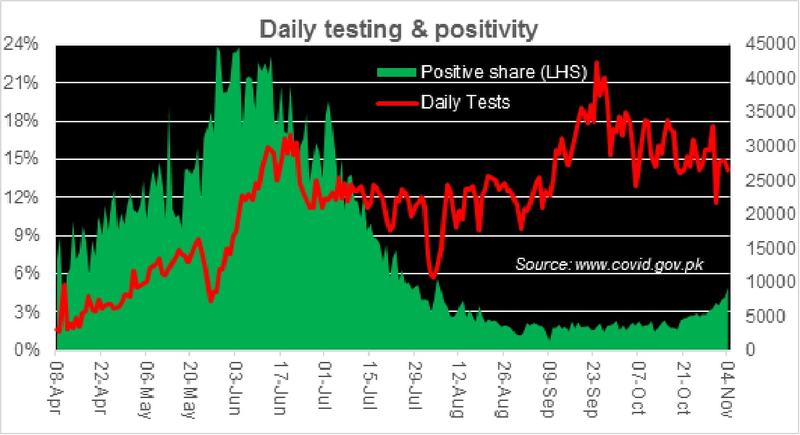
What qualifies as pandemic “under control” remains open to discussion and has frequently changed since the pandemic began. The safest bet is to take the WHO as the benchmark which has also been amended during the pandemic. WHO now believes a positivity rate under 3 percent for over two weeks should be considered a sign of adequate testing and controlled spread. Pakistan had it for two months, but that has since been breached, as Pakistan enters what is called the “orange” zone, which marks the early signs of the virus gaining momentum.
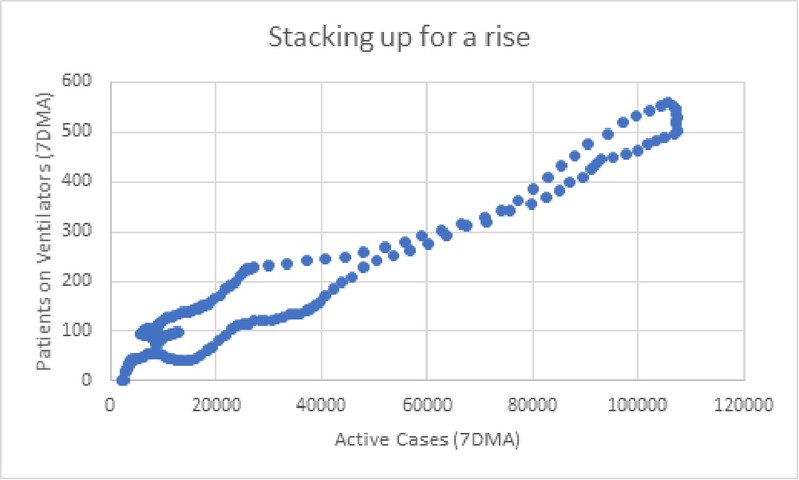
The active cases are at an 80-day high, which is worrying. The toll at less than 13,000 appears very manageable and minuscule when compared to the horrors of June and July, but the spread elsewhere tells that this is no time to sit back. Pakistan’s healthcare infrastructure has luckily been battle-hardened and is ready to cater to more patients than it did at the peak with 15,000 hospital admissions at a single point.
Right now, patients on ventilator are at a very manageable 100, and the capacity has been stretched to near 2000. But, mega cities such as Karachi could still run in trouble, if the cases rise exponentially, as the ventilator capacity in the country counts for little to nothing in such cases. Reinfections have been reported around the world, but the known scale is exceedingly small (25 cases) for it to be considered a real threat right now.
What is almost certain is that the drop in temperatures has found to be in high correlation with the rise in infections. The next three months could prove to be extremely tough as Pakistanis go deep into the winters. Studies suggest the case to fatality rate may be lower than the first wave, as more and more younger people are now being infected, and the group has a significantly lower mortality rate than the elderly.
As things stand, the governments have started to impose various versions of smart lockdowns. Pakistan going into another nationwide lockdown appears highly unlikely at this point, but restrictions would certainly go up. In absence of a vaccine, wearing masks cannot be more overemphasized. Pakistan may well have been among the top performers during the first wave. It will have to be as proactive to standout in the second one.




















Comments
Comments are closed for this article.