


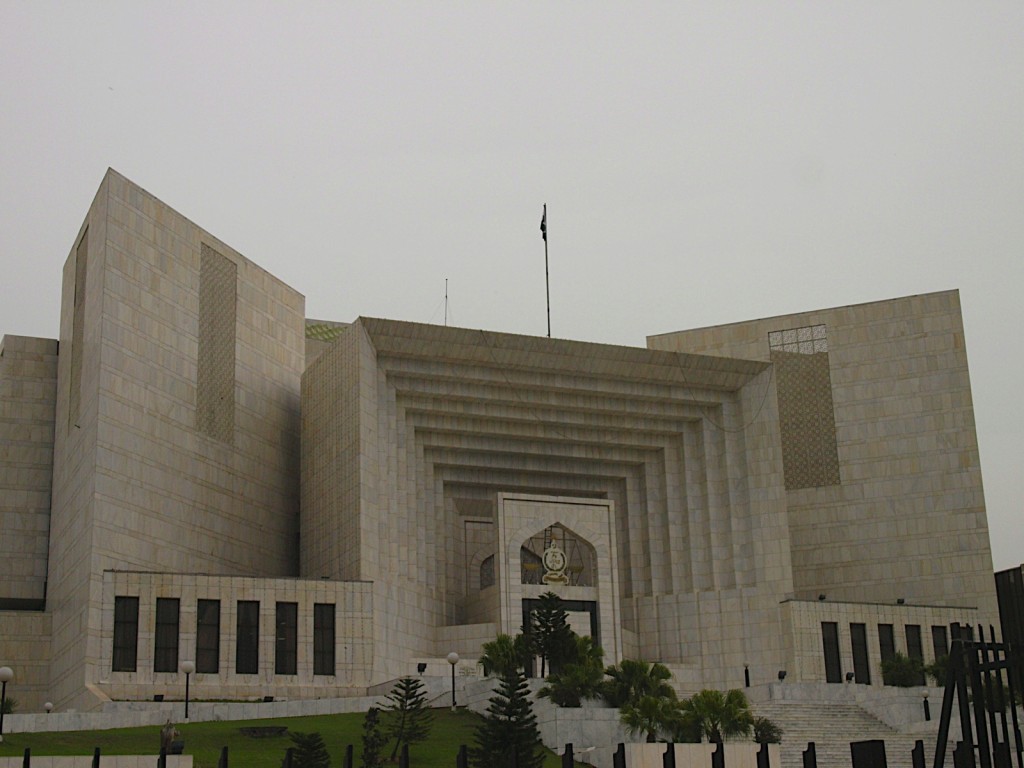
 While the Supreme Court is hearing two petitions, one pertaining to enforced disappearances in Balochistan and the other detention by military intelligence agencies of 11 civilians four of whom died in custody, three Jamaat-i-Islami senators have submitted an important bill to the Senate Secretariat seeking amendments in Articles 9 and 10 of the Constitution to curtail civil and military agencies' arrest and detention powers. Noting that disappearances have taken the form of "state terror", the senators have proposed amendments in the existing laws as well as new safeguards against prolonged detentions and denial of the right to a fair trial. These include reducing preventive detention period from three months - increased by Ziaul Haq's military regime in 1975 - to one month. Another urges change in the current 15-day limit for informing a detained person of the charges against him to make it "as soon as possible, but not later than one week". The bill also calls for removing ambiguity in the law under which the arresting authority is obliged to establish contact between the detainee and his family "at the earliest opportunity," suggesting instead that the family be informed within one week, and the arrested person presented before a competent judicial authority within a maximum period of one month to allow for defence. The major issue at this point in time, however, is 'enforced disappearances' and custodial killings at the hands of intelligence agencies. Such arrests usually are carried out without observance of the legal formality requiring production of arrest warrants. And in the case of Balochistan, nationalists/dissidents simply disappear, leaving behind only eyewitness accounts of kidnapping by unknown persons. Hence the preceding proposals, badly needed in other situations, do not apply to the 'missing' persons. What may make a difference is the proposal that "in case a person is detained without affording him the opportunity to fair trial and without informing his relatives, or if any of his rights are infringed, the authority issuing order of preventive detention and persons carrying out such illegal order shall be deemed to have committed the offense of abduction or wrongful confinement and shall be tried in a court of law." But to make that possible, the Parliament will have to change the existing laws, under which members of the armed forces are not subject to civilian courts' jurisdiction in any matter arising out of their service, or in respect of any action taken in relation to them as a members of the armed forces. The proposed amendments have also failed to take notice of the problems arising out of the military agencies' powers to arrest and try civilians under the Army, Air Force and Navy Acts of 1952 having constitutional cover, over which the high courts have no jurisdiction. The courts cannot hear petitions challenging the military courts' decisions. As per the Constitution, only the Supreme Court can hear an appeal "if it considers that a question of public importance with reference to the enforcement of any of the fundamental rights ... is involved." It is about time the relevant constitutional provisions are amended to establish civilian courts authority over military vis-a-vis issues related to fundamental rights. Copyright Business Recorder, 2012
























Comments
Comments are closed for this article.