


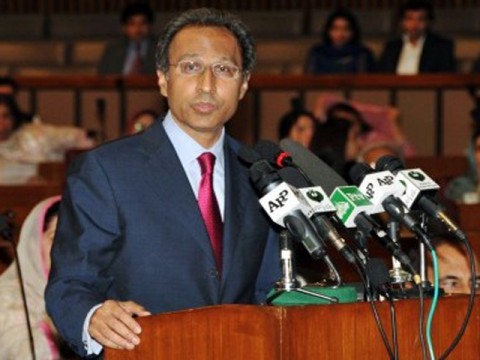
 In a Business Recorder exclusive the Finance Division, while briefing the Economic Co-ordination Committee of the Cabinet headed by the Finance Minister Dr Hafeez Sheikh, reportedly admitted that inflation in Pakistan was the second highest in the region. Bangladesh had the dubious title of having the highest inflation rate in the region. However, Bangladesh economy is expected to register an inflation rate of 7.5 percent this year while Pakistan's is expected to register a rate in double digits. One factor responsible for inflation in Bangladesh and common with Pakistan and indeed with other countries of the world is upward adjustments in the price of petroleum and energy attributed to the Arab Spring and, more recently, to the US and the EU sanctions on Iranian oil. Tariffs in Bangladesh were scheduled to rise by 7.1 percent from February 1 following a 13.2 percent rise last month. In this context, it is relevant to note that India has so far refused to sanction purchase of Iranian oil no doubt for national economic interests. However, India has considerable leverage with the West given the fact that it has the purchasing power to procure EU/US products backed by high Gross Domestic Product (GDP) growth rate and its current account position. In marked contrast, the Iran-Pakistan gas pipeline project that has the capacity to deal with our energy shortages in the medium as well as long-term, remains hostage to the US opposition though in recent days there are indications that the government may well proceed ahead with the project in spite of US position on the matter. Analysts, however, urge a wait-and-see policy not entirely convinced that the government would opt to alienate the US to access Iranian gas. Secondly and again in common with Pakistan, the Bangladesh economy is grappling with high credit growth - an intrinsically inflationary policy. The State Bank of Bangladesh (SBB) pledged last week to "pursue a restrained monetary growth path in order to curb inflationary and external sector pressures" and indicated that the rise in credit was among companies and individuals. The SBB also committed to reducing credit growth from 18 percent to 16 percent. However, in Pakistan credit growth is attributable to borrowing by the government to finance its spiralling budget deficit, which is rising due to inability to control current, notably for subsidies, as opposed to development expenditure. Or in other words, the output growth aspect of the increase in government expenditure as well as credit is minimal. Thus while the Bangladesh economy is forecast to register a GDP growth of between 6.5 and 7 percent, Pakistan's economy will register around 4 percent at best in the current fiscal year. On all other fronts, Pakistan remains the worst performer within the regional context. The World Bank report dated 12th January 2012 would one hope be a wake-up call for our economic managers. It states that: "Economic activity in Pakistan, representing about 15 percent of regional GDP, (in contrast to India's 80 percent) continues to markedly lag outcomes elsewhere in the region, reflecting worsening security conditions, greater political uncertainty and a breakdown in policy implementation. The GDP growth slowed to 2.4 percent in fiscal year 2010/11, ending in June 2011, from 4.1 percent in 2009/10, in part due to economic disruptions of the devastating floods that hit in July and August of 2010. Pakistan is projected to post a rebound to 3.9 percent in 2011/12, and to firm further to 4.2 percent in 2012/2013." The report also acknowledges that "workers remittances remain a critical source of foreign exchange in South Asia - equivalent to 20 percent of GDP, as of 2010, in Nepal, 9.6 percent in Bangladesh, 7 percent in Sri Lanka and 5 percent in Pakistan." It cautions that if the world economic conditions deteriorate markedly "remittances growth could stall, resulting in weaker incomes, weaker foreign currency earnings and slower domestic demand growth within the region". And further points out that "countries heavily reliant on foreign assistance, such as Afghanistan, Nepal and Pakistan, could be hit hard if fiscal consolidation in high-income countries were to result in cuts to overseas development assistance". Need one add this has been pre-empted in the case of Pakistan because of the failure of the government to implement the critical reforms agreed with the International Monetary Fund and inability to procure a Letter of Support from the Fund that has led to cessation of all bilateral and multilateral budgetary support (programme lending) to the country. There is an urgency to focusing on the poorly performing macroeconomic indicators by implementing fiscal reforms. The World Bank also correctly argues that expanding the drivers of growth holds potential and "with markets in the US and Europe expected to experience prolonged weaknesses South Asian countries have the opportunity to rethink and pursue new sources of growth in both domestic and external markets." That activity appears to be lacking amongst our policy planners. It is certainly a sad state of affairs. Copyright Business Recorder, 2012
























Comments
Comments are closed for this article.