


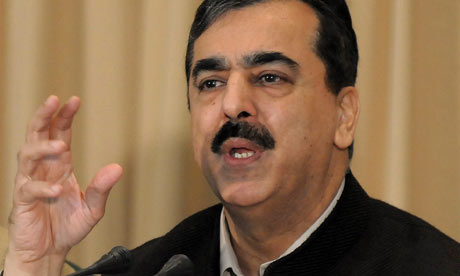
 Prime Minister Gilani is now confronted with the Hobson's choice: no real choice at all - the only options being to either write a letter to the Swiss authorities to reopen money laundering charge against President Zardari or refuse to do that. The latter option can lead to stipulate sentence after a formal accusation or indictment is made by the prosecuting authority of the State in the contempt of court case, which is being heard by a seven-member Supreme Court bench. If Prime Minister Gilani's posturing towards the Supreme Court's hearing of the infamous and annulled NRO is any indication, he seems prepared for the latter course. Of late, he has been talking in terms of leaving behind a legacy; that he is the longest serving prime minister of Pakistan and 'he may or may not be there but the parliament would stay'. A waive of 'martyrdom' evidently pervades the PPP camp, as its leaders insist it is a 'party of martyrs' and that they won't shirk from offering one more grand sacrifice. It would be uncharitable to think that Prime Minister Gilani has been pushed into this cul-de-sac by President Zardari's historic comment that writing the letter would amount to putting Benazir Bhutto's grave on trial. Prime Minister Gilani would not like to be another Farooq Leghari, a fellow politician from the Seraiki belt. Given the Supreme Court's policy of extra restraint the to-be-or-not-to-be moment may not come on February 13 when he appears before the court. Yet matters have moved to the cusp and nothing extraordinary can be ruled out. As of today the government still has a few tricks up its sleeve. It may go for an intra-court appeal as suggested by Aitzaz Ahsan, the prime minister's counsel. Then there is the talk of buying time in the post-verdict implementation procedure when the buck gets passed on to the Speaker of the National Assembly and the Election Commission. But that may get short-circuited. The abruptness marking the announcement of the court's order following a brief recess tends to suggest that the time of extra restraint has run out. Consider the instant closure of hearing. The hearing was over as soon as Aitzaz Ahsan threw up his hands saying 'it is beyond my brief' in reply to the court's question whether the government will write the letter in case contempt indictment is withdrawn. In fact, by uttering these words the prime minister's counsel had exposed the very heart of the government's plan that it would like to remain part of the court proceedings till it is no more possible to hide its basic position - never to write a letter to the Swiss authorities. The game-plan seems to be the following: 'Let the tree (read President Zardari) stand no matter how many leaves fall. If the situation has warranted Gilani's sacrifice the party would make that offering without a murmur for once. That Prime Minister Gilani's approach to the NRO case in the Supreme Court is very well thought-out is a fact beyond any iota of doubt. He had planned to delay writing a letter as long as possible and he has largely succeeded in that. But the question why Aitzaz Ahsan agreed to put his career as a brilliant lawyer at stake still needs a clear and plausible answer. All along till he accepted the prime minister's brief as his counsel Aitzaz had advocated the need to write the letter. But then he joined - the circumstances leading to that development being no less intriguing - and took a stand against such a move. He made yet another U-turn: after his forceful pleading for acknowledgement of President Zardari's purported right to immunity against criminal legal proceedings on the penultimate day of hearing, he completely moved away from that stance on the last day of hearing insisting that the prime minister was within his legal position to refuse approaching the Swiss authorities. That a lawyer of Aitzaz Ahsan's standing should goof up his argument so terribly and so recklessly is beyond one's comprehension. Is it that he was helpless on day one and as on the day after and had to toe the line dictated by his client (read party leadership) that whatever the cost, no letter would go to Switzerland? The question: Will it be all over if Gilani gets penalised and he is no more the chief executive? Will his successor write a letter? And if his successor also refuses to obey the court's order? There is no clear answer to these questions, but an apprehension of a much-dreaded clash of institutions. So far it has been avoided, not through courtesy of the political elite but because of patience and restraint exercised by the higher judiciary. Perhaps that may no more be possible. The only way out of this dilemma is that the government should write a letter and save its prime minister. That will strengthen the ambience for the rule of law, vindicate democratic credentials of political leaders and keep away the demons that breed and thrive on politicians' follies and failures. More importantly, it would add to arguable intellectual and moral greatness of Prime Minister Gilani who never tires of saying he respects the judiciary and will abide by its orders. Copyright Business Recorder, 2012























Comments
Comments are closed for this article.