


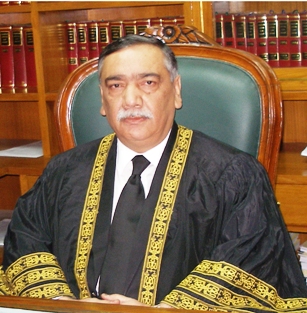
 Given the Supreme Court's consistent and praiseworthy position that it will not do anything to derail the democratic system in the country it has displayed considerable restraint and sensitivity once again. Deciding not to give any ruling on the NRO non-implementation case, it has thrown a six-day lifeline to the government by outlining six options of which one or more the present set-up may decide to adopt with sincerity and honesty. On what would be the final shape of things to emerge from the last hearing of the case to the hearing by a larger bench of the apex court remains to be seen. The jury is still out. But if the observations made by the five-member bench headed by Justice Asif Saeed Khosa are any guide one would tend to deduce that the present dispensation is faced with the most profound challenge to its survival. All the options essentially stem from the court's comprehension, as clearly and unambiguously reflected from its order of Tuesday, that government has 'blatantly and brazenly' defied the apex court's directives in the case, earning it the culpability of violating the Constitution. Not only has Prime Minister Gilani been termed a constitutional offender by breaching his oath of office, President Zardari too attracts the same charge: its evidence cited by the court being his interview to a private TV channel in which he point-blank opposed reopening the Swiss cases, for to him it would amount to disgracing the grave of the late prime minister Benazir Bhutto. An answer to a question whether there is a chance of implementation of court's order by the government is 'absolutely nil'. That within minutes of court's order the government's legal eagle, Babar Awan, was raising the ante of defiance and President Zardari's late night caucuses with his party's core committee and his allies in the parliament were endorsing policy of defiance, was a highly unsavoury development that leaves very little hope of finding a way out of the deepening crisis of institutional clash. Option One of the six options formulated by the court countenances initiation of court proceedings against the Chief Executive [Prime Minister Gilani] and Secretary Law for not just their failure to implement the NRO verdict. It has in fact termed Prime Minister Gilani not only as a court contemnor but a violator of the Constitution who, according to the court, breached his oath of office and thus in the eyes of law prima facie he may not be an "honest" man. Rarely can a person as politician in our country who has been 'declared' dishonest by the country's highest court survive. The situation, therefore, brings under spotlight the question of propriety in relation to prime minister's orders and decisions between now and January 16 when the larger bench would hear the NRO non-implementation case. For President Zardari the court's edict isn't in any less serious either; he too has been found to be guilty of standing in line with others who "have allowed loyalty to a political party and its decisions to outweigh and outrun their loyalty to the State" and their "inviolable obligation" to abide by the Constitution and all its commands. These are grave charges, indeed. However, the court does offer the president one last chance to approach the court to seek his immunity granted under the Constitution. But that doesn't seem to be happening. In fact, it is the Option No 6 that has the potential to lead us out of the situation, which for its criticality, is pregnant with dangerous consequences for the democratic process in the country. Given that this option has a political colour, that to some appears uncalled for, it lacks clarity of expression, though it is perhaps the best available option before the ruling coalition and all others having a stake in the democratic system. If the Executive is bent upon defying the court's final judicial verdict and "thus bringing down the constitutional structure itself (then) this Court may exercise judicial restraint and leave the matter to the better judgement of the people of the country or their representatives in the Parliament to deal with the delinquents". That the parliament would re-inforce its confidence in the leadership of Yousuf Raza Gilani is not what a highly controversial chief executive of the country deserves but given the present weird set of conditions it cannot be ruled out. The Parliament can also reject him or he may seek dissolution of the house and go for snap elections. But if the parliament fails to deliver on this account then the court wants the people to deal with the 'violator'. That is where we fear that this may incite political violence and promote anarchy. This is indeed a defining moment in our history, its gravity made all the more punishing now that the United States has resumed drone attacks with every possibility of triggering a wider conflict in the region. How will that impact the political narrative in the country is what we should not lose sight of. It is tragic to witness the present unnecessary and avoidable situation that is likely to become more difficult and complicated. Where does this slippery slope end? Copyright Business Recorder, 2012
























Comments
Comments are closed for this article.