


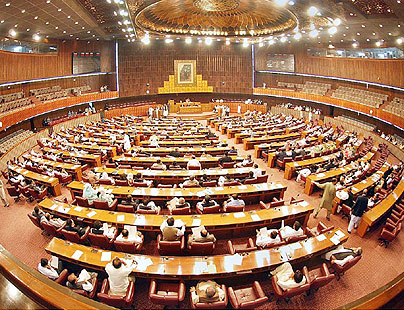
 Members of parliament do stage walkouts, and quite often, as a mark of protest but the chair doesn't - until this Thursday when the acting Senate Chairperson Jan Muhammad Jamali adjourned the house to express his annoyance over the ministers' absence from the proceedings. Finding the concerned ministers missing from the house during the Question Hour once again he said "as a mark of (my) disillusionment I adjourn the House for 10 minutes". This was something that has not happened in Pakistan or elsewhere where democracies function. But it did at last in Pakistan, because the country's Upper House, which quintessentially represents the federal character of our polity, remains seated on the back seat, even after the passage of the 18th Constitutional Amendment. As usual, the ministers who were supposed to be present to answer the supplementary questions that arise from the written answers were not there. That out of some four dozen-strong federal cabinet ministers, only two who too had nothing to do with the slated questions, were present in the House, the acting chairperson couldn't take it any longer. The irony of the situation was that even after the proceedings were resumed, the concerned ministers didn't turn up, and the poor Leader of the House Nayyar Bokhari volunteered to stand for his missing colleagues. But his offer was confined to answering questions about the Capital Development Authority (CDA), as he found himself absolutely inadequate in case of rest of the questions that were about the Finance and Cabinet. Ministers or their deputies should be present to personally offer answers, this is a time-tested parliamentary tradition backed by the logic that instant accountability is an inseparable part of the democratic process. Given that the questions that finally come up before the House have to pass through strict screening by the chair and that the written part of the answers is a bureaucratic product, opaque and often misleading, it is only supplementary questions that help bring out the real information. The Question Hour tends to obtain an ambience of face-to-face democracy. No surprise then, in line with the norm of cabinet's collective responsibility, the productive parliaments would often have prime ministers stand up to reply the supplementary questions. As a practice, in case of concerned minister not being present for a cogent reason, the slated question is deferred. But the excuse has to be acceptable, unlike the case here, when instead of coming to the Parliament House, the ministers prefer to sit in their offices, and in some cases even when they come, they sit in their parliamentary chambers - which is an insult to what we never tire of boasting about, the 'sovereign parliament'. Some of members on the treasury benches too joined the opposition in lambasting the ministers' attitude the prime minister need to look into the issue and try to alleviate the situation - even when earlier complaints about this fact didn't. But given that our federal structure is continuously evolving as federating units insist on greater autonomy, the Senate is gradually gaining importance, a development conspicuously reflected through the 18th Amendment. Not only a number of Articles of the Constitution have been amended essentially to accommodate the sentiments of the federating units for greater provincial autonomy, there's the growing appetite for a more powerful Upper House. A case in point, an angry Deputy Chairman Jan Muhammad Jamali told reporters that the time had come that the Senate should be directly elected as in the United States and duly empowered to oversee fiscal matters. Since in the Senate, the provinces get equal representation, the smaller provinces get a better chance to air their points of view and positions on various national issues. If our parliamentary history is any guide, it comes out that the quality of debate in the Senate has been always much better than in the National Assembly. At least that aspect of the work should attract the cabinet members to the Upper House, if nothing else. But, more importantly, it's the public confidence in the democratic process that gets undermined by reports like the one we are discussing which portray the government as non-serious and non-functional. If the ministers are not there in that House, it is natural that the Senators would feel short-changed and let down by the federal government. One hopes the ministers would take their work - of which presence in the parliament should be on the top of their engagements schedule - seriously, and not let the Deputy Chairman Jamali stage yet another walkout. Copyright Business Recorder, 2011






















Comments
Comments are closed for this article.