


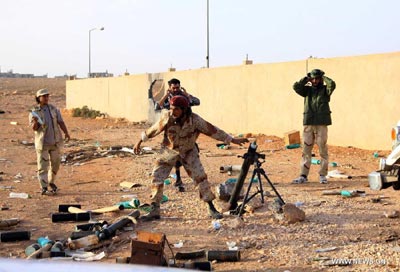
 From Monday onward the Libyan National Council (NTC) will be on its own to defend and protect its revolution. Much to its disappointment, the United Nations Security Council has unanimously voted to end its mandate for international military action in Libya from October 31, of which no-fly zone authorisation was the principal component. If the NTC diplomats haven't succeeded in getting extension of the UN mandate it is so not as much for lack of their pleadings as the growing international opinion that the no-fly zone authorization was grossly misused and the very civilians it was supposed to protect became its prime target. Since the no-fly zone accorded in March the Nato flew about 26,000 sorties into the Libyan airspace of which at least 9,600 were strike sorties. The losses on the ground were almost ousted all regime's defence installations and armour but these killed hundreds if not thousands non-combatants. That the air strikes continued long after the rebel forces had taken over Benghazi - which the North Atlantic Alliance was anxious to defend and had secured the UN authorization for that purpose - until the fall of Sirte and elimination of Colonel Qadhafi, the world body was certainly taken for a ride. Now that the New Libya transitional rulers have lost the Nato protective cover Libya's new rulers are confronted with huge, menacing challenges, given the frighteningly unpredictable aftermath of the revolution they inherited. For one, the new Libya suffers from leadership vacuum. Unlike Morocco, Tunisia and Egypt which by all standards are nation-states Libya is not; it's a country of tribes, argues Lee Kuan Yew, former prime minister of Singapore. As he explains, democracy cannot take root in a tribal society because it has no 'history of counting votes'. Since all through revolution Libyan tribes generally stood on the side of Colonel Qadhafi how they would respond to the new situation, nothing can be said with any degree of certainty. With a unifying effect of hostility to Qadhafi regime now gone with his removal from the scene there is not much in evidence to keep rebel forces united behind the NTC. A case in point is the lingering anarchy that has beset Somalia for the last two decades in the wake of ouster of dictator Muhammad Said Barre. No less unpredictable is the course the Islamic militancy that is said to have made clear that it would not take orders from the NTC - a challenge the NTC chief Mustafa Abdul-Jalil is trying to deflect by declaring that the new Libya would be governed under the Sharia. Obviously, by saying so he runs afoul of the broad thinking among his Western patrons, but what to do when the Islamic forces have strongly emerged also in the just-concluded election in Tunisia and the Muslim Brotherhood is likely to do well in Egyptian polls next month. One would like to say that in the times to come when Syria and Yemen are over with their revolutions the pro-Islam political forces will occupy substantial electoral space, requiring correction on the part of those who wrongly think Islam and democracy cannot co-exist and confuse political Islam with militant Islam. Admitted the revolution that toppled Colonel Qadhafi was popular not only in Libya but around the world and rightly received instant international recognition. But the way things have turned up on the ground in that country during the last fortnight or so this heroic feat on the part of Libyan masses seems to be losing its credibility rather quickly. Not only is the sincerity of the North Atlantic Alliance being questioned - the Alliance is said to be interested more in securing Libya's oil than its people's freedom, for which it exploited Security Council authorisation - the transitional leadership too didn't do enough to stop revenge killings. Not only are a number of mass graves containing remains of Qadhafi supporters discovered the NTC fighters are accused of committing war crimes for carrying out execution of the ousted dictator who some say was wounded by the Nato bombing carried out in violation of the UN mandate. In this disturbing backdrop the question is: will the Arab Spring survive this winter? Copyright Business Recorder, 2011





















Comments
Comments are closed for this article.