



Pharma MNC’s used to dominate the local market about a decade ago. Not so anymore! Helped in part by years of regulatory indifference, the tables have now been turned, with local pharmaceuticals controlling roughly two-thirds of the $3 billion plus market. Now, a local pharma firm, AGP Limited (AGPL), is heading to the stock market this month, in another sign of local pharma’s asserting their growing confidence.
Two existing investors of AGPL – OBS Pakistan and Muller & Phipps (M&P) – are set to offload 12.5 percent of AGPL’s paid-up capital (35 million ordinary shares @ face value of Rs10/share) at a floor price of Rs80/share. Institutional investors can bid for entire 35 million shares on offer. But successful bidders will be allocated only 75 percent of the available shares, with the remaining 25 percent later offered to retail investors at the strike price. The strike price will be determined through the Dutch auction method.
Readers can consult the AGPL Offer for Sale Document (OFSD) for detailed information on the IPO’s specifics and the bidding timelines and process. As this IPO also places the local pharma market in sharp focus, this column has some broad takeaways for the readers, instead of talking entirely about the firm, its 66-year lineage, and how AGPL came into being following a Rs7 billion acquisition by OBS Pakistan.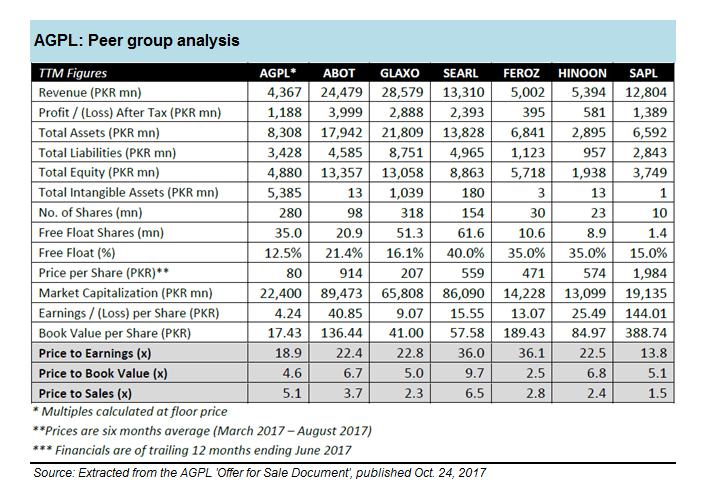
One, it increasingly seems that pharma’s dealing in generic drugs may have a better future in this market. Bulk of AGPL product portfolio –homegrown as well as owned rights of international brands – is generic in nature. Getz Pharma, which ranks among the top three pharma’s in Pakistan, has built its empire on generics. The 4P’s of marketing are relatively easier for generic drugs compared to non-generics.
Two, to grow bigger, small acquisitions may be the way to go. After AGPL acquisition, OBS Group joined the top ten pharma players locally, with revenues over Rs9 billion. AGPL holds exclusive licenses to manufacture several established generic drugs in Pakistan – so it doesn’t have to pay royalties or fees to its many overseas principals. AGPL’s top ten products provided roughly 71.5 percent of CY16 revenues of Rs4.2 billion – many of them are internationally-licensed and locally manufactured.
(OBS Pakistan currently holds 58 percent of AGPL shareholding. After divesting 20 million shares via the coming IPO, OBS shareholding will come to 51 percent).
Three, while the lack of drug pricing relief for fifteen years since 2001 crushed the spirit of pharma MNC’s, progressive local pharma’s survived and now stand ready to benefit from a more accommodating pricing regime in a market that has expanded at a 14 percent CAGR between 2011 and 2016. Pharma sales – which equate just about 1.2 percent of Pakistan’s GDP – can grow much as per capita health spending is languishing below $40. So, this is a growth market, and the likes of AGPL are out to claim their share.
And four, since local R&D lags international pace, expanding overseas partnerships in order to introduce new products may be the key to growing at home. AGPL’s one such partnership is with Mylan, a US-based pharma making generics and specialty drugs. As per the OFSD, AGPL is looking to increase Mylan business to Rs2 billion by 2022, with a focus on drugs related to female health, cancer, HIV, hepatitis, cardiovascular diseases and diabetes. Those areas constitute a roughly Rs50 billion market – about a sixth of the whole local pharmaceutical sales.
Now, coming back to the IPO, why does AGPL need to get listed? After all, its balance sheet looks healthy; revenues grew 12 percent each year since the 2014 acquisition; with optimized costs, net profits crossed billion-rupee mark in CY16, even as ROA stood a decent 13 percent and ROE 29 percent. Sure, management is planning to invest in modernization and expansion of its two plants, besides introduction of a nutraceuticals plant – but that doesn’t need the kind of money this IPO will cough up (about Rs3 bn).
It appears that the AGPL board is following through on agreements earlier made with investors in the OBS-led consortium to have a liquidity event soon. This IPO will surely provide a price discovery for those investors, who can, at some point later, offload their holdings in the secondary market. So, OBS Pakistan and M&P get to offload some of their holdings now.
Now on to the main question, how does the AGPL fare compare to the pack of listed pharma’s? At a strike price settling somewhere above the Rs80 floor price, AGPL can provide a foot in the door to retail investors wanting to get in on the pricey pharma market. But even at Rs80, the stock doesn’t look cheap (using the P/E multiple) when compared to the six pharma stocks used in the OFSD as a reference.
The OFSD used average stock price (six months ended August 2017); the EPS used was trailing twelve months (TTM) ended June 2017. Based on that (see the extracted table), the AGPL stock, at Rs80, looks cheaper than most pharma stocks, offering a 26 percent discount on average sector P/E of 25.6. The upside potential exists from that perspective – the stock will need to rise at least 36 percent before it breaches that sector average.
But that frame can be tricky to interpret, for many pharma stocks have also come down sharply in the months of September and October 2017. Using the earnings for TTM ending September 30, 2017 and closing price on October 31 for all of those stocks (except Ferozsons), the average sector P/E comes down to 17.18, which is 9 percent lower than AGPL’s P/E of 18.9 at Rs80/share. But the stock does look cheaper than Searle, which is in the same league of generic market as AGPL.








Comments
Comments are closed for this article.