



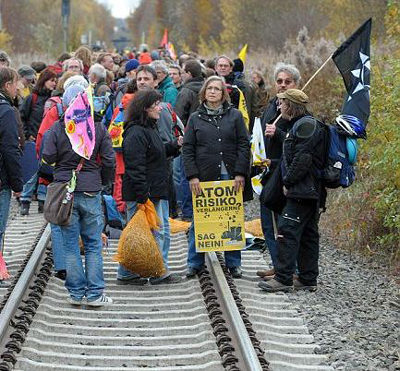
 DANNENBERG: Thousands of German anti-nuclear protesters mobilised Friday against a train carrying radioactive nuclear waste from France that has already sparked violent opposition.
The train with 11 wagons of reprocessed German nuclear waste crossed the Franco-German border early on Friday, stopping for more than five hours at the small German town of Neunkirchen to change engines. Protests had been peaceful, said officials.
It left Neunkirchen just after 4:00 pm (1500 GMT), but ground to a halt 100 kilometres further on at the town of Hassloch where protesters had blocked the line.
Police officers moved in to clear the tracks and the train continued its journey to its destination in the storage site in Gorleben, northeastern Germany.
Jochen Stay, a spokesman for the anti-nuclear group Ausgestrahlt (Irradiated), told NTV public television that there would be more attempts to block the train as it neared its destination in Gorleben, northeastern Germany.
"There will of course be action taken to block it when it approaches," he said from Dannenberg, some 20 kilometres (12 miles) from Gorleben, where the waste will be stored.
"People will block the tracks and the roads," he warned.
"But we do not want this to escalate. We want the police to act sensibly and appropriately with people."
Television pictures showed activists removing ballast stones from under the tracks in a bid to slow the train's progress.
"It's not about putting the convoy in danger, it's about slowing it down for as long as possible or, even better, stopping it altogether," said Hanna Spiegel from activist group "Castor Schottern".
Late Thursday, police had deployed water cannon and tear gas against a few hundred protesters who tried to block the road near Gorleben. There were a handful of arrests and light injuries on both sides.
But the police methods angered the protesters. "The police reacted in a completely disproportionate manner. We call on them to use other methods," said one demonstrator, Kerstin Rudek.
There were also isolated outbreaks of violence on Friday. An AFP photographer in Metzingen, also near Gorleben, said around 10 masked people had attacked police with bricks and smoke bombs, managing to escape arrest.
Police also said unknown assailants had set fire to two patrol cars.
Activists claimed on their website that journalists had been among the victims of police violence.
Journalists at the scene said police units had scuffled with demonstrators and reporters, but there were no reports of casualties.
It was the second consecutive night of violence there.
In November last year, at the height of a furious debate over nuclear power in Germany, tens of thousands turned out to protest against the shipment, managing to delay the train by a whole day.
Activists played a sometimes violent game of cat-and-mouse with police. Stunts included sit-ins, abseiling from bridges into the train's path, removing ballast supporting the tracks -- even shepherding sheep and goats into the convoy's way.
Since then, however, in the wake of March's nuclear disaster in Fukushima, Japan, the German government has decided to abandon atomic power. This appears to have dampened the protests.
Organisers have said they were expecting some 20,000 people to protest against the train, fewer than half the number that turned out this time last year. Opposing them was a similar number of police officers.
But if smaller in number, the protesters were at least determined.
On Wednesday, the train ran into violent protests soon after leaving its yard operated, by French nuclear giant Areva in Valognes, in Normandy, as it began its 1,100-kilometre journey to Gorleben.
Protected by several hundred riot police, the train stopped overnight Thursday at the station of Remilly, just outside the town of Metz in eastern France. It moved out of there at around 9:00 am (0800 GMT) on Friday.
In June, Chancellor Angela Merkel's government agreed to halt all German reactors by 2022, forcing energy suppliers to close the plants.



















Comments
Comments are closed for this article.