



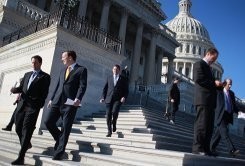
 WASHINGTON: Lawmakers handpicked to make historic reductions to swollen US government deficits were poised Monday to admit failure, setting the stage for an angry election-year battle over red ink.
The 12-member "supercommittee" had been tasked with finding $1.2 trillion in savings over 10 years but failed to bridge yawning partisan gaps over raising taxes on the rich and slicing into cherished social programs.
"I wouldn't be optimistic; I don't want to create any false hope here," Republican Senator Jon Kyl told Fox News television amid widespread expectations that the panel would call it quits after US financial markets closed.
With that looming failure set to trigger cuts of a half-trillion dollars each to military spending and the social safety net come January 2013, lawmakers vowed to take their case to the voters in November 2012 elections.
"If we fail to do this today, it will define 2012 going forward," Democratic Senator John Kerry, who sat on the special panel and serves on the Senate Finance Committee, told MSNBC television.
US President Barack Obama, who just returned from a nine-day tour of Asia, refused to comment on the impasse, twice ignoring journalists' questions about it at the signing of a law promoting jobs for veterans.
However, without referring directly to the work of the supercommittee, he said he was pleased "both parties came together" to pass the veterans jobs bill.
"It is important to note that in addition to our veterans, there are millions of other Americans who are still looking for work right now," he said.
But Obama also has made clear he will campaign for a second term in part by slamming Republicans over their refusal to agree to tax hikes on the wealthy as part of any deficit-cutting plan.
White House spokesman Jay Carney said Congress still has the ability to act on the deficit, because the automatic budget cuts do not take effect for another year.
"Instead of pointing fingers and playing the blame game, Congress should act, fulfill its responsibility," he told reporters.
"In the end, it comes down to a decision by Republicans that they are unwilling to do what the American people say they believe should be done, which is ask the very wealthiest Americans, millionaires and billionaires, to pay a little bit extra so that we can achieve the kind of deficit reduction and long-term debt control that we need."
Democrats were poised to wage a year-end fight to extend jobless benefits and a cut in a payroll tax, measures designed ease worker pain amid unemployment over nine percent and spur the sluggish economy with consumer spending.
And Republican lawmakers were pushing to repeal automatic defense spending cuts, citing warnings from Defense Secretary Leon Panetta that they will leave the military slower, weaker, and smaller than at any time since World War II.
"There will be efforts to find offsets or other ways to reduce spending so that those cuts in defense spending don't occur," Kyl told CNBC.
Congressional stalemate over how to tackle America's $15 trillion national debt added to global economic concerns dominated by the financial woes that are threatening to unravel Europe's cherished monetary union.
The current gridlock recalled partisan infighting back in July and August over raising the debt ceiling.
Congress finally reached an 11th hour deal, but not before blue chip stocks on Wall Street plunged more than 2,000 points and Standard & Poor's cut America's sterling triple-A credit rating.
Members of the panel vowed to keep working.
"I am committed to ensuring that the American people get the deficit reduction that they were promised," said Texas congressman Jeb Hensarling, the Republican co-chair of the panel.
"Under the law, Congress will have 13 months to do that in a smarter, more prudent fashion. And I plan to be part of the process."



















Comments
Comments are closed for this article.