



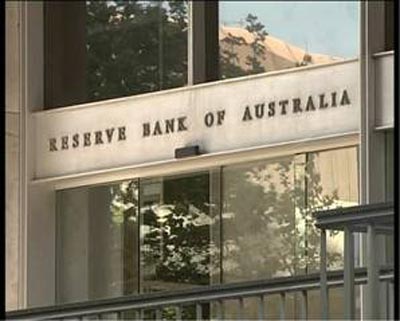
 SYDNEY: Australia's central bank on Friday trimmed its outlook for economic growth and slashed forecasts for inflation, warning the biggest threat to the local economy was Europe's sovereign debt and banking crisis.
In a 70-page report, the Reserve Bank of Australia (RBA), gave no hint on when it might move interest rates again, having on Tuesday eased policy for the first time in over two years.
"The Board judged that a more neutral stance of monetary policy was now appropriate given that, over the period ahead, inflation was likely to be consistent with the medium-term target and that economic growth remained moderate," the statement said.
At the Nov. 1 policy meeting, the RBA reduced the cash rate to 4.50 percent from 4.75 percent -- the first cut since April 2009. Interbank futures imply a nearly 100 percent chance of a follow-up rate cut in December.
"They didn't confirm that we're at neutral yet. By our calculations, we still think we're a quarter point above neutral," said Su-Lin Ong, senior economist at RBC Capital Markets.
"They were suitably vague to give themselves maximum policy flexibility, which is fair enough given what is a very fluid global environment."
Indeed, news on Thursday that Greece would abandon a proposed referendum that could threaten to unravel a euro zone bailout deal gave markets a shot in the arm.
The Australian dollar , which barely reacted to the RBA statement, stayed bid at $1.0400, having jumped about two cents overnight on the Greek news.
LESS UPBEAT
The RBA now expects the local economy to grow by 2.75 percent for 2011, versus 3.25 percent in an earlier forecast. Underscoring great uncertainty in the outlook, the RBA gave a range of 3.0-3.5 percent for its end-2012 growth forecast and 3-4 percent for 2013. This compared with the August call for 3.75 percent growth in both 2012 and 2013.
"The largest risk to these forecasts is the sovereign debt and banking problems in the euro area. The Bank's central scenario continues to be one in which the European authorities do enough to avert a disaster, but are not able to avoid periodic bouts of considerable uncertainty and volatility," the RBA said.
"Under this central scenario, confidence can be expected to remain weak and growth in the euro area is likely to remain subdued."
The central bank also cut its underlying inflation forecast to 2.5 percent for the whole of 2011, from an earlier estimate of 3.25 percent.
It saw underlying inflation at 2.5 percent for 2012, excluding the impact of a carbon tax to be introduced in July, and between 2.5 and 3.0 percent for 2013. That compared with previous forecasts of 3.0 percent for 2012 and 3.25 percent for 2013.
It expected the carbon tax to add around 0.25 percentage points to underlying inflation over a year.
The abrupt change in the central bank's inflation view came after official data was revised down following an overhaul of the key report by the government's statistics office.
"This general outlook for inflation is condition on aggregate wage growth remaining at around its current pace. It is also condition on a pick-up in productivity growth as firms respond to competitive pressures and take advantage of lower prices for capital goods," the RBA added.
"Aggregate wage growth has been relatively firm, although the Bank's liaison suggests that the likelihood of a significant acceleration of aggregate labour costs in the near term has lessened."
In cutting its growth forecasts, the RBA noted a drop in the price of iron ore, one of the nation's biggest export earners. It said increased global supply and a slowdown in global steel production, including in China were probably responsible for the decline. However, it noted that overall commodity prices were still at high levels.
The central bank said mining and related industries were still growing strongly, with investment in the resources sector set to increase very strongly over the next few years.
It added the nation's terms of trade had reached the highest in at least 140 years in the third quarter, boosting both national income and investment.
But the central bank again pointed to a strong local currency and changes in household spending and borrowing behaviour as factors hurting other sectors of the economy.
"At its future meetings, the Board will continue to set monetary policy so that it is consistent with achieving sustainable growth and 2-3 percent inflation over time," the statement said.






















Comments
Comments are closed for this article.