



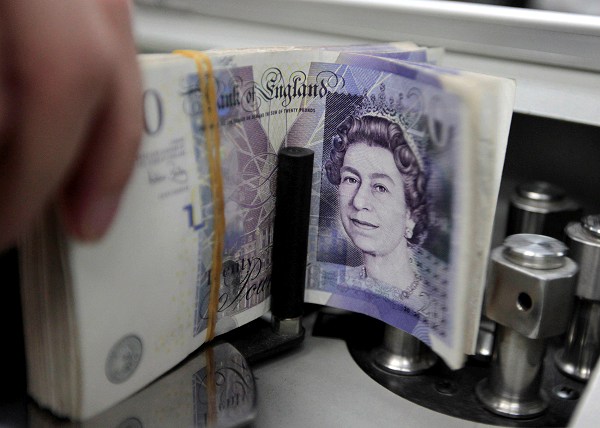
 LONDON: Sterling rose briefly on Wednesday after data showed claims for unemployment benefit in Britain unexpectedly fell in July, before expectations of easier monetary policy returned to the fore and prompted a bout of selling.
Claimants fell by 8,600 in the month, compared with an increase of 900 in June, the Office for National Statistics said. Economists had expected the number of benefit claimants - considered to be a potential early warning sign of an economic downturn - to rise by 9,500.
Britain's jobless rate held steady in the three months to June at 4.9 percent, as expected, while wage growth in the April-June period picked up slightly.
Sterling rose to $1.3058 immediately after the data, up 0.1 percent on the day, and firmer than $1.3029 before the data was released. It slid back to $1.3010 by 0910 GMT, down 0.3 percent on the day.
The euro eased to 86.35 pence from 86.47 pence after the data. The single currency then recovered and was last trading 0.15 percent higher at 86.56 pence, approaching a three-year high of 87.245 pence struck on Tuesday.
"At this point, the data is comforting but we still need more time," said Tobias Davis, head of corporate treasury sales at Western Union. "Sterling/dollar strength was shortlived with technicals supporting a renewed bout of selling around the $1.3040-50 mark."
Analysts said that in a market where speculators held record high bets against sterling, stronger-than-expected data is providing an excuse to some to trim positions. But a rally is likely to be fleeting, given the subdued outlook for the economy and rates as a whole.
Two weeks ago, the Bank of England cut interest rates to record lows and announced a bond buying programme. Analysts expect Britain's central bank to relax policy further in coming months as the economy slows further.
Sterling had been bolstered on Tuesday by slightly better-than-anticipated inflation readings. But analysts said higher inflation readings in the coming months would not change the BoE's monetary policy outlook.
"The BoE has made it clear that it can tolerate an inflation overshoot and will remain very accommodative, supporting our $1.24 target for sterling/dollar," Morgan Stanley analysts said in a note.




















Comments
Comments are closed for this article.