



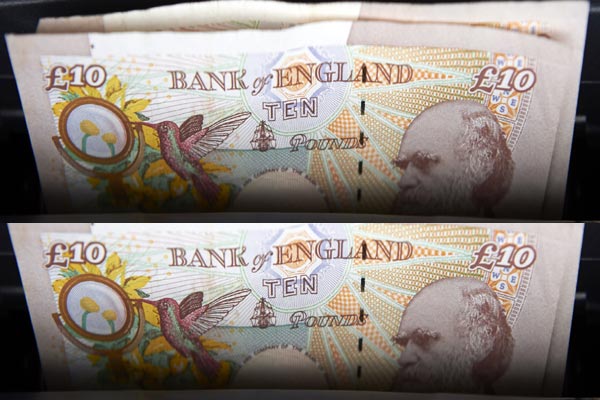
 LONDON: Sterling rose against the euro and recovered all of the day's losses versus a broadly stronger dollar on Wednesday after a Bank of England survey showed no clear evidence of a slowing of economic activity after last month's Brexit vote.
The survey reported signs that demand for credit was easing and that there were lower expectations for investment spending, but it also said the majority of companies did not expect any near-term impact on capital spending from the vote.
That argued against the main narrative that has weakened sterling since the June 23 vote to leave the European Union: that the economy would tank in the second half of this year, forcing a sharp easing of monetary policy by the Bank of England.
"This data does look like a positive for sterling," said BNP Paribas strategist Michael Sneyd. "It plays into that suspicion that things may not be bad as we feared."
In the run-up to last month's vote, Britain's jobless rate fell to its lowest level since 2005, a separate report from the Office for National Statistics showed on Wednesday.
Sneyd also said BNP's own STEER positioning indicator shows bets on further sterling weakness are extremely stretched, and that its analysis, even accounting for a large deterioration of Britain's balance of payments, shows fair value for the pound is around $1.35.
Sterling, which fell 1 percent on Tuesday, rose a full cent to $1.3186 after the BoE survey was published, gaining more than half a percent on the day. It rose 0.8 percent to 83.48 pence per euro.
"We certainly think that some of the gloom has been overplayed," Andrew Goodwin, lead UK economist at independent research house Oxford Economics, told Reuters' Global Markets Forum.
"The consensus for 2017 GDP growth is currently hovering just above zero. Our modelling suggests it would take a hit to confidence which is two thirds of that seen in the global financial crisis to hit growth that much."
FISCAL HANDS-OFF
The pound saw its best performance since 2009 last week as many of those who had sold in the currency's 14 percent slide after the referendum took some of the profit they had earned. It also gained around a third of a percent on Monday and is more than 3 cents above the 31-year low it hit after the referendum.
But a 1 percent fall after higher than expected inflation data on Tuesday was more evidence that investors will tend to sell any rise in the pound in expectation that sooner or later the economy will slow substantially.
Some analysts said markets had also taken badly new finance minister Philip Hammond's declaration on Tuesday that any immediate response to the economic challenges posed by Britain's vote to leave the bloc would come only from the BoE.
Hammond said he would not unveil new fiscal plans until the autumn.
"A substantial loosening of fiscal policy - and a major round of investment in creaking infrastructure - is the obvious response to the UK's self-inflicted shock," Societe Generale strategist Kit Juckes said.
"To choose to try and offset the economic hit with even looser monetary policy - rate cuts and more QE - will drive the pound significantly lower. Before long it will deliver new lows against the dollar for sure, and perhaps against the euro too."
Next up for sterling watchers is Prime Minister Theresa May's first weekly question time in parliament, before she flies to Berlin to meet with German leader Angela Merkel.
Flash PMI surveys of company purchasing managers on Friday will offer more on the immediate economic fallout from the vote.
"It doesn't seem as though markets have taken (the referendum) as badly as many were predicting but sterling still seems to be fairly heavy," said Paul Bednarczyk, Head of research at 4CAST. "Friday is not going to be pretty."

























Comments
Comments are closed for this article.