



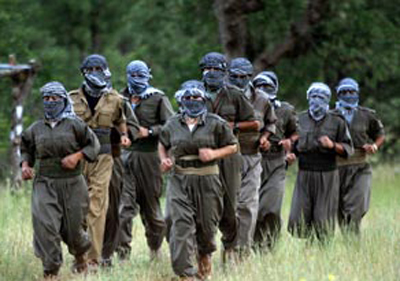
 ARBIL: Iraq's Kurds are caught between ethnic ties to Kurdish rebels based in the autonomous Kurdistan region, and heavy pressure by Iran and Turkey, which aim to eradicate the rebels' bases.
Iran launched major attacks against rebels of the Party of Free Life of Kurdistan (PJAK) in July, targeting their rear-bases in Iraqi Kurdistan along the Iran-Iraq border, and shelling the area for weeks.
And in mid-August, Turkey began its own campaign of shelling and air raids against bases of the Kurdistan Workers' Party (PKK) in Kurdistan, which has ties with the PJAK.
"We are in a difficult situation because there are two countries (Iran and Turkey) telling us to control our borders so there will be no problems," Massud Barzani, president of the Kurdistan region in north Iraq, said on Tuesday during a meeting in Arbil with Kurdistan representatives based abroad.
But "we are afraid to send forces to the borders for fear of a Kurdish-Kurdish war," he said.
"The PKK and the PJAK are not taking the situation of the Kurdistan region into their considerations," Barzani said. "I call on the two sides to stop the idea of getting their rights through military means."
"We are now working with (Iraqi) President Jalal Talabani, Turkey, Iran, the PJAK and the PKK, and we are about to reach a solution to stop the war," Barzani said.
"If we succeed, it would be a great service to the people of Kurdistan, Iran and Turkey, and if not, we will not be part of the war."
It is undoubtedly difficult for Barzani -- a former guerrilla who is the son of another guerrilla who fought 20 years ago for Kurdistan's autonomy -- to not feel sympathy for Kurds across the border in Iran and Turkey.
But for Iran and Turkey, the PJAK and the PKK are thorns in their sides.
"There is coordination and cooperation between Turkey and Iran" against the Kurdish rebels, said Yussef Koran, an adviser to the political bureau of Talabani's Patriotic Union of Kurdistan party.
"I think there was a green light from Turkey to Iran to put pressure on PJAK fighters," he said.
Koran said that there were two reasons for the recent strikes on the Kurdish groups, the first of which "is the increasing activity of PJAK fighters inside Iran."
"The other reason is the latest events in some areas and the collapse of some regimes (in the region) and the popular revolutions, which have made some countries afraid of the presence of armed groups on their borders," he said.
"If the attacks do not stop, the battle will continue, because Turkey and Iran are insisting on stopping the activities of these armed groups."
The PKK took up arms in Kurdish-majority southeast Turkey in 1984, sparking a conflict that has so far claimed about 45,000 lives.
The PJAK was founded in 2004 and has engaged in periodic fighting with Iranian forces.
Political analyst Rahman Gharib said he believes that Iran is aiming to take the focus off internal issues and move it to border issues and problems with the PJAK.
He also said he thinks the conflict will likely continue until there is a negotiated solution.
"I think the bombings will continue until (the issue) is solved through negotiations," he said.
The other option is a military defeat for the PJAK, "which will be difficult due to guerrilla tactics of the party" and the tough terrain in which its fighters are based, making operations against them difficult, he said.
But until a solution is reached, Kurdistan residents will continue to suffer.
Hassan Abdullah, the mayor of the Qalat Dizah area near the Iranian border, said that 330 families have been displaced and dozens of houses destroyed since the Iranian shelling began.
Turkey has also bombed the area, including a late-August airstrike that killed a family of seven in the town of Kortek.
Copyright AFP (Agence France-Presse), 2011














Comments
Comments are closed for this article.