


Sarkozy, Cameron discuss debt crisis

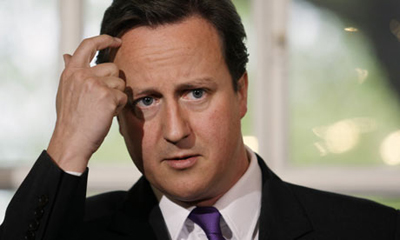 BRUSSELS: British Prime Minister David Cameron and French President Nicolas Sarkozy discussed the eurozone and US debt crises in telephone talks Saturday, a Downing Street spokesman said.
Cameron, currently on holiday in Italy, and Sarkozy spoke to each other for around 30-minutes, the French president's office said.
"Both agreed the importance of working together, monitoring the situation closely and keeping in contact over the coming days," the Downing Street spokesman added.
Barely two weeks after a special summit held to offer a definitive fix to Europe's rumbling debt crisis, the market panic biting the single currency is whipping eurozone leaders back into action.
With markets now homing in on government debt rather than banks, further turbulence lies ahead following Friday's historic US ratings downgrade by Standard & Poor's.
Italy, which along with other major economic power Spain faces threats of being engulfed in euro turbulence, is raising the possiblity of G7 ministerial talks "in a few days" to address the burgeoning crisis -- with Britain, Canada, France, Germany, Japan and the United States.
G7 nations for example could attempt to coordinate central bank action at talks which unconfirmed reports said might be held by tele-conference at the weekend.
Europe's economic affairs commissioner Olli Rehn insisted Friday that input from G7 and G20 partners will be of "critical importance" in efforts to resolve spiralling chaos.
Hundreds of billions of dollars in value were lost this week during a global stocks sell-off sparked by eurozone debt concerns, enhanced by prospects of a slowdown in the US economy.
Across Europe, leaders broke vacation to tighten ranks and speed up work on new debt rescue machinery as alarm spread of renewed global recession.
Italian Prime Minister Silvio Berlusconi said Saturday his government would be hard at work through the summer break and lawmakers called back early to rush through austerity measures, including a constitutional amendment to force governments to keep balanced budgets.
Italy's vow to accelerate deficit cuts won needed approval from the European Central Bank (ECB), which is to start buying up Italian bonds from Monday after Italian shares plunged over 13 percent last week and investors worried about slow growth sold off their bonds.
Seeking to soothe tension after contagion even began to threaten France on the bond market, the EU's Rehn rushed back to Brussels and announced he will propose new, common "Euro-bonds" next month.
Until now taboo, these would allow eurozone governments to raise funds needed to run their countries based on guarantees from the entire 17-country bloc of 332 million people.
The Commission, the ECB and the European Financial Stability Facility (EFSF) are each "working night and day to put flesh on the bones" of an agreement struck at the eurozone's July 21 summit.
Under the July accord, leaders of the 17 nations sharing the currency agreed a second bailout for Greece in just over a year, this time with a one-off participation by the private sector.
But they also fleshed out a euro crisis response, agreeing to beef up the size of a rescue pot -- the 440-billion-euro ($625 billion) EFSF -- as well as its powers.
The new muscle would enable the EFSF to step in to help troubled banks and buy back debt on secondary markets, a first step to building something akin to a European version of the International Monetary Fund.
"Such a comprehensive, detailed and technically complex agreement requires time to implement," Rehn said Friday.
"It would have been fantastic if the agreement had been fully operational on 22 July," Rehn said. "But this was of course impossible".
If national parliaments ratify the changes as swiftly as hoped, the euro's new financial armour should be in place "by early September."
"This is the necessary -- and legitimate -- price to pay for living in democracies," Rehn said.
But parliaments in some northern nations, where taxpayers are loathe to pay bills for the likes of Greece, may balk at moves to ramp up the rescue pot in size or scope.
And there were signs of discord Saturday when German Finance Minister Philipp Roesler questioned calls this week from European Commission president Jose Manuel Barroso for a reassessment of the eurozone rescue fund.
In an interview with German weekly Focus, due to be published Sunday, Roseler said: "It is not clear how reopening the debate just two weeks after the summit can lead to calming the markets".
Copyright AFP (Agence France-Presse), 2011

















Comments
Comments are closed for this article.