



Back when the Chaudhrys of Gujrat were ruling Punjab (2002-07), a modern mass transit system was planned with special coverage of major commercial and residential corridors in a phased manner. The plan was to have four lines, with 7 interchange stations of independent transit systems connecting the city.
Green line is already in place (the 27-km long Metro Bus System {MBS} route) though in a different shape from initial plans. Then Punjab government under Chaudhry Pervaiz Elahi had spent billions of rupees on detailed engineering studies and designs for an underground train system on the green line. But by the time of implementation, he was no longer in power.
Shahbaz Sharifs team rather implemented the MBS project which, according to a senior architect, was a suboptimal solution. Partisan critics suggest that Sharif did not want the projects credit to go to Elahi and PML-Q. So he replaced the train with bus.
In its second consecutive tenure, PML-N is brave enough to execute the "Orange Line" metro train system, as per earlier plans of the PML-Q government. The route will be 27-km long, connecting Lahore railway station Chauburji and a few other congested areas.
But, the projects cost is exorbitant. Unlike Lahore MBS, the Orange Line projects cost was too high for the government to execute from the development budget. The Rs30 billion MBS spending was possible by compromising projects across the province. But, there is no way Punjab government can raise Rs160 billion internally within two years on a train system facilitating one-fourth of Lahore.
Thats why the Punjab government is building this $1.6 billion project in 27 months with the loan of Chinese counterpart. The project is expected to start by December this year and is to be completed by March 2017.
BR Research attempted to find the projects operational feasibility and came up with a break even fare per passenger at Rs171 as compared to Rs65 for MBS. By keeping the ticket at same price of that of metro bus (Rs20), annual subsidy of train system will be a whopping Rs14 billion in todays value. On the other hand, government is spending mere Rs2-2.5 billion per year on metro bus from its pocket.
Orange lines feasibility report prepared in 2005-6 assumed that 250,000 passengers, on an average, will travel on the train in 2015 and 495,000 by 2025. The latter is too optimistic in an experts view while the former is a fair assumption given that the similar-length metro bus is now being used by 150,000 passengers daily. Hence, we take 250,000 passengers per day in our calculations.
The operational and maintenance, cost in that report was computed at Rs1.7 billion in 2005-06 with electricity cost at 6.5 per kWh. Today, power cost has escalated by almost three times as we assumed Rs18 per unit in our model while we doubled (in line with inflation) staff, maintenance and other cost elements--estimates are now revised up to Rs3.9 billion or Rs43 per passenger.
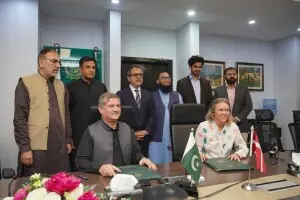
Thats not too much, but thats not the end of the story, as major chunk of cost would be financial as $1.6 billion project is planned to be financed and executed by the Chinese. The negotiations are going on; Punjab government is trying to have most of that loan from the Chinese counterpart and while the latters wish is to have it on commercial basis.
The government-to-government loans with China are usually priced in the range of 1-3 percent. Then there are preferential credits extended with quasi-fiscal arrangement of sovereign guarantees and these hover around 2-4.5 percent, and commercial loans would be nothing less than 7-8 percent.
Mind, you the Chinese government has never financed that big amount of money in a year on any project in Pakistan before--a maximum$100 million or so was lent in a year. But, Punjab government is eyeing a loan worth 80 percent of project cost from the government. We have assumed a mix of three types of loans and have taken interest rates conservatively at 4 percent with 20 years to repay. This will result in debt repayment of Rs11.7 billion per year at a parity of Rs100 per dollar.
In case of no subsidy, every passenger has to pay Rs128 per trip to repay the loans alone and by adding operational cost of Rs43 per passenger, cost is estimated at Rs171. Now, by charging similar fair as that of MBS (Rs20), government ought to pay Rs14 billion in subsidy.
Since this system is going to be better than that of MBS in terms of luxury, marginal customers using car or motorbike can switch to train system and higher rates can be charged, but by doing so lower class customers may not use it. We assumed if the government charged Rs50 per trip, it may lose 50,000 passengers per day and the subsidy element will reduce to Rs12 billion.







Comments
Comments are closed for this article.