


High costs, mixed record for US space shuttle

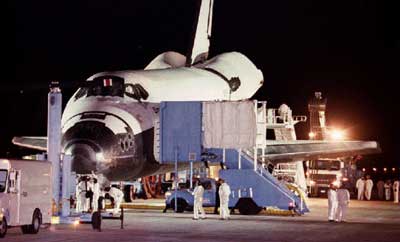 WASHINGTON: The US space shuttle is the most complex and costly flying machine ever built, and although it helped build a pioneering space outpost it also kept Americans confined to low Earth orbit for 30 years.
As the shuttle program prepares to retire after Atlantis takes off toward the International Space Station for a final time in July, the legacy recounted in history books is likely to show both successes and failures, experts say.
"I think the shuttle program record is mixed," John Logsdon, external adviser to the White House and former head of the Space Policy Institute George Washington University, told AFP.
"The highlight of the shuttle program was demonstrating the ability of astronauts to do useful things in space," he said.
"The real failure of the shuttle was to live up to its original promises of being affordable and routine."
The three-decade space shuttle program, NASA's most enduring project in its 50 years of existence, cost a total of $208 billion (in 2010 dollars) compared to $151 billion spent on Apollo which put Americans on the moon in 1969.
NASA's chief historian Bill Barry recalled that the space shuttle's initial aim, when it was formally launched by president Richard Nixon in 1972, was to make spaceflight a possibility for common people, not just the educated elite.
"The original goal... was to make flight into space less expensive, easier and not just a province of highly trained and experienced military test pilots but allow average people go and live in space," said Barry.
But the White House kept pressure on NASA to lower costs as the space agency was designing the shuttle, a process Barry suggests actually drove prices up over the long-term.
"The program was never funded to the level that was expected. Design compromises were made as it was being built. It was never inexpensive or easy to operate," he said.
Nevertheless, the shuttle went on help build a revolutionary orbiting outpost for the world's scientists.
Even though it suffered two major disasters when the shuttles Challenger and Columbia exploded in mid-air in 1986 and 2003, the overall memory of the program is likely to be a positive one, Barry said.
"I think future historians will see the shuttle as a spectacular program," Barry said.
"We have done amazing things with the shuttle, the space station, repairs on orbit, Hubble," he said, referring to the Hubble Space Telescope, brought into orbit by Atlantis in 1990 and which has led to major advances in astronomy.
"It's a big success," he said, one that has made its way into the popular imagination and inspired the 1979 James Bond film "Moonraker" even before the shuttle took off on its maiden voyage in 1981.
"If you ask average Americans and even (people) around the world to identify how a space ship looks, a lot of school kids will draw something that looks like a space shuttle."
Looking back, the key downfall of the space shuttle program may have been the amount of attention paid to it by NASA for so many years, according to Logsdon.
"I think it was a mistake made back in 1970s to build the program totally around the shuttle -- at least the human space program totally around the shuttle," he said.
Copyright APP (Associated Press of Pakistan), 2011
Copyright AFP (Agence France-Presse), 2011























Comments
Comments are closed for this article.