



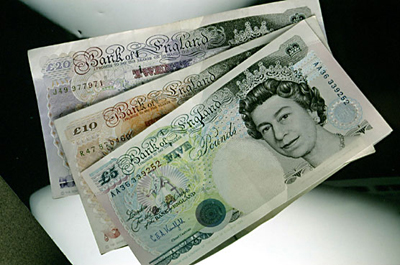
 LONDON: Sterling hit an eight-week low against the dollar and fell against the euro on Friday as investors moved towards traditionally lower-yielding safe haven currencies after the United States authorised air strikes against militants in Iraq.
A bigger-than-expected British trade deficit also weighed modestly on the currency, which is heading for its fifth successive week of losses against the dollar - the worst run in over two years.
But it was clear that the main driver across financial markets was risk aversion, with shares tumbling and oil and gold jumping. In the currency market, investors sought refuge in the traditional security of the yen and Swiss franc, as well as the euro, which some say is also emerging as a safe-haven play.
U.S. President Barack Obama said in an address on Thursday that he had authorised "targeted" use of air power to blunt the onslaught of Islamist militants in northern Iraq and to protect U.S. personnel.
Israel launched air strikes on the Gaza Strip on Friday in response to Palestinian rockets fired after Egyptian-mediated talks failed to extend a 72-hour truce in the month-long war.
Fighting continued in east Ukraine and Russia banned imports of most food from the West in retaliation for sanctions over the conflict there.
"Investors are fearful about the rise in geopolitical tensions across the board," said Lee Hardman, a currency strategist at the Bank of Tokyo Mitsubishi UFJ in London.
"Generally during these periods, the more traditional safe-haven currencies like the yen outperform the more high-risk currencies - the pound is generally seen as more high-risk."
Sterling fell to a trough of $1.6796, its lowest since June 12, and was last trading at $1.6800, down 0.2 percent on the day.
The euro gained widely and was up 0.4 percent against the pound at 79.69 pence.
The euro had fallen against the pound on Thursday after European Central Bank President Mario Draghi said the fundamentals for the euro to weaken had improved, stressing the continued diverging path of euro zone and U.S. monetary policy. Some analysts interpreted that as talking down the euro.
"The fact that the ECB ... intervened when the euro was ... approaching the $1.40 mark in the spring could have been accepted by the bona fide observer as what it was made out to be by the ECB: an intervention necessitated by an appreciating euro putting pressure on inflation," said Commerzbank analysts.
"Now that the euro is trading in the mid-$1.33 area it does come as a surprise that Draghi has not returned to the old 'we don't comment on exchange rates'."


























Comments
Comments are closed for this article.