


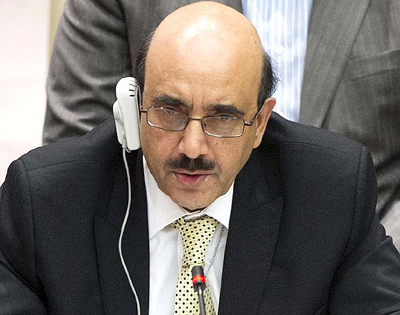
 UNITED NATIONS: Pakistan told the UN Security Council Wednesday that drone strikes against suspected militants not only caused civilian casualties but also adversely affected Islamabad's efforts to conduct dialogue aimed at eliminating extremism and terrorism.
In his comments on the work of the 15-nation Council's anti-terrorism committees, Ambassador Masood Khan said Pakistan's counter-terrorism strategy was based on Three D's: deterrence, development and dialogue.
The Pakistani envoy said dialogue must be allowed to continue according to national priorities. "Those who are willing to renounce violence should be brought back to societal and national mainstreams," he said.
"The use of drones results in casualties of innocent men, women and children leading to disaffection, alienation, and psycho-social trauma among the population centers hit by drones," Masood Khan said as he called for an end to strikes by remotely controlled aircraft. "It is also detrimental to our efforts to conduct dialogue and eliminate extremism and terrorism," he added.
"The war against terrorism must be prosecuted within the framework of international law."
The Pakistani envoy went on to say that terrorists had adapted to new conditions and their tactics now took more sinister forms, utilizing new technologies and the Internet.
Therefore, he said counter-terrorism efforts also needed to be adaptable.
Underscoring the need to address the root causes of terrorism, Masood Khan said that deprivation, unresolved conflicts and stereotyping created conditions that supported the drift to the phenomenon.
No religion, ethnicity, or culture or society should be associated with terrorism, he said, adding that the universal norm of zero tolerance to terrorism should be strengthened.
The Phenomenon of individuals radicalized by extremist websites was rampant, and terrorists now use electronic safe havens to host websites for inspiration and training, the ambassador said.























Comments
Comments are closed for this article.