



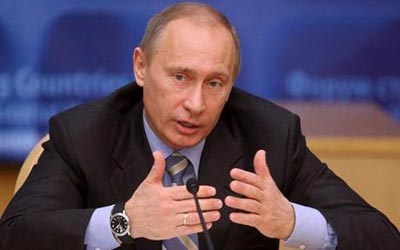
 PENZA: Russian Prime Minister Vladimir Putin criticised Japan on Saturday for its "slow" reaction to its nuclear disaster and for building nuclear reactors in earthquake-prone zones.
Japan's Fukushima Daiichi nuclear reactor complex was hit by a massive earthquake and tsunami on March 11, touching off the world's worst nuclear crisis since Chernobyl in 1986 as radiation from damaged reactors spewed into the surroundings.
Putin said Japan should have promptly brought electricity storage devices such as batteries and accumulators to the complex to help pump in water to cool stricken reactors.
"But they didn't manage to do that on time, and then problems erupted," he said, speaking at a Russian nuclear industry meeting in the Volga region city of Penza, 630 km (390 miles) southeast of Moscow.
Putin also questioned Japan's decision to build nuclear power stations in areas vulnerable to earthquakes.
"As far as the Japanese are concerned, they are in a unique situation out there. I don't know why, it is their choice, but they build (reactors) in seismically dangerous zones..., which are everywhere there," he said.
Russian officials previously suggested Japan might be exaggerating the scope of the crisis to reduce the liabilities of insurance companies. President Dmitry Medvedev has called for new world rules on nuclear plant safety to be adopted.
Japan's response to the crisis, including the dumping of contaminated water into the sea, raised an outcry in South Korea and public concern in China. Tokyo offered apologies over perceptions that it had not given enough warning and explanation to neighbours about its steps to contain the crisis.
Japanese Prime Minister Naoto Kan was publicly berated over his government's slow response when he visited one evacuation centre in the devastated region earlier this month.
Almost all of Russia's 32 working nuclear power reactors were built during the Soviet era, when the Chernobyl disaster occurred. But Putin said on Saturday that Russian reactors were secured by "modern methods of protection".
Moscow said after Japan's disaster that it had no intention of curbing its drive for more nuclear power at home and for export, unlike several countries including Germany.
Russia plans to spend billions of dollars over the next decade on building new reactors to reduce reliance on the oil and gas that fuel its $1.5 trillion economy.
As the Japanese disaster unfolded, Russia increased shipments of liquefied natural gas to Japan and also offered to bolster coal and electricity supplies to its neighbour, separated by a 40-km (25-mile)-wide Pacific Ocean channel.
Putin earlier said the nuclear accident in Japan and unrest in the Arab world would boost global demand for oil and gas.

















Comments
Comments are closed for this article.