



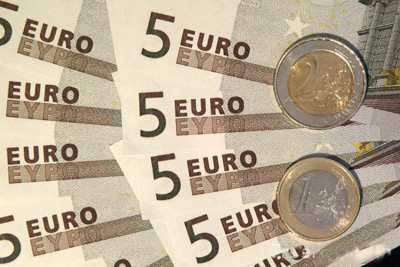
 NEW YORK: The euro hit a 16-month high against the dollar on Tuesday, with no respite in sight seen for the greenback if the US Federal Reserve keeps monetary policy accommodative.
The Federal Open Market Committee, the Fed's policy making arm, starts its two-day meeting on Tuesday. The post-meeting news conference by Fed Chairman Ben Bernanke on Wednesday -- the first regularly scheduled news briefing by a Fed chief in the US central bank's 97-year history -- will be closely watched to see how the Fed plans to exit from its ultra-loose policy.
"Bernanke is likely to acknowledge that dollar policy is set by the Treasury, but the Fed takes it into account in terms of its impact on inflation and growth and that it is part of the transmission mechanism of monetary policy," said Marc Chandler, global head of currency strategy at Brown Brothers Harriman in New York.
"Investors are unlikely to learn from Bernanke when the Fed will tighten as it is doubtful that he himself knows."
The Fed is expected to say it will stick to its plan to complete a $600 billion bond-buying program in June.
If the Fed surprises the market and turns more hawkish it will pose a risk to the sizable amount of dollar shorts in the currency market.
The Fed is far more reluctant to tighten policy than the European Central Bank, which raised rates for the first time since July 2008 last month, a divergence largely behind the euro's 9.4 percent gain in 2011.
The euro was up 0.4 percent at $1.4634, having hit a 16-month high of $1.4653. It bounced from a session low of around $1.4494 on steady buying by Middle East investors and Asian central banks, traders said.
Traders said a sizable options expiry at $1.4600 on Tuesday could influence trade, keeping it hovering close to that level. They added that an options barrier at $1.4700 could also limit the euro's gains.
The break to a new high opens up a test towards historical congestion at $1.48, and could test $1.50 in the coming weeks if Bernanke indicates that the Fed's accommodative policy may continue for the foreseeable future, a forex technical analyst said.
The euro got a boost from investor relief at the sale of close to 2 billion euros of short-term debt by Spain. Spain sold three- and six-month Treasury bills on Tuesday.
That helped it wipe away earlier losses after some used comments by European Central Bank President Jean-Claude Trichet on the need for a strong dollar as an excuse to cut long euro positions.
The dollar index, which measures the currency's value against six major currencies, was down 0.2 percent at 73.852. Traders say it could test a three-year low of 73.735 hit last week. A break of that could open the way for a test of the record low of 70.698 touched mid-July 2008, according to Reuters data.
With dollar sentiment overwhelmingly bearish, any pullbacks in the euro will continue to be viewed as buying opportunities, according to Omer Esiner, chief market analyst at Commonwealth Foreign Exchange in Washington.
"As such, the single currency's losses should remain limited, despite mounting debt concerns in the bloc's periphery, as long as the Fed is seen as lagging the ECB in tightening lending rates."
Against the yen the dollar slipped to a four-week low of 81.56 yen, before recovering to trade at 81.72.
The Australian dollar was up 0.3 percent at $1.0754, very close to its 29-year high of $1.0777 struck on Monday. It had earlier fallen as commodities edged lower.


















Comments
Comments are closed for this article.