



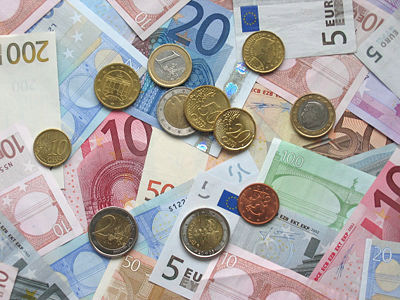
 NEW YORK: The dollar edged higher against the euro on Monday but will likely test an all-time low this week if the US Federal Reserve shows no sign of changing its easy monetary policy.
With many markets closed for Easter and no major US economic reports on the calendar, the April 26-27 Federal Open Market Committee meeting will be the key risk this week as traders try to gauge the direction of US policy.
Market participants will look to the post-meeting news conference by Fed Chairman Ben Bernanke on Wednesday -- the first regularly scheduled news briefing by a Fed chief in the US central bank's 97-year history -- to see how the Fed plans to exit from its ultra-loose policy.
If the Fed surprises the market and turns more hawkish it poses a risk to the sizable amount of dollar shorts in the market.
Currency speculators pared bets against the US dollar for a fourth straight week, according to data from the Commodity Futures Trading Commission released Friday.
A surprise outcome from the FOMC could prompt a flush-out of dollar shorts, but even a "hawkish" surprise from the Fed may not disrupt recent moves in the foreign exchange market, according to Todd Elmer, G10 strategist at CitiFX in New York.
"As it is difficult for reserves managers to accelerate sales in an environment in which USD is under pressure, they may use any rally as an opportunity to sell more dollars," he said. "Similarly, corporates who need to sell USD and are under-hedged may take action on a dollar rally given that it looks as if the broad dollar downtrend remains in place."
These factors should mitigate USD-upside even if there is a correction in investor positioning, he said.
The dollar index, which measures the currency's value against six major currencies, traded up 0.1 percent at 74.096. However, many traders say it could test a three-year low of 73.735 hit last week. A break of that could open the way for a test of the record low of 70.698 hit in 2008.
If Bernanke indicates that the Fed's accommodative policy may continue for the foreseeable future, the dollar will likely see selling pushing the EUR/USD towards the key $1.5000 figure, strategists said.
"The bond and currency market reaction is still an unknown and a significant risk," said Camilla Sutton, chief currency strategist at Scotia Capital in Toronto.
The Fed is expected to confirm its $600 billion asset purchase program known as QE2 will end as scheduled in June. The program is a bane for the dollar since it is tantamount to printing money, so an indication that it may end earlier would be positive for the beaten-down currency. The euro is up nearly 9 percent against the dollar this year.
Once QE2 ends there will be some upward pressure on yields. With US monetary policy still notably weak, an extended dollar rally is not likely, Sutton said.
"This is the medium-term risk; the near-term risk lies in the wording of the statement, any shift in tone, the press conference itself and the FOMC's updated set of forecasts," she said.
The euro hit New York session lows against the dollar, with traders attributing the greenback's strength to a slide in commodity prices. The euro hit $1.4539 on electronic trading platform EBS, the lowest level in the New York session, and it was last at $1.4562, down 0.1 percent on the day.
US crude futures were down 0.4 percent at $111.81 per barrel while spot gold fell 0.2 percent to $1,505.32 per ounce.
That fall in crude futures pushed the Australian dollar down from a fresh 29-year high of $1.0777 set earlier in the session. It last traded at $1.0706.
Against the yen, the dollar ticked up 0.1 percent to about 81.94 yen, helped by expectations of Japanese investor buying, including by asset management firms which tend to launch new investment trusts at the end of the month.
USDJPY has weakened from roughly 85.50 since early April with recent support seen just below 82, Scotia's Sutton said.


















Comments
Comments are closed for this article.