



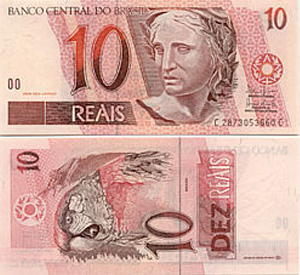
 RIO DE JANEIRO: Brazil's interventions in the foreign exchange market have helped convince economists that the real will remain stable around 2 per dollar for at least the next six months, a Reuters survey found on Thursday.
Expectations that US monetary stimulus would drive strong dollar inflows to Brazil have also given way to growing concerns about China and the euro zone, adding to bets on a stable currency.
Economists now expect the real to trade at 1.97 per dollar in one year, only 2.5 percent stronger than its current level, according to the median forecast of 32 financial institutions in Brazil and abroad.
The real currently hovers around 2.02 per greenback, more than 16 percent weaker from late February. Only a couple of months ago, economists had forecast it would recover to 1.96 by February of 2013 and to 1.92 by August.
"The world has changed, commodity prices have changed, China has changed, and we also see the central bank intervening more actively," said Dalton Gardiman, chief economist with Bradesco BBI, the investment banking arm of Banco Bradesco.
"Altogether, those factors totally justify a weaker real in the next few months," he added.
Worries about the magnitude of China's economic slowdown, which is likely to extend to a seventh consecutive quarter, have been tempering investors' bets on higher commodities prices, and on Brazil's trade performance as a result.
Adding to the cloudy global scenario is a persistent euro-zone debt crisis that is likely to trigger regular bouts of capital flight to dollar-denominated assets.
Dollar outflows from Brazil could also grow as local companies honor debt payments on a large number of bonds they issued in international capital markets, noted Marjorie Hernandez, Latin American strategist at HSBC in New York.
"All of a sudden the picture is a lot more neutral (for the real). We see slight dollar outflows," she said.
Even if all those factors turn out to be not as bad as feared, investors would still need to surmount a "wall" of interventionist measures that the Brazilian government has pledged to put in place if needed.
"Even if the international scenario improves next year, which I don't think is likely, it's still difficult to see the real strengthening too much because the government has been using administrative measures to curb currency gains," said Darwin Dib, chief economist at CM Capital Markets, a brokerage in Sao Paulo.
Government sources have recently told Reuters that the first line of defense against undesirable currency gains would be currency swap auctions and dollar purchases by the central bank. If that is not enough, the Finance Ministry would join the fight with targeted tax hikes on capital inflows.
The measures should ensure the real remains weaker than 2 per dollar, a level considered beneficial to exporters.
The plan is part of President Dilma Rousseff's campaign against what she has called a "monetary tsunami" caused by the expansionary monetary policies in the United States and Europe, which can potentially hurt Brazilian exporters by driving up the value of the real.
But many economists now believe markets have already priced in the impact of the latest rounds of monetary stimulus in the developed world, removing a key driver for currency gains in Latin America.
In Brazil, that leaves inflation as one of the main arguments for a stronger currency.
Brazil's 12-month inflation currently runs nearly 1 percentage point higher than the center of the government's 4.5 percent target. If price indexes continue to go up in the next few months, policymakers could choose to let the real strengthen in order to make imports cheaper.
That might be a more palatable alternative than raising interest rates, which Rousseff's government has lowered to an all-time low of 7.5 percent.
Still, many economists say there are other options to put a lid on inflation.
"That is going to be their last option before raising interest rates. Their priority will be (sales) tax cuts," said Dib from CM Capital Markets.




















Comments
Comments are closed for this article.