



 BRUSSELS: The eurozone looked set Monday to throw Greece a new financial lifeline after tightening conditions behind a massive bailout to secure the country's immediate future in the single currency area.
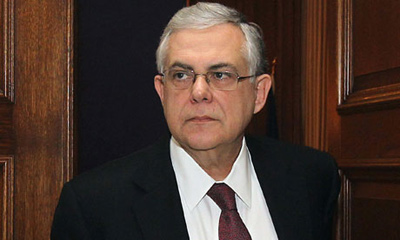
Greek Prime Minister Lucas Papademos joins finance ministers for talks in Brussels from 3:30 pm (1430 GMT) at which the Greek government expects the go-ahead from its euro partners on a 230-billion-euro package ($300 billion).
His Finance Minister Evangelos Venizelos said Greece sees "a long period of uncertainty coming to a close today, a period that benefited neither the Greek economy, nor the euro area overall."
"We have all the elements for an accord," French counterpart Francois Baroin said after six months of wrangling that saw eurozone hardliners' patience with Greece almost snap and suggestions that Athens be cut adrift.
European Union partners see Greece as the victim of chronic financial mismanagement by dynastic political forces -- what Italian Prime Minister Mario Monti last week called a "perfect catalogue" of errors.
But after much debate, euro nations are nearing the point where they can finally agree on a writedown of privately-held debt worth 100 billion euros as well as guarantees and loans eventually adding up to another 130 billion euros.
"Luckily, Greece is no threat to the world economy," European Central Bank executive board member Joerg Asmussen told the Financial Times Deutschland.
But a spokesman for the European Commission said Monday there was a need to "resolve uncertainties" for other "vulnerable states" such as Portugal, which could yet require an adjustment of its bailout too.
Most analysts consider that if Greece were to default, the consequences for the Greek people would be catastrophic, even if less dangerous now for the rest of the eurozone than would have been the case last year.
In Washington, US Treasury Secretary Timothy Geithner said the United States backed the idea of a new IMF loan for Athens.
The Group of 20 major economies will meet later this week in Mexico seeking to boost IMF lending resources.
If agreed, a bond swap with private investors would be launched on Wednesday, right on time for Athens as it faces debt repayments of about 14.5 billion euros on March 20.
But full delivery of the rest of the package, as well as IMF assistance, will be contingent on Greece enacting deeply unpopular spending cuts and reforms ordered by the EU and International Monetary Fund.
Debt reduction targets have veered off course with Greece now in a fifth year of recession but a senior official told AFP there was still a 5.5-billion euro hole in the figures.
Ahead of a general election in April, surveillance of day-to-day economic management is critical after the failure of an initial 110-billion-euro EU-IMF rescue package approved nearly two years ago.
After weeks of what officials said was "deliberate pressure" to get the ruling class in Athens to stick to promises of change, the new bailout has been likened to the aid equivalent of a hospital drip.
Germany and the Netherlands still need to get the second bailout past their sceptical parliaments.
A small army of EU officials is building up in Athens to make sure Greece delivers on its pledges including a 22 percent reduction in the country's minimum wage and a 12-percent cut to pensions of more than 1,300 euros a month.
"Greece must be shadowed on its reform path so that the money arrives where it is meant to," said Austrian Finance Minister Maria Fekter.
On top of 3.2 billion euros in the latest spending cuts, Greece agreed to open a blocked, or "escrow" account to ensure that aid set for for repayments to government creditors is set aside and not used for other purposes.
Thousands of people protested in Athens and Thessaloniki on Sunday, one week after rioters set fire to buildings in the Greek capital to protest new cuts approved by the parliament.
Finally parking the Greek problem to one side this week would allow eurozone leaders to focus on building a financial firewall for the currency as a whole at a March 1 and 2 summit.



















Comments
Comments are closed for this article.