


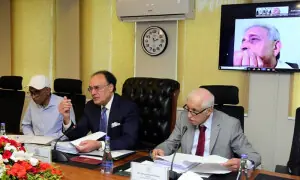
A meeting regarding establishment of Disaster Management Resource Centre at University of Sindh Campus Thatta was held at Centre for Coastal and Deltaic Studies University of Sindh Campus Thatta. District Thatta is vulnerable to various natural and human induced hazards including floods, cyclones, droughts, sea intrusions, deforestation of mangroves, water logging & salinities and earthquakes as natural hazards, while fires, civil unrests, road accidents and health epidemics are prominent human induced hazards.
Besides, poor communication infrastructure, lack of health facilities, low literacy ratio and poverty especially in the remote coastal villages makes the area very vulnerable to various hazards. Keeping in mind all above facts, Centre for Coastal and Deltaic Studies University of Sindh and Malteser International started to mutually decide to establish a Disaster Management Resource Center (DMRC).
Professor Dr Sarfraz Hussain Solangi, Pro Vice Chancellor, presided over the meeting. Dr Splangi said that DMRC will be very helpful to community people, students, faculty members, research scholars, civil society and Government sector and professionals in awareness and further work on DRR. Dr Solangi highlighted that it is very necessary to review the available secondary data before to conduct any research and this kind of resource centre will provide a good space and knowledge to work on ground. He further said that to conduct Multi Hazard Vulnerability Risk Assessment, there is need for reviewing of previous and current studies and activities related to hazards in the forms of hydrological, meteorological, and geological phenomena. Besides, it also important to review of past disasters impacts on the population, crops, infrastructure, level of exposure against various hydro-meteorological and geological processes that appeal disasters. "In this centre we are planning to provide such information through research articles, books and other available data that will play a vital role for researchers as well as development workers."
Mubashir Hassan, Area Co-ordinator Malteser International Sindh Office Thatta, said that as Malteser International intends to conduct seminar and workshop for integration of DRR in to syllabus, we hereby inform that university has started the DRR course. To facilitate students further in the field of DRR, the Malteser International can support in the establishment of DRR resource center. This will be a sustainable contribution of Malteser International.
Hassan further said that District Thatta is geographically divided into three zones; zone 1: Coastal Belt ie Taluka, MP Sakro, KT Bunder and Ghorabari; Zone 2: Non Coastal belt ie Taluka Thatta; Zone 3: Riverine belt ie whole district. Flooding has been reported as the most frequent and damaging natural hazard in the district Thatta which occurs at regular intervals during the monsoon seasons. In addition, other potential hazards are hail storm, earthquakes, epidemics, water logging and salinity and conflict are also reported time to time, due to this diversity here researchers, workers and students can work on multi hazard vulnerability and they can suggest the remedies to cop up these hazards by using numerous traditional tools like Participatory Rural Appraisal (PRA), scientific and technical tools like Geographical Information System and Remote Sensing etc.

















Comments
Comments are closed for this article.