



ISLAMABAD: Pakistan State Oil (PSO) has approved ambitious commercial targets and strategic priorities for FY2027–FY2030, focusing on strengthening its core fuel business, expanding and modernising its retail network, and developing non-fuel retail (NFR), cards and other high-margin businesses, subject to approval by the company’s Board.
PSO’s Board Strategy Committee, appreciated the improvement in PSO’s market share and approved the targets and strategic pillars presented for Commercial B2C under Engine 1 – Driving the Core, covering market share, retail network expansion and modernisation, non-fuel retail, energy transition, cards and infrastructure. It recommended the targets and strategic pillars to the Board for approval, subject to a number of directions and recommendations.
The Committee was informed that FY2025 had been a challenging year, as regional conflict and changing geopolitical conditions reshaped energy flows in Pakistan. However, fuel supplies remained uninterrupted throughout the year, with PSO playing a pivotal role in maintaining continuity.
The company retained the largest market share in high-speed diesel (HSD) and petrol (PMG), maintained a 99 percent share in jet fuel and contributed USD378 million to foreign exchange reserves, compared with USD247 million in the previous year.
PSO also reported sales of 44,000 metric tons of lubricants and 5,200 metric tons of chemicals, the latter representing a record increase from 1,060 metric tons. Its retail network expanded to 3,688 outlets, while the company recorded zero fatalities over more than 48 million safe man-hours.
The Committee was also apprised of key areas requiring improvement, including erosion in core fuel market share, slower growth in high-margin products, liquidity and financing constraints, project execution gaps, weaknesses in human-resource structures and systems, succession planning, performance management and the presence of zero-sale retail sites.
Management presented a three-year strategic plan built around three engines of growth, supported by governance and enabling functions. The plan includes base and stretch targets for key business lines, while distinguishing business-unit aspirations from corporate targets.
The strategy is aimed at defending and expanding PSO’s core franchise through improved margin quality, higher retail-network productivity and supply-chain discipline, while scaling its presence in businesses with unregulated margins to support its evolution into an integrated energy provider.
On the retail side, the Committee was informed that PSO had achieved a significant improvement in market share during July and August 2026. HSD market share increased from 42.5 percent to 46.7 percent, petrol (MOGAS) from 38.5 percent to 46 percent, and RON 95 from 28 percent to 30.8 percent.
Management stated that the gains had been achieved without offering discounts, in line with the position previously conveyed to the Board. However, it acknowledged that part of the improvement reflected a temporary market movement that could normalise.
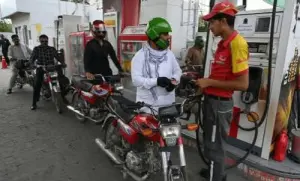
The increase was attributed primarily to operational activation rather than price-based competition. Initiatives included fortnightly customer-service days involving Management representatives at retail forecourts, customer-service and forecourt improvements across approximately 3,500 retail sites, supply-side management during the post-conflict period and implementation of the network plan.
The objective, according to Management, was to secure higher volumes through the existing network without resorting to discounts.
The Committee was informed that the improvement had been achieved despite a fragmented market comprising approximately 61 licensed oil marketing companies and prevailing supply-side constraints. PSO had also emerged as the price leader in the high-octane category, with competitors waiting for its price announcement.
The Committee took note of the performance and commended the commercial team.
For FY2027, the company identified several execution priorities, including expansion of the retail network in high-volume and future-growth areas, development of Vibe and Shop Stops at identified locations in Karachi, Lahore and Peshawar, increasing the number of New Vision outlets, rectifying or exiting underperforming retail sites and activating point-of-sale terminals at all Category AAA outlets.
The Committee also reviewed the strategy for non-fuel retail, which is to be advanced through forecourt transformation, a customer-centric digital ecosystem, strategic partnerships, operational excellence and new growth platforms. The proposed implementation sequence envisages building the foundation in FY2027, scaling and differentiating the business in FY2028 and achieving market leadership in FY2029.
In the cards business, Management outlined plans to improve earnings through a revised value proposition for business-to-business and business-to-consumer customers, relaunch of DigiCash as a mass-market prepaid platform, an upgraded Fuelink portal and prepaid application, expansion of alliances and co-branded bank-card arrangements, and a stronger digital media presence.
The company also plans a comprehensive rollout of its refreshed masterbrand identity, including re-imaging more than 1,000 retail sites and launching a nationwide “Fueling Pakistan” campaign through above-the-line and below-the-line communication channels. Lubricants and LPG categories are also to be elevated under the refreshed brand identity.
While appreciating the improvement in market share, the Committee issued a number of recommendations to strengthen the commercial strategy.
It advised Management to bring RON 95 market share to parity with the aspirational market shares set for MOGAS and HSD.
On retail operating costs, the Committee directed Management to examine cleaning-contract expenses at Company Operated Retail Outlets (CORO) against comparable costs at non-CORO sites and rationalise expenditure where it was found to be higher.
Regarding non-fuel retail branding, the Committee advised that brand guidelines be revisited to ensure that PSO and VIBE receive greater prominence than partner brands, including Esquires Coffee, at retail outlets. The direction is also to be enforced at the Cliff service station adjacent to PSO House.
The Committee suggested evaluating partnerships with established e-commerce platforms to benefit from their scale, wider product range and procurement strength, while securing exclusive, high-margin offerings for PSO stores. It further recommended bringing dark sites within the scope of the proposed arrangements and incorporating them into targets for the non-fuel retail business.
On electric mobility and quick commerce, the Committee called for collaboration with the New Ventures team to identify opportunities for reducing delivery-transport costs through electric-vehicle initiatives. The cost savings could be leveraged to attract and develop a quick-commerce delivery system during the current year and build internal expertise. Management was also advised to obtain insights from relevant experts, including Amir Baqi.
The Committee further directed that an analysis of artificial-intelligence deployment at Al-Askar be shared with it.
To reduce project costs and accelerate retail-network expansion, the Committee emphasised the need to evaluate prefabricated or modular service stations that could be installed within hours and potentially relocated when required.
The Committee also discussed the commercial potential of electric-vehicle charging stations. It noted that electricity for EV charging was available at a discounted tariff of approximately Rs39.70 per unit, while there was no regulated ceiling on the rate charged to end customers. It suggested that PSO invest at this stage to capture margins before increased competition puts pressure on returns.
In the cards business, the Committee advised Management to extend the card proposition to the company’s immediate stakeholder base, including PSO employees and employees of its corporate customers. It also recommended leveraging the retail network and corporate customer base for cross-selling and up-selling third-party products, including insurance.
The Committee observed that customer data generated through these arrangements could potentially be monetised on a white-label basis, provided ownership and control of the data remained with PSO and appropriate data-protection measures were put in place beforehand.
It also reiterated that PSO’s brand should remain foremost in all co-branding arrangements, which should be structured carefully to ensure that the resulting goodwill accrues to the company.
The Committee further advised that the company’s visual brand identity should be built around technology, performance and quality and consistently reflected in all communications. The base-grade fuel should be positioned around economy, while premium-grade products should be marketed on the basis of performance.
The recommendations are intended to strengthen PSO’s core fuel business while accelerating diversification into non-fuel retail, digital services, cards and electric-vehicle charging, as the company seeks to improve profitability and move towards becoming an integrated energy provider.
Copyright Business Recorder, 2026





















Comments