


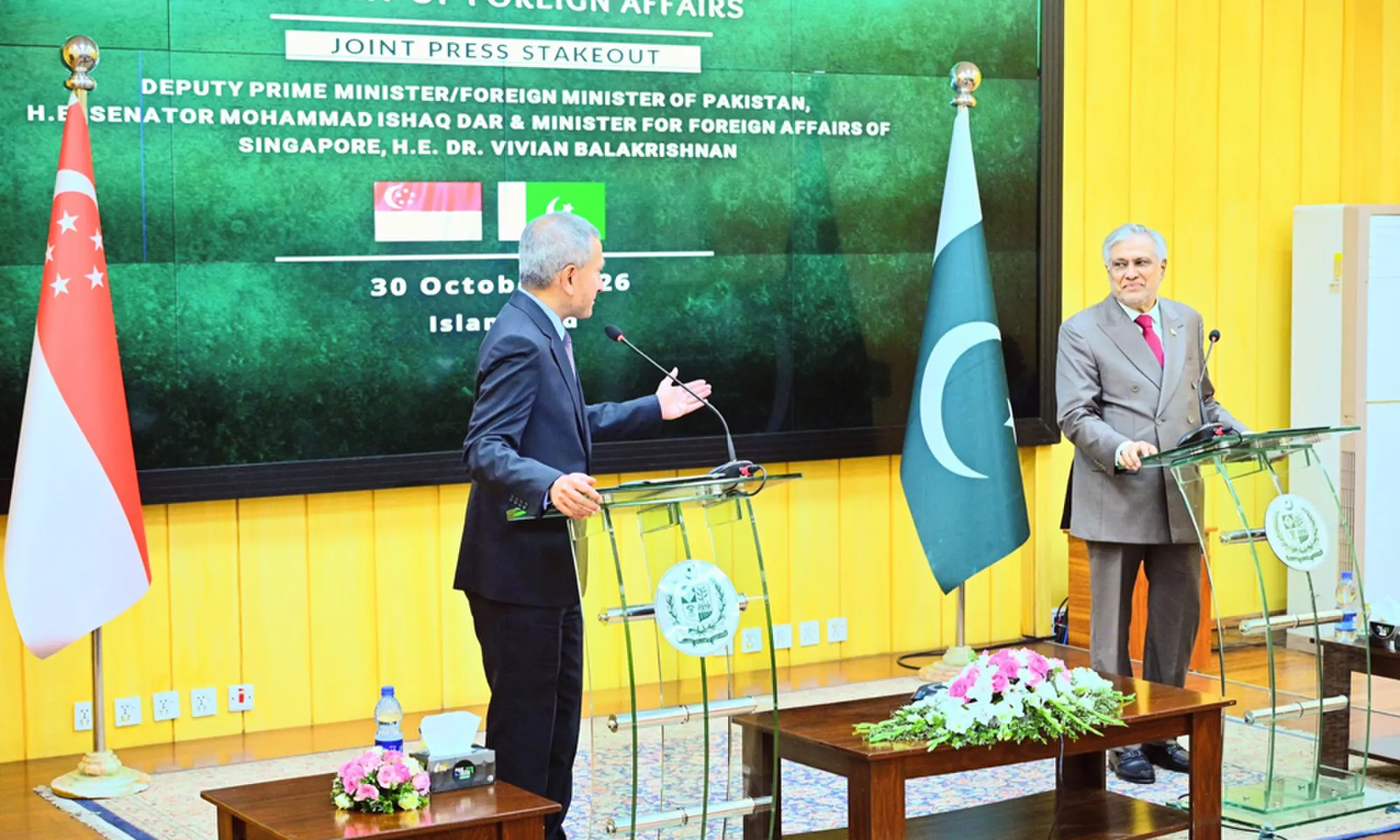
ISLAMABAD: Singapore on Friday threw its weight behind Pakistan’s diplomatic efforts to ease tensions in the Gulf, describing its role as “unique, very constructive and valuable”, as the two countries agreed to expand bilateral trade, investment and co-operation across a range of sectors.
Speaking at a joint press conference with Deputy Prime Minister and Foreign Minister Ishaq Dar, Singaporean Foreign Minister Dr Vivian Balakrishnan commended Pakistan’s diplomatic engagement, saying: “We commend Pakistan for the incredibly valuable role it is playing. We wish you success because if you succeed, it’s good for all of us.”
Highlighting the wider regional and international implications of tensions in the Gulf, Dr Balakrishnan said much of the region’s energy supplies were destined for South, Southeast and Northeast Asia, making regional stability and uninterrupted maritime trade a shared concern.
He stressed that freedom of navigation and over flight through international straits were rights guaranteed under international law, rather than privileges granted by coastal states.
He also welcomed Pakistan’s alignment with Singapore’s position on these issues.
On the bilateral front, Pakistan has reopened its Trade and Investment Office at the Pakistan High Commission in Singapore to facilitate business contacts, attract investment and strengthen commercial ties.
Dar said the move was part of Islamabad’s efforts to promote closer business-to-business engagement between the two countries.
During delegation-level talks, the two foreign ministers discussed ways to expand bilateral trade and investment, with particular focus on information technology, education, agriculture, food security, vocational training, research, innovation and connectivity.
Dar said the two countries had identified considerable untapped potential in their relationship and agreed to maintain regular political consultations, encourage high-level exchanges and strengthen institutional mechanisms to translate existing understandings into tangible outcomes.
He called for greater engagement between the two business communities through trade delegations and closer links between their respective chambers of commerce.
The possibility of resuming direct flights was also discussed to facilitate business, tourism and people-to-people contacts.
Disaster management also featured prominently in the discussions, with the two sides exchanging a memorandum of understanding between Pakistan’s National Disaster Management Authority (NDMA) and Singapore’s Civil Defence Force (SCDF) to strengthen co-operation in disaster preparedness and emergency response.
The discussions also covered digital technologies, artificial intelligence, human resource development and climate-related co-operation.
Dr Balakrishnan highlighted the potential of carbon markets to attract green investment to Pakistan, while both sides underscored the importance of sustained institutional engagement in advancing joint projects.
On regional and international issues, Dar reiterated Pakistan’s position that dialogue, diplomacy, respect for international law and adherence to the UN Charter were essential to resolving disputes.
On Palestine, he expressed concern over the expansion of Israeli settlements and attempts to alter the status of the West Bank and Al-Quds Al-Sharif.
He called for unhindered humanitarian assistance to Gaza and reaffirmed Pakistan’s support for an independent Palestinian state based on pre-June 1967 borders, with Al-Quds Al-Sharif as its capital.
The two sides also discussed Pakistan’s engagement with the Association of Southeast Asian Nations (ASEAN). Dar said Islamabad looked forward to working closely with Singapore as it prepares to assume the organisation’s chairmanship in 2027, while seeking to strengthen Pakistan’s engagement with the regional bloc.
Later in the evening, Dr Balakrishnan called on Prime Minister Shehbaz Sharif, who reaffirmed Pakistan’s commitment to further strengthening its longstanding relations with Singapore.
The prime minister expressed admiration for Singapore’s economic transformation and achievements in innovation and development, underscoring the importance Pakistan attaches to its partnership with the country, both bilaterally and through multilateral platforms, including ASEAN.
The two sides discussed ways to enhance trade and investment and expand co-operation in priority areas, including the digital economy, fintech, infrastructure development, logistics, small and medium-sized enterprises (SMEs) and the services sector.
They also explored new avenues for mutually beneficial economic co-operation and greater people-to-people contacts, while exchanging views on regional and international developments and reaffirming their commitment to continued engagement at bilateral and multilateral fora.
Copyright Business Recorder, 2026





















Comments