


Pakistan targets 50% local value addition in mobile phone manufacturing
- Aims to move beyond assembly to develop a strong domestic manufacturing base
Pakistan is developing a new policy to achieve 50% domestic value addition in mobile device manufacturing, aiming to shift from import-dependent assembly to local component production and strengthen its industrial base.
- New policy targeting 50% local value addition in mobile manufacturing.
- Significant growth in domestic mobile phone production and reduced imports.
- VGO TEL emerging as the largest local handset producer.
- Factors influencing the sustainability of local manufacturing growth.
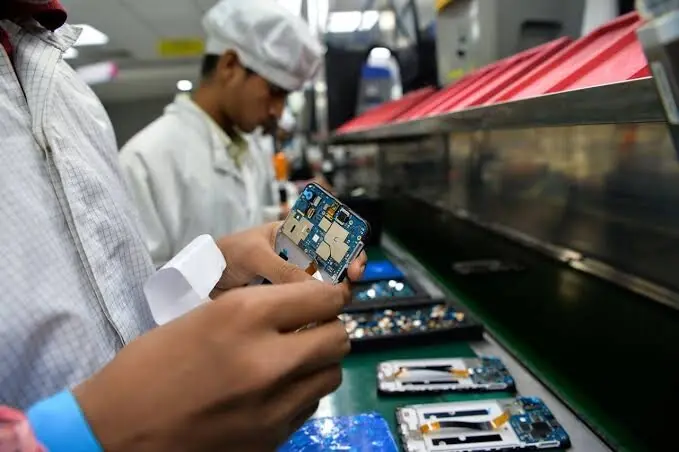
ISLAMABAD: Pakistan is targeting up to 50% domestic value addition in mobile device manufacturing under a new policy being formulated by the government, aimed at shifting the industry from import-dependent assembly towards local component manufacturing and higher-value industrial production.
According to an official document, the Ministry of Industries and Production is evaluating a new Mobile Device Manufacturing Policy to build on the investment attracted under the previous Mobile Device Manufacturing Policy 2020–2023, which facilitated the establishment of domestic and foreign-invested mobile phone assembly and manufacturing facilities in the country.
The proposed policy envisages progressively increasing localisation to as much as 50% over time through the development of local component manufacturing and a supporting industrial ecosystem.
Currently, domestic value addition in mobile device manufacturing is estimated at around 10 to 20%, indicating considerable room for improvement.
The government is pursuing a broader policy agenda to reduce reliance on imported components and promote higher domestic value addition across key engineering and manufacturing sectors.
In this regard, the Ministry of Industries and Production is working on sector-specific policies covering the automotive industry, mobile device manufacturing, battery energy storage systems and other engineering sectors.
In the electronics and mobile device sector, the government intends to promote local component production, technology transfer and the development of supporting industries through the proposed policy.
The initiative is aimed at moving beyond basic assembly operations towards a stronger domestic manufacturing base, creating opportunities for local suppliers and increasing the industry’s contribution to industrial development.
The success of the proposed policy, however, will depend on the development of a competitive local component supply chain and the ability to attract investment in higher-value manufacturing activities.
Pakistan’s local mobile phone manufacturing plants produced 20.08 million handsets during January-September 2026, compared to just 2.85 million units imported commercially, reflecting the growing role of local assembly in meeting domestic demand.
According to official data, locally assembled handsets included around eight million smartphones and 12 million 2G phones.
Pakistan Telecommunication Authority (PTA) data shows that smartphones account for 71% of active mobile devices on local networks, while 2G phones make up the remaining 29%.
Pakistan’s mobile phone import bill declined by 16.6% in dollar terms during the first quarter of fiscal year 2026-27, falling to $417.24 million from approximately $500.01 million in the same period last year.
In September 2026, mobile phone imports increased by 7.1% month-on-month to $143.14 million, compared to $133.66 million in August. However, imports remained 28.2% lower than the $199.27 million recorded in September 2025.
In rupee terms, the mobile phone import bill stood at Rs39.75 billion in September, up 7% from Rs37.17 billion in August. On a year-on-year basis, however, it declined by 29.2 percent from Rs56.17 billion.
During July-September FY27, the cumulative mobile phone import bill fell to Rs116.01 billion, down 18% from Rs141.42 billion in the corresponding period of the previous fiscal year.
The figures show that despite a monthly recovery in September, mobile phone imports remained significantly lower than a year earlier, while local assembly continued to supply the bulk of handsets entering the domestic market.
Pakistan’s local mobile phone assembly industry is expanding rapidly, with VGO TEL emerging as the largest producer in January-September 2026, overtaking Infinix and Itel, while local manufacturers continue to dominate the country’s handset market.
According to the data on locally assembled and manufactured mobile devices, VGO TEL produced 2.50 million handsets during the first nine months of 2026, followed by Infinix at 1.96 million and Itel at 1.59 million.
TECNO ranked fourth with 1.16 million units, followed by Samsung at 1.04 million, Vivo at 0.99 million and Nokia at 0.97 million. Other major producers included China Mobile at 0.72 million, X Mobile at 0.71 million and G’FIVE at 0.64 million.
The data reflects a shift in the production rankings compared with previous years, when Infinix topped the list of local assemblers. In 2024, Infinix produced 3.98 million handsets, followed by Itel at 3.64 million and VGO TEL at 3.37 million.
In 2025, Infinix retained the top position with 3.65 million units, narrowly ahead of VGO TEL at 3.57 million. Vivo ranked third with 2.80 million, followed by Itel at 2.34 million.
The figures highlight the growing presence of local assembly operations across multiple brands, including Chinese manufacturers and established international handset companies.
However, the production data also shows that output is spread across a range of manufacturers rather than concentrated in a single brand. The performance of VGO TEL in the first nine months of 2026 marks a notable change in the competitive landscape.
The expansion of domestic assembly has become an important feature of Pakistan’s mobile phone market, helping reduce reliance on commercially imported finished handsets. The sustainability of this trend, however, will depend on consumer demand, access to imported components, exchange-rate stability and the ability of local assemblers to maintain competitive prices.
The figures for 2026 cover January to September only, while the 2024 and 2025 figures represent full calendar years.























Comments