


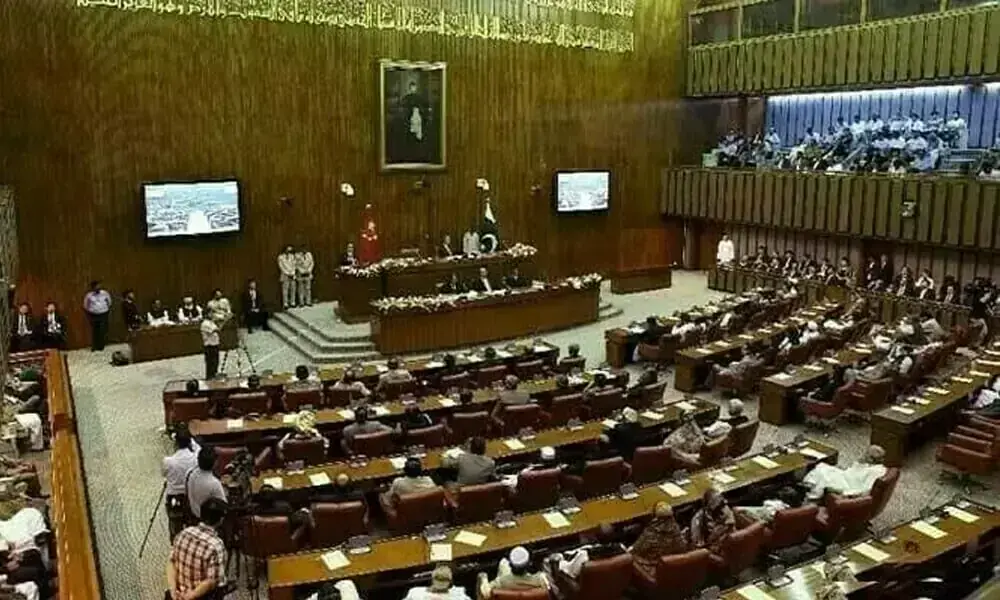
ISLAMABAD: The Upper House of the Parliament passed eight bills on Thursday including the Life Insurance (Nationalisation) (Amendment) Bill, 2026, a government bill that paves the way for the future privatisation of the State Life Insurance Corporation (SLIC).
Already passed by the National Assembly, the bill seeks to amend the Life Insurance (Nationalisation) Order, 1972 for “greater operational flexibility” of the SLIC and its possible privatisation in future.
According to the Statement of Objects and Reasons of Life Insurance (Nationalisation) (Amendment) Bill, 2026, the proposed amendments aim to address structural and operational constraints faced by the state-owned insurer and improve its efficiency, transparency and corporate governance.
“The existing legal framework, rooted in the Life Insurance (Nationalisation) Order, 1972, established the nationalisation of the life insurance business and constituted State Life as a statutory entity.
READ ALSO: Bill to turn SLIC into a co cleared by NA
However, changes in the financial sector and the introduction of modern regulatory and governance standards have necessitated a review of the corporation’s legal and operational structure.
The amendments seek to facilitate the transformation of State Life into a company under the Companies Act, 2017, giving it greater operational flexibility and bringing its legal framework in line with the State-Owned Enterprises Act, 2023, and other relevant laws.
The proposed legislation also provides a framework for possible future divestment or privatisation, subject to approval by the federal government and compliance with applicable laws,” reads the bill’s Statement of Objects and Reasons.
“However, the amendments do not themselves constitute a decision to privatise or divest State Life. They are intended to remove legal impediments should the government decide to pursue either option in the future,” it reads.
The bill provides for the transfer of assets, liabilities, rights and obligations to the successor company to ensure continuity during the transition.
It also seeks to “safeguard policyholders’ interests and protect employees’ existing terms and conditions of service, including retirement benefits.”
The other seven bills passed by the Senate in Thursday’s session were; the Higher Education Commission (Amendment) Bill, 2026, the NFC Institute of Engineering and Technology Multan (Amendment) Bill, 2026, the National Textile University (Amendment) Bill, 2026, the National Rahmatul-lil-Aalameen Wa Khatamun Nabiyyin Authority (Amendment) Bill, 2026, the Archival Material (Preservation and Export Control) (Amendment) Bill, 2026, the Centres of Excellence (Amendment) Bill, 2026 and the National College of Arts Institute (Amendment) Bill, 2026.
Earlier, Petroleum Minister Ali Pervaiz Malik said in the question hour that the issues faced by gas consumers in Balochistan were being addressed.
The minister said he contacted Balochistan Chief Minister Sarfraz Bugti in this regard, and that it was decided to jointly devise a mechanism to resolve the problems of gas consumers in the province, particularly those related to the slab system.
Meanwhile, the House also passed a unanimous resolution moved by PPP Parliamentary Leader in Senate Sherry Rehman calling for a coordinated national effort to curb Pakistan’s rapid population growth.
Copyright Business Recorder, 2026





















Comments