


Pakistan’s debt profile
Pakistan secured $5.445 billion in foreign loans in Q1, challenging its commitment to end IMF reliance. High-interest borrowing and a rising trade deficit exacerbate debt repayment challenges.
- Pakistan's significant foreign loan intake in the first quarter.
- Composition of new loans, including Eurobonds and commercial bank borrowing.
- Challenges of debt repayment amidst rising trade deficit and high policy rates.
- The government's strategy of converting short-term to long-term debt.
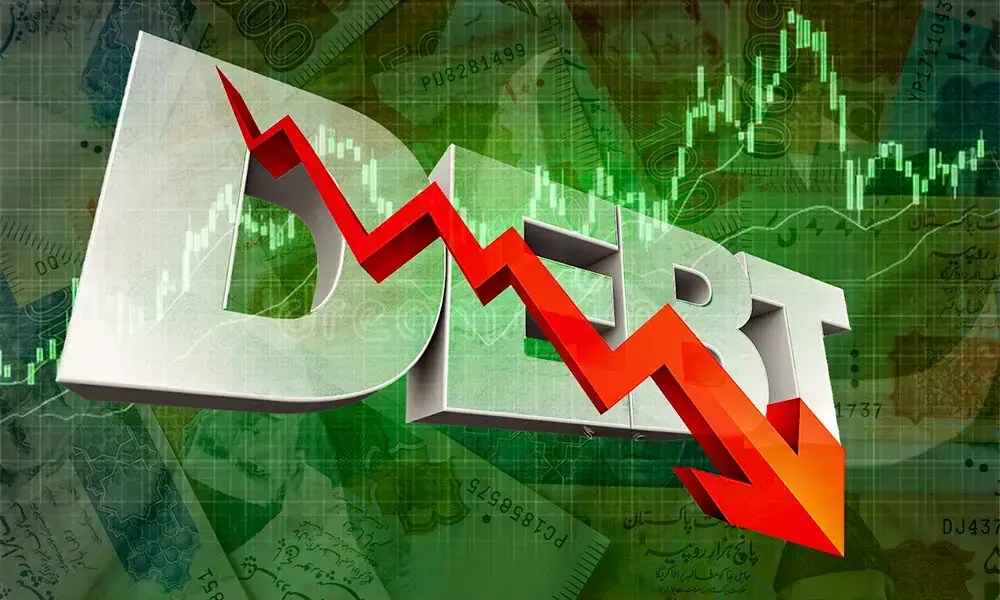
EDITORIAL: According to data released by the Economic Affairs Division, Pakistan was the recipient of 5.445 billion dollars in the first quarter of the current year (July-September) against 1.815 billion dollars in the corresponding period last year – data that may raise concerns amongst those members of the executive, including the Prime Minister, who have repeatedly pledged that the ongoing 7 billion-dollar Extended Fund Facility, as well as the 1.4 billion-dollar Resilience and Sustainability Facility, both scheduled to end in 2027 at this time, would be the very last International Monetary Fund (IMF) programme secured by the country.
However, out of this total multilateral loans accounted for 952.2 million dollars available at comparatively low rates of return while bilateral loans were 58.1 million dollars.
The remaining 5144 million dollars was secured from issuance of dual phase Eurobonds - at 7.5 percent for 1.75 billion dollars with an amortization period of five and a half years and 1.25 billion dollars issued at 7.9 percent for 10 years. It is relevant to note that the depreciation of the Pakistan currency was calculated at nearly 3 percent last year, a rate that has generated some concern amongst independent economists as the rupee remained stable even as the value of the majority of currencies in the basket to which the rupee is pegged lost value considerably due to geopolitical factors.
The previous average depreciation was between 4 and 5 percent. However, repayment of these bonds will become a serious challenge upon maturity unless there is a major uptick in exports and an improved trade balance.
The trade deficit during the first quarter of the current year has been rising yet again, as part of the usual boom-bust cycle to which the Pakistani economy is subjected. An additional 300 million dollars was borrowed from foreign commercial banks (including UBL, Dubai) at high commercial rates.
Furthermore, 942.7 million dollars was raised through Naya Pakistan Certificates (NPCs), consisting of 300 million dollars under conventional certificates and 642 million dollars under Islamic certificates.
Needless to add, these loans would have been secured at higher rates than those from multilaterals and bilaterals.
Pakistan is currently on its twenty-fifth IMF programme loan, averaging three years per loan. Since 2019, the authorities have had to accept stringent conditions prior to loan approval by the Fund Board, alongside managing the regular renewal of approximately 10 billion dollars in rollovers deposited in the State Bank of Pakistan by three friendly countries.
The reason given the by the Fund in its documents dated 10 October 2024 was as follows: “repeated efforts to reform, including under Fund-supported programs, were generally short lived, and abandoned or reversed” - an observation that accounts for extremely harsh upfront conditions prior to the release of each subsequent tranche that impacts negatively on the quality of life of the general public.
However, to get a macro picture of total debt—both domestic and external—two factors must be taken into consideration. First, the government has proactively converted short-term debt into long-term debt. This is a common practice among debtor nations to reduce the immediate burden of debt repayment on the budget. While this conversion reschedules the year the principal is due, the total interest payable on the loans increases until maturity.
In this context, the high policy rate of 11.5 percent—which is higher than the regional average—raises debt servicing costs. Consequently, debt servicing in the current year is budgeted at 43 percent of the total outlay and 46 percent of current expenditure.
The incumbent government would be well advised to look at the serious financial issues facing developed Western economies, particularly the United States. As a superpower, the US has relied heavily on cheap borrowing costs because the dollar serves as the world’s primary reserve currency, holding nearly 60 percent of official global foreign exchange reserves.
However, this primacy is being challenged today, much to the chagrin of US Treasury Secretary Scott Bessent. Furthermore, the debt-to-equity ratio has risen markedly this year as the fiscal deficit continues to be met by both domestic and international borrowing. This trend bodes ill for achieving the salutary objective of ending reliance on loans.
The preferred approach would be to desist from budgeting large fiscal deficits—estimated at 7 trillion rupees this year, which must be plugged by borrowing—and instead focus on the payment of past loans, including both interest and the retirement of the principal as and when due.
Copyright Business Recorder, 2026

















Comments